



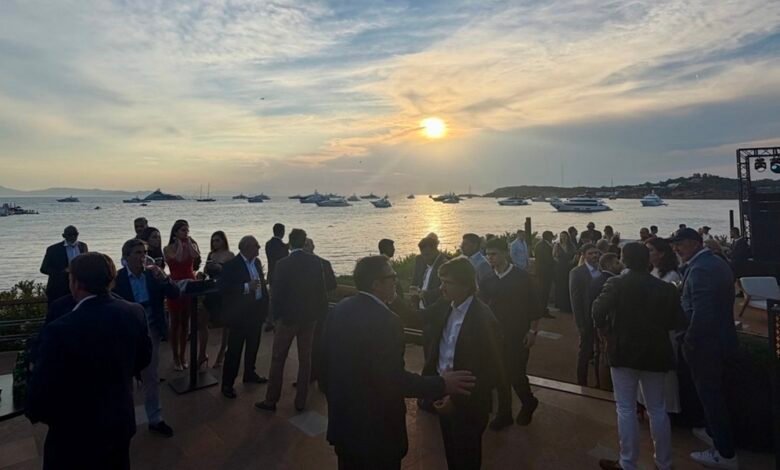
There is a certain feeling that lingered over this year’s Posidonia — a mix of celebration, excess and confidence that, for some, felt uncomfortably familiar.
Described by many as “extravagant, excess, excellent,” the atmosphere in Athens was undeniably electric. But for those who attended the 2008 edition, held just months before the global financial crisis, the comparisons were hard to ignore.
This is not to suggest history is about to repeat itself. But as the saying goes in shipping: it rarely repeats exactly — it rhymes.
A market at record highs
The numbers in today’s market are striking enough to trigger reflection.
ClarkSea Index is currently averaging around $40,000 per day, the strongest start to any year on record. According to Clarksons, shipping is currently generating “more cash than we’ve ever had.”
At the same time, the global fleet and orderbook value has reached a record $2.4 trillion, with another $2 trillion potentially required in newbuilding investment over the next decade.
Asset values remain elevated across multiple sectors, particularly tankers, reinforcing a sense of prolonged strength that feels unusually stable — and unusually long.
Déjà vu from a different era
Despite today’s fundamentally different financial environment, the mood of confidence evokes memories of 2008.
Back then, the industry also believed in an unstoppable cycle of growth. Today, there is again a visible gap between strong shipping markets and a more fragile global macroeconomic backdrop.
Global growth is slowing. Trade tensions are intensifying. Tariffs are increasing. Energy markets remain highly sensitive to geopolitical shocks, particularly around the Strait of Hormuz.
In both eras, rising oil prices and geopolitical instability have acted as destabilising forces for the broader economy — even if shipping itself continues to benefit in the short term.
Capacity discipline… for now
One of the industry’s most persistent historical mistakes has been mistaking cyclical strength for structural demand growth.
While today’s orderbook is far from the excesses of 2007–2008, Clarkson data suggests around 200 shipyard expansion or reactivation projects are underway, most of them in China.
At the TradeWinds Shipowners Forum in Athens, several industry figures openly acknowledged the risks.
Safe Bulkers’ Polys Hajioannou expressed concern about expanding yard capacity. Meanwhile, Harry Vafias, whose group has reduced debt by roughly $1.1 billion, warned that ordering at current prices is “statistically wrong,” adding: “Sooner or later the party will finish.”
A statement that stood out not for its optimism — but for its restraint.
A fundamentally different financial industry
Despite the parallels, today’s market is structurally very different from 2008.
Banks are far more cautious. Shipping balance sheets are significantly stronger. The pandemic-era boom was largely used to reduce debt rather than expand leverage. Newbuilding capacity is tighter, and consolidation has improved discipline across both owners and shipyards.
Unlike in the past, many of today’s earnings are also being driven not by pure trade growth, but by disruption.
Red Sea diversions, geopolitical fragmentation, sanctions and routing inefficiencies have all increased tonne-miles — effectively boosting freight demand artificially.
As JP Morgan Asset Management’s Andrian Dacy noted in Athens, shipping may even be benefiting from an “inverse geopolitical risk premium,” where instability itself supports earnings.
It is a powerful dynamic — but only as long as it lasts.
The uncomfortable questions
The real risk lies not in current strength, but in assumptions about its permanence.
What happens if the Red Sea fully reopens?
What happens if global growth slows further?
What happens if shipyard expansion accelerates faster than demand?
These are questions few were eager to discuss amid the celebrations in Athens.
Between celebration and caution
This year’s Posidonia felt, for many, like a paradox. On the surface: record cash generation, booming asset values and packed exhibition halls. Beneath it: a growing awareness that cycles always turn.
AI dominated conversations, parties were bigger than ever, and optimism was everywhere. But among the most experienced voices, the tone was more measured — focused on resilience, flexibility and balance sheet strength.
That may ultimately be the key difference from 2008.
Back then, the industry believed the cycle had no ceiling. Today, most know it does.
The question now is whether that awareness will be enough when the cycle inevitably turns again.