



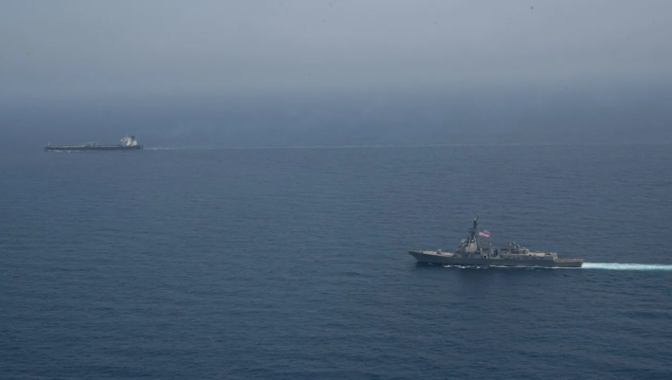
The United States has formally lifted its port blockade of Iran, a significant step in the implementation of the new ceasefire framework announced last month by Washington and Tehran. At the same time, security assessments in the Strait of Hormuz have improved, although shipping organizations continue to urge caution before a full return to normal operations.On June 18, the U.S. Central Command confirmed that all maritime restrictions targeting Iranian ports and coastal areas had been removed.“Today, US forces lifted the blockade on all maritime traffic entering and exiting Iranian ports and coastal areas, in accordance with the President’s direction. American forces are not impeding the transit of vessels to or from Iranian ports. All US military blockade enforcement efforts have ceased,” the statement said.The move forms part of the Memorandum of Understanding (MoU) agreed between the United States and Iran, which establishes a 60-day ceasefire period while negotiations continue toward a broader long-term agreement. Under the framework, the U.S. committed to ending the blockade, while Iran agreed to reopen the Strait of Hormuz to commercial shipping without imposing transit tolls.Although the blockade has been lifted, U.S. naval forces will remain in the region to monitor compliance with the agreement and help maintain stability during the transition period.Threat level reduced, but mine risks remainIn another positive development, the Joint Maritime Information Centre (JMIC) has lowered its threat assessment in the Strait of Hormuz for the second time this week.The latest update reduced the threat level from “substantial” to “moderate,” indicating that while an attack remains possible, it is no longer considered likely.However, maritime authorities continue to warn that dangers have not disappeared entirely.A key concern remains the potential presence of naval mines in the area. Although security conditions have improved, mine clearance operations are still ongoing and commercial operators are being advised to remain vigilant.“Mariners should be advised of the existence of mines and expect naval presence as clearance operations continue. Mariners should also expect congestion through transit routes and potential VHF hailing from naval forces to support free flow,” JMIC stated.Commercial vessels are currently advised to avoid the main Traffic Separation Scheme (TSS) in the Strait of Hormuz until navigation conditions are fully stabilized.Industry calls for cautionDespite the easing of tensions, major shipping organizations remain reluctant to declare the situation fully secure.Jakob Larsen, Chief Safety & Security Officer at Bimco, stressed that the maritime industry continues to face significant uncertainties.“Despite the signing of the ceasefire agreement, we believe the security situation for the shipping industry remains volatile,” Larsen said.He noted that congestion risks and navigational challenges within the temporary transit corridors still create safety concerns. Bimco is therefore advising shipowners to continue conducting comprehensive risk assessments before authorizing voyages through the Strait.Larsen also highlighted several unresolved questions within the MoU framework, including the lack of detailed guidance regarding safe navigation routes, traffic separation measures, vessel sequencing procedures, reporting requirements, security arrangements, naval protection mechanisms, and emergency response protocols.“The MoU raises several questions and does not offer sufficient information regarding key aspects such as safe routes, measures to separate traffic, sequencing of ships leaving the Gulf, reporting procedures, ship security procedures, procedures for naval protection and emergency response,” he explained.Priority remains stranded vessels and crewsFor the World Shipping Council (WSC), the immediate focus is not simply reopening the waterway but ensuring the safe evacuation and repositioning of ships and seafarers that have remained stranded in the Gulf since the conflict began on February 28.Joe Kramek, Chief Executive Officer of the WSC, emphasized the need for close coordination between governments, the International Maritime Organization (IMO), and industry stakeholders.“That will require coordination between states, the IMO and industry, backed by the necessary safety and security guarantees,” Kramek said.He added that coordinated risk assessments, mine-clearing operations, and vessel traffic management should remain top priorities as commercial shipping gradually resumes in one of the world’s most strategically important maritime corridors.While the reopening of Iranian ports and the reduction in the Hormuz threat level are encouraging signs, industry leaders agree that restoring confidence and normal shipping patterns will take time. The coming weeks are expected to be crucial in determining whether the ceasefire can translate into a stable and secure recovery for global maritime trade.
- Latest
- Trending
ADVERTISEMENT