



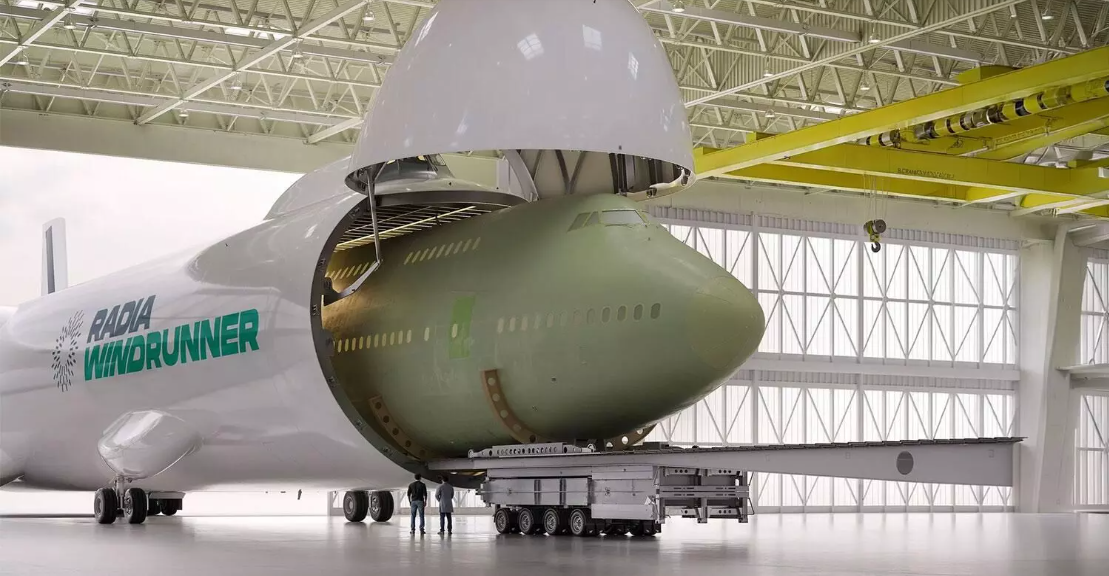
Italy is reinforcing its role in the future of strategic air transport. The Italian Ministry of Enterprises and Made in Italy (MIMIT) and aerospace company Radia have signed a new Memorandum of Understanding (MoU) to further collaborate on the development of WindRunner, an ultra-large cargo aircraft designed to transform the movement of oversized and mission-critical freight.
The agreement seeks to strengthen cooperation between Radia and Italy’s aerospace ecosystem while exploring industrial opportunities linked to the programme. The initiative will focus on engaging Italian companies and organisations in manufacturing, engineering and supply chain activities associated with the aircraft’s development.
WindRunner is being developed as the world’s largest aircraft and is intended to address critical logistics challenges across multiple industries. According to Radia, the aircraft will be capable of transporting outsized cargo directly to locations that are inaccessible through traditional logistics networks, significantly reducing delivery times from months to days—or even hours in certain cases.
The programme is expected to support a wide range of sectors, including defence, energy, aerospace manufacturing, industrial production and humanitarian operations. By enabling the transport of exceptionally large equipment and infrastructure components, WindRunner aims to improve both commercial supply chain resilience and national strategic mobility capabilities.
A key feature of the aircraft is its ability to operate from compacted dirt runways, allowing access to remote or undeveloped locations where conventional large cargo aircraft cannot operate. This capability could prove valuable for defence logistics, energy infrastructure projects, emergency response missions and large-scale industrial deployments.
“As strategic mobility requirements continue to grow, allied nations will require new airlift capabilities,” said Mark Lundstrom, Founder and CEO of Radia. He noted that no new strategic airlift aircraft has entered production anywhere in the world for more than a decade and described WindRunner as a solution designed to fill that gap by providing a new method for transporting oversized, mission-critical cargo.
Lundstrom also highlighted the importance of Italy within the programme, stating that the company is proud to strengthen its collaboration with MIMIT and with Italy’s aerospace and industrial sectors as development progresses.
Under the new agreement, MIMIT and Radia will work together to identify opportunities for Italian companies to contribute to the programme. The collaboration will leverage Italy’s long-standing expertise in aerospace manufacturing, engineering and supply chain management while also supporting broader transatlantic industrial cooperation.
Italy already occupies a strategic position within Radia’s international operations, with Rome serving as one of the company’s principal headquarters outside the United States. The agreement further formalises institutional and technical cooperation between the two parties and creates a framework for future collaboration.
Regional stakeholders will also play a role in the initiative, particularly in the Campania and Puglia regions, which are home to important aerospace and manufacturing clusters. Both parties will assess opportunities for industrial participation across the country as the programme advances.
The MoU sets the framework for cooperation but MIMIT and Radia stressed that all future investments, industrial commitments or programme-related decisions will be subject to further analysis, approvals and separate agreements.
With the global demand for strategic airlift solutions on the rise, the WindRunner project could see Italy joining the ranks of the main contributors to one of the most ambitious aerospace logistics programmes currently in development.
- Latest
- Trending
ADVERTISEMENT