



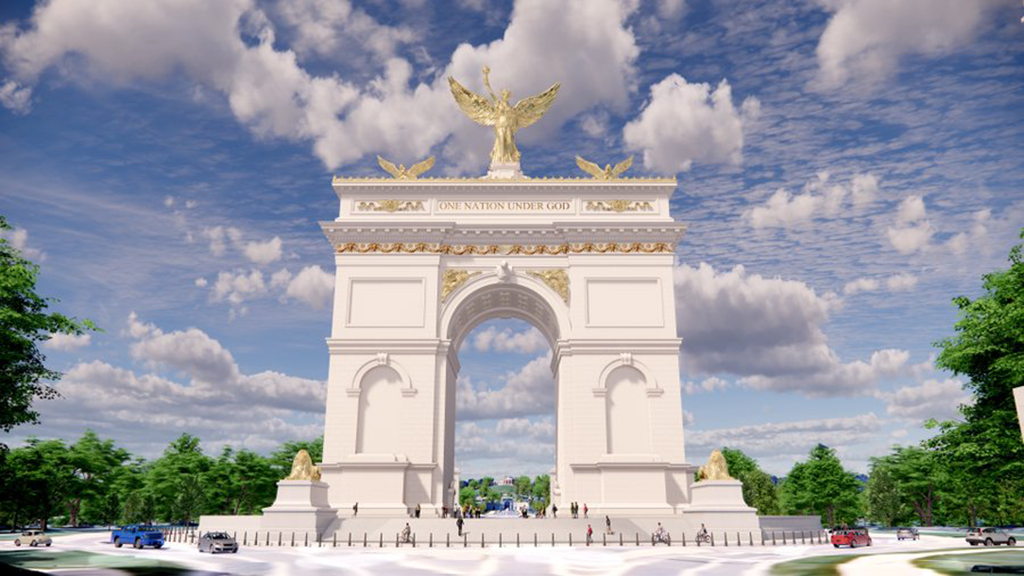
A proposed 250-foot-tall memorial arch backed by President Donald Trump is facing growing scrutiny after a National Park Service assessment warned that the structure could significantly alter the historic character of some of Washington’s most important landmarks.
The report says the towering, gilded arch could affect the “integrity” of dozens of historic properties by changing visual and spatial relationships that have been deliberately preserved for decades.
Washington’s monuments and public spaces were designed not only as individual landmarks but also as parts of a wider symbolic landscape. Sightlines between major sites often carry historical meaning, connecting important moments and institutions in the nation’s history.
The proposed arch, according to the assessment, could disrupt some of those carefully planned relationships.
A historic corridor at the centre of the debate
The immediate construction area lies within the Memorial Avenue Corridor cultural landscape, a nationally significant historic designed landscape extending between the Lincoln Memorial in Washington, D.C., and Arlington National Cemetery in Virginia.
One of the most important concerns identified by the National Park Service involves the existing visual alignment between the Lincoln Memorial, Memorial Bridge and Arlington House, the former residence of Confederate Gen. Robert E. Lee.
According to the assessment, the alignment was deliberately designed to create both a physical and symbolic connection between the North and South across the Potomac River.
The new arch could interrupt that relationship.
The assessment identifies the Lincoln Memorial-Arlington House connection among dozens of historic structures and sites that could be directly affected by the proposed monument.
Other locations identified include the National Mall, the U.S. Capitol, the Washington Monument and its grounds, and Lady Bird Johnson Park.
The project has already cleared several hurdles
The National Park Service findings create a new complication for a project that has already moved through several stages of the federal approval process.
The proposed design has received initial approval from the U.S. Commission of Fine Arts, whose commissioners were appointed by Trump.
The National Capital Planning Commission also approved the proposed site and preliminary plans during its July meeting. The commission is expected to revisit the project at its September meeting.
The White House said the administration would comply with all legal requirements governing construction.
White House spokesman Davis Ingle defended the proposal, describing the Triumphal Arch as a potential landmark for Washington and the wider world.
He said the structure would enhance the visitor experience at Arlington National Cemetery and provide veterans, families of fallen service members and other Americans with a visible reminder of the sacrifices made throughout the country’s 250-year history.
Lawsuit adds another challenge
The project is also facing legal opposition.
Three veterans and a historian have filed a lawsuit challenging the proposed construction, arguing that the project requires authorization from Congress.
Their legal challenge focuses on whether the federal government can authorize construction of such a monument on National Park Service land in the heart of Washington, D.C. without an act of Congress.
Nicolas Sansone, an attorney with Public Citizen Litigation Group representing the plaintiffs, said the central argument is that the project does not currently have the necessary legal authorization.
The plaintiffs also argue that the proposed structure would damage the symbolic and solemn character of the surrounding area.
Sansone said the National Park Service assessment is particularly significant because it appears to confirm concerns raised in the lawsuit about the project’s potential impact on Washington’s historic landscape.
A monument with a much larger footprint
The controversy surrounding the arch goes beyond its physical size.
Supporters see it as a lasting symbol of American history and sacrifice, while opponents argue that introducing a new monumental structure into an already carefully designed historic landscape could undermine the meaning of the sites that surround it.
The dispute comes as Trump pursues several projects intended to leave a lasting mark on Washington.
For the National Park Service, however, the issue is not simply whether a new monument can be built, but whether its presence would fundamentally change the relationships between landmarks that were deliberately designed to be viewed together.
With further consideration expected from the National Capital Planning Commission in September and litigation continuing, the proposed arch still faces significant legal, planning and historic-preservation questions before construction can move ahead.