



The European Union’s introduction of a €3 customs duty on low-value e-commerce imports on July 1, 2026 has not, at least initially, caused a significant drop in shipment volumes among the US merchants served by ePost Global. Instead, the company is seeing a growing move away from delivery duty unpaid (DDU) towards delivery duty paid (DDP).
The EU ended its duty exemption for imports valued at €150 or less on July 1, replacing it with a €3 duty. The measure is putting additional pressure on a business model built around high volumes of inexpensive cross-border parcels. For ePost Global, however, the first 45 days under the new regime have not resulted in an overall decline in volumes.
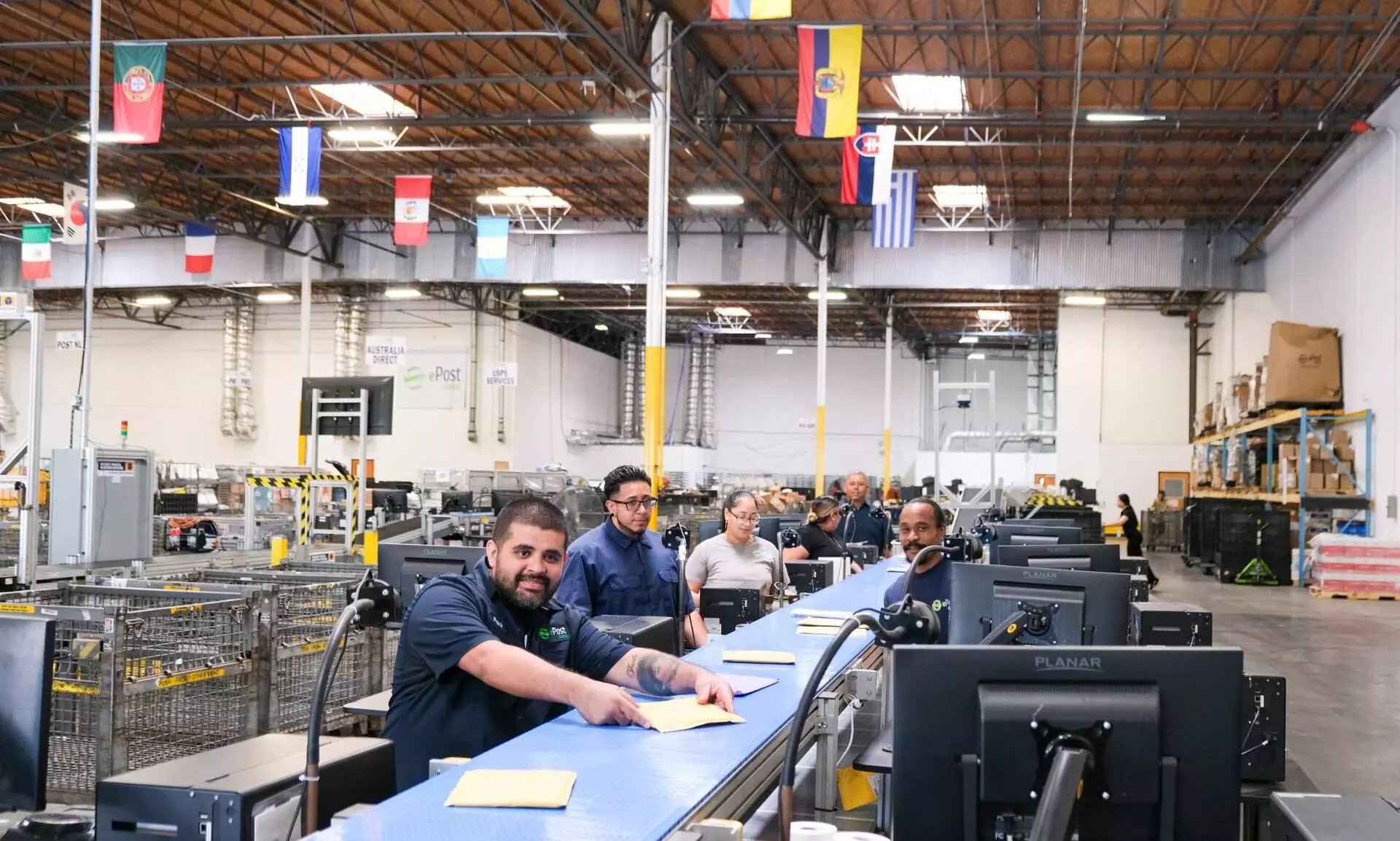
The US-based international shipping services provider operates a multi-carrier network for mail and parcel shipments worldwide. It delivers more than 20 million items each year to more than 200 countries and territories through a network of over 100 carrier partnerships.
Alison Layfield, Vice President of Product Development at ePost Global, said demand from US merchants selling into Europe remains strong.
“It is still early, only around 45 days in, but so far we are not seeing any significant negative impact on volume,” she said.
Layfield has been with ePost Global for 17 years, while the company itself has operated for more than 25 years. Its primary customers are US businesses selling internationally, with Canada, the UK and the EU among its key markets. Canada remains its largest market, but the EU is an important destination for the US merchants using its services.
ePost Global routes all shipments destined for the EU through Amsterdam Schiphol Airport in the Netherlands. There, the shipments clear customs before being handed over to partner carriers for distribution across the bloc.
DDU becomes more difficult as merchants turn to DDP
While shipment volumes have so far remained resilient, the experience of moving goods under DDU terms is becoming more complicated.
Under DDU, consumers are responsible for paying applicable charges when their parcels arrive. The new customs duty has therefore created an additional point of friction that did not exist when low-value imports benefited from duty-free treatment.
ePost Global is already hearing reports of shipments being returned.
“What is not yet clear is whether those returns are because postal operators are unable to deliver the shipments, or because consumers are refusing them because they do not want to pay the additional fees,” Layfield said.
The company is working closely with the United States Postal Service, which is analysing shipments returned from the EU. ePost Global expects to obtain more information about the reasons behind those returns.
For now, the immediate impact of the new duty may be less about reducing consumer demand and more about whether merchants can collect the additional charges without disrupting deliveries.
“What we expect is a shift from DDU to DDP,” Layfield said. “More of the accounts currently using DDU are likely to move to DDP.”
The distinction is increasingly important for consumers. With DDP, merchants incorporate applicable charges into the transaction and manage the customs process rather than leaving the customer to deal with unexpected costs at delivery.
“We already have customers that have either switched to DDP or are working on making that change, and we are hearing more about it as merchants see shipments being returned. So we do expect to see an even bigger shift from DDU to DDP.”
HS6 grouping can reduce the impact of the duty
The €3 charge is not simply an additional cost attached to every e-commerce transaction. The way shipments are declared can determine how the duty accumulates, making customs data and shipment architecture increasingly important.
Layfield said ePost Global can group identical products carrying the same HS6 (Harmonized System) classification. This means several qualifying items can be treated together instead of generating a separate €3 charge for every declaration line.
“If a shipment contains three identical items, those items may have the same HS code but appear on separate lines. If the service provider cannot group those items, the €3 duty can apply to each line.”
This capability is creating an increasingly important distinction between postal and commercial routing solutions.
According to Layfield, direct postal routing does not currently provide the same ability to group products. When identical goods appear as separate declaration lines, this can lead to higher charges.
For merchants, the issue therefore goes beyond simply selecting a delivery service. Logistics providers increasingly need to combine customs expertise with the technology required to interpret and structure product-level information.
Accurate data becomes increasingly important
The EU’s wider customs changes are also increasing the importance of accurate product information.
Layfield said ePost Global has been educating its customers about the need to provide correct manufacturer, merchant and product identifiers as customs requirements evolve.
The company continues to submit item-level information to customs even when products are grouped for duty calculations.
“The grouping happens behind the scenes in our programme,” Layfield said. “But that does not mean we are removing the item-level information from the customs declaration.”
The distinction is particularly relevant to concerns over whether HS6 grouping could be interpreted as a loophole. Layfield said customs authorities are aware of the practice and that it is currently permitted.
“The EU’s goal here is to introduce all of the changes with the EU customs reform in 2028,” she said. “For now, HS6 grouping is allowed.”
November handling fee could increase pressure on DDU
Another pressure point is approaching. By November 1, 2026, the EU is expected to introduce a new Union handling fee on low-value consignments sold through distance selling. The measure is designed to cover customs processing and monitoring costs and will be separate from the existing €3 customs duty.
The exact amount has not yet been officially confirmed, although industry expectations have centred on around €2.
If the fee is set at €2, Layfield said, it would be added to the existing €3 duty. Because the handling fee would follow the same HS6 grouping principle, the difference between grouped and ungrouped shipments could become even more significant.
“If someone is saying, ‘I don’t want to switch to DDP,’ and they’re not taking into consideration that grouping, come November 1, it’s going to have a huge impact on their customers,” Layfield said.
“Now you’re looking at €5, and if those two items are line-itemed, that’s €10 for that consumer, as opposed to €5.”
Postal operators face collection challenges
The interaction between the new duty and the EU’s existing Import One-Stop Shop (IOSS) framework is creating another complication for postal operators.
IOSS already enables VAT to be collected and remitted upfront, while the new customs duty may still have to be collected from the consumer. The result is effectively two separate payment mechanisms within the same shipment.
“You’re mixing a DDP service with a DDU service,” Layfield said. “It really became a challenge for the postal operators to be able to handle the collection of that duty.”
The issue is already affecting individual national postal networks. Layfield cited Denmark and Germany as examples of markets moving away from accepting DDU shipments, with other postal operators expected to follow.
The Netherlands remains ePost Global’s EU gateway
Despite the regulatory changes, ePost Global has not made an immediate overhaul of its European entry strategy.
The company continues to consolidate shipments in the Netherlands, clear them through customs and then transfer them to partner carriers for distribution throughout the EU.
Layfield said the Netherlands remains an attractive gateway because ePost Global already has established relationships with customs brokers and carriers there, making the process efficient.
“Once the shipments clear customs, they are in free circulation,” she said. “Our partner carriers then take them into their networks and deliver them throughout the EU.”
The model is supported by ePost Global’s wider network of more than 100 carriers worldwide. After shipments clear customs in the Netherlands, partner carriers collect them and move them through their respective networks.
DDP could become the standard for predictable deliveries
For Layfield, the most significant practical consequence of the new rules concerns the relationship between merchants and consumers.
Under DDU, the customer discovers the additional cost when the parcel arrives. Under DDP, the merchant incorporates the applicable charges into the purchase and takes responsibility for the customs process.
“For the customer experience, we believe it will be much better if small and medium-sized companies make the shift from DDU to DDP,” Layfield said. “The consumer has no surprises because everything is paid at checkout.”
As a result, DDP could gradually move from being viewed as a premium logistics option to becoming a basic requirement for merchants seeking predictable delivery and pricing.
EU warehousing has yet to become a major response
Despite the higher cost of moving low-value products across EU borders, ePost Global is not seeing a significant rush among its US customers to relocate fulfilment operations into Europe.
According to Layfield, only a handful of customers have discussed the possibility. The strategy appears more visible among some China-linked sellers of lower-value goods, but it has not yet emerged as a major response among the US merchants that form ePost Global’s core customer base.
The temporary nature of the current €3 regime is also influencing the decision. With a broader EU customs overhaul expected in 2028, major investment in European fulfilment solely to avoid the current regime could be difficult to justify.
“I think it would be a short-lived solution for companies,” Layfield said. “It would be a big cost impact to move an entire operation into the EU.”
For logistics providers, the immediate response to the EU’s new duty is therefore less about building entirely new networks and more about reinforcing the technology, customs capabilities and carrier infrastructure supporting existing operations.