



In southern British Columbia, a destructive early winter storm in November 2021 resulted in widespread damage at the Tank Hill Rail Underpass on Highway 1 near Lytton. Road and rail infrastructure was damaged, cutting off two of the province’s main transportation corridors.
In response, the provincial government declared a state of emergency, which ran until January 18, 2022.
It followed an already extraordinarily tough summer for Lytton. Before the village was ravaged by raging wildfires that burned through 90 per cent of the community, the community set the record for the highest temperature ever in Canada at 49.6 C. The extreme heat had weakened soils throughout the watershed and contributed to the severity of the subsequent runoff, flooding and debris flows.
While temporary measures restored traffic in weeks, a permanent grade separated solution was required to rebuild the corridor and improve resilience.
Massive reconstruction finished before schedule
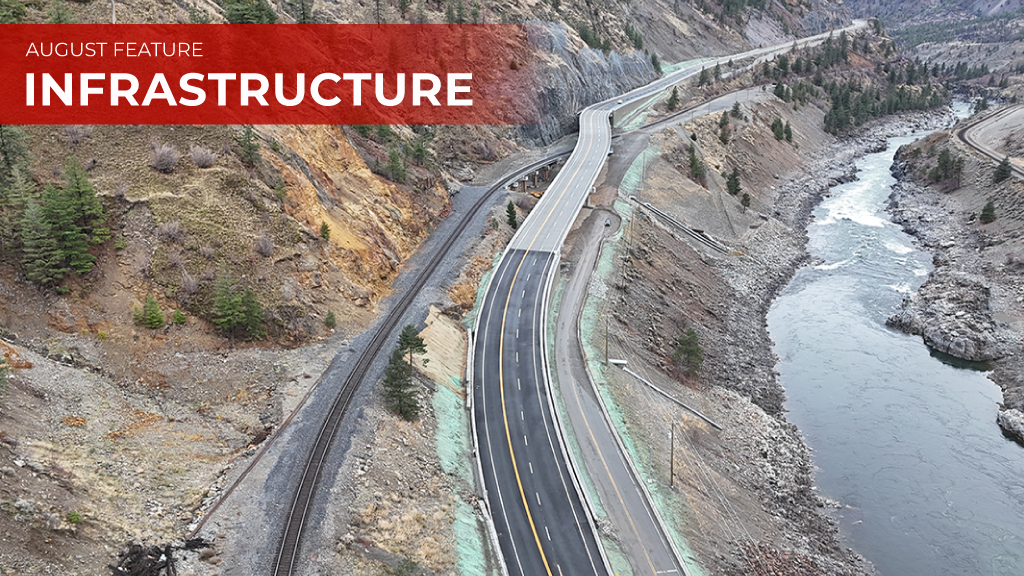
The Tank Hill project, completed in October 2025, a month ahead of schedule, realigned a three-lane section of Highway 1 over the railroad and creek channel. At the center of the reconstruction is a 279-metre structural viaduct with a 24-degree skew.
The new infrastructure restored two major transportation arteries through the Fraser Canyon, one of British Columbia’s most constrained and high-risk transportation corridors.
The project was delivered by the Tank Hill Alliance which includes the BC Ministry of Transportation and Transit (MOTT), Western Highway Infrastructure/Ledcor, McElhanney and Associated Engineering.
Brian Taylor, the alliance’s project manager, Baldev (Dave) Dulay, design manager and Shane Cook, coordinating professional engineer, describe how the partnership was formed, how the teams worked together and what the project ultimately achieved.
The alliance model is founded upon a collaborative approach where the owner, contractor and designers work together as one integrated team. The participants work within a shared contractual framework, sharing risks, responsibilities, decision-making and project objectives, with the project and the needs of surrounding communities at the core of the process.
The approach was particularly well suited to Tank Hill, given the urgency of the project, the technical complexity, the challenging site conditions and the need for constant coordination among multiple stakeholders.
This allowed the team to work together to solve problems and make decisions throughout the project, from planning and designing to building and finishing.
The model is based on joint decision-making of the project partners, shared risks and benefits, and joint responsibility for the final result. The project team said: “The features were faster, more collaborative problem-solving, better constructability and safety in the design phase, and greater scope for innovation and climate-adaptation measures.”
The use of alliance delivery for highway construction in British Columbia is still not common, with MOTT typically using more traditional design-bid-build and design-build models.
Engineering designed for a highly constrained site
The innovation at Tank Hill didn’t involve untested building materials or unfamiliar techniques. Rather, engineering solutions, proven elsewhere, were adapted to the demanding conditions of the site – railroad clearance requirements, safety issues, climate resilience and tight scheduling constraints.
There are a few things that really jump out.
A 279-meter structural viaduct was built over the Canadian Pacific Kansas City (CPKC) railroad and a creek channel.
From about 2.2 meters at the top to 1.2 meters at the bottom, the variable-depth steel box girders are custom-designed to maximize railroad clearance and minimize highway profile.
Approximately 290 m of mechanically stabilized earth retaining walls were constructed, with heights up to 11 m.
Extensive rockfall protection measures were introduced including anchored mesh, slope scaling and a catchment wall.
But the work was not without considerable difficulties. Geotechnical uncertainty, slope stability, rockfall hazards, traffic management, railroad coordination and long term climate resilience had to be addressed.
The physical environment also was an obstacle. It was constructed in a very narrow corridor bounded by steep mountain sides, the Thompson River, a creek crossing, an operating railroad and an active highway.
Given those constraints, the alliance was able to maintain regular road and rail services during construction through detailed staging and close coordination with CPKC.
The team looked at 16 different alignment alternatives before deciding on the final design. It also developed bespoke bridge and foundation designs that could accommodate changing ground conditions, and implemented extensive rockfall mitigation and slope stabilization measures.
Build back better after the 2021 disaster
Ultimately, the Tank Hill project was more than just replacing infrastructure destroyed by the 2021 atmospheric river event.
The goal was to rebuild the corridor to make it safer and more resilient to future climate-related events and better connected to the communities that depend on it.
Recognition came soon after completion. The Tank Hill Project – BC Highway Reinstatement Program won the 2026 Lieutenant Governor’s Award, Bridges Category, at the Association of Consulting Engineering Companies British Columbia’s 2026 Awards for Engineering Excellence.