



With shifting regulatory requirements, tougher enforcement and freight brokers increasingly focused on the safety records of the carriers they hire, trucking companies are under greater compliance pressure. This can be especially difficult for smaller fleets, where the owner or an employee responsible for regulatory issues is already involved in many other aspects of the business.
“The gap between what the regulators are asking for and what resources companies have to manage it is getting harder and harder to deal with,” says David Vincent, co-founder of Visionary Ventures, the technology company behind Dotra Compliance. The platform was designed to be a virtual compliance department for carriers to have access to regulatory oversight and document management tools without the need for a full-time, dedicated safety team.
In an interview with FreightWaves, Vincent discussed the challenges carriers face, the consequences of failing to meet compliance requirements, and how software can help fleets stay on top of regulatory changes.
The pressure has increased considerably in recent months. According to Vincent, carriers have had to navigate several significant developments alongside their existing administrative responsibilities.
“ In the last 18 months alone, carriers have absorbed English proficiency becoming an out-of-service violation, revoked ELDs, a non-domiciled CDL crackdown, a new FMCSA registration system and a Supreme Court ruling that changed how brokers choose carriers,” Vincent said.
These changes come on top of recurring obligations involving medical certificates, motor vehicle records (MVRs), drug and alcohol testing, vehicle inspections and regulatory filings.
For Vincent, the central issue is not whether carriers want to comply, but whether they have sufficient resources to manage the workload.
“A large carrier has a safety department, while a 10-truck fleet has the owner,” he said. “The volume of change is the same for both, and that’s the gap we built Dotra to close.”
Rising enforcement increases the cost of compliance failures
Roadside inspection figures illustrate the growing pressure on the industry. Vincent said inspections fell to approximately 2.6 million in 2020 before exceeding 3.1 million in 2025. More than 23.5% of inspected trucks were placed out of service.
Although part of the increase reflects a recovery from the pandemic period, Vincent attributes much of the additional pressure to enforcement priorities targeting violations that can immediately prevent a vehicle from operating.
“The bigger driver is policy, with enforcement focused on things that stop a truck on the spot, like English proficiency, revoked ELDs and driver qualification,” he said.
The financial consequences of noncompliance extend well beyond the initial citation. An out-of-service order can leave a truck and its freight stranded, while violations can affect safety scores reviewed by brokers, shippers and insurers.
Vincent said many carriers experience these consequences because of administrative oversights rather than deliberate attempts to bypass regulations.
“An out-of-service order parks a truck and a load,” he said. “Violations feed safety scores, which brokers, shippers and insurers all screen on. And most carriers who get hurt aren’t cutting corners. They missed a date nobody was watching.”
That risk has become more significant following a U.S. Supreme Court decision in May. In Montgomery v. Caribe Transport II, the court ruled unanimously, 9-0, that freight brokers can face lawsuits under state law for negligently selecting an unsafe carrier.
According to Vincent, the ruling has changed the commercial importance of compliance.
“It means compliance is now how you get loads, not just how you avoid fines,” he said.
The carrier involved in the case had a conditional safety rating and deficiencies involving driver qualification, hours of service and vehicle maintenance. These were issues that a broker could have examined before selecting the carrier.
With brokers facing greater potential legal exposure, Vincent says their vetting practices are changing. They increasingly request safety records and compliance documentation before tendering freight, and carriers unable to provide the required evidence risk losing business.
The industry does not yet have a universally accepted definition of what constitutes a sufficiently safe carrier from a broker’s perspective. Vincent noted that the broker association has asked the Federal Motor Carrier Safety Administration (FMCSA) to establish a federal standard.
Until such a standard exists, individual brokers can apply their own criteria. For carriers, maintaining a clean and well-documented compliance record is therefore one of the most effective ways to demonstrate reliability.
Administrative gaps remain a major source of risk
The challenge for smaller carriers is often the sheer volume of records they must maintain. Driver qualification files, medical certificates, motor vehicle records, testing documentation, inspection reports, registrations and regulatory filings all require organization and regular review.
Even carriers with complete files can fall behind when they lack a reliable process for identifying documents that need updating.
Vincent highlighted several recurring requirements that can easily be overlooked when no automated reminders are in place: annual MVR reviews, annual queries of the Drug and Alcohol Clearinghouse, random testing rates, biennial MCS-150 updates and annual vehicle inspections.
Recruiting and onboarding drivers represent another particularly vulnerable stage.
“The riskiest moment is hiring, when a driver file gets built in a rush and a pre-employment test or previous-employer check gets missed,” Vincent said.
He identified fleets operating roughly one to 50 trucks as especially exposed because compliance responsibilities often fall to a single person who handles them alongside other duties.
Traditional spreadsheets and paper files offer limited protection against these risks. Their effectiveness depends on someone remembering to check them, recognizing regulatory changes and updating records at the right time.
“A spreadsheet only works if someone remembers to open it,” Vincent said. “It doesn’t warn you, it doesn’t know a rule changed, and when the person who keeps it is out or leaves, the system leaves with them.”
When a requirement is missed, the consequences can arrive simultaneously: a driver may be placed out of service, a delivery may be delayed, a broker may demand explanations, or an audit may require hours of searching through paper records.
The Supreme Court ruling adds another commercial consequence. A carrier that cannot promptly produce reliable documentation may find itself excluded from a freight opportunity altogether.
Dotra positions itself as a virtual compliance department
Dotra Compliance was developed to address these weaknesses by combining document management with regulatory monitoring and deadline tracking. Vincent distinguishes the platform from conventional reminder applications and digital document repositories, which generally depend on users knowing which requirements apply to their operations.
“It means Dotra does the work a compliance person does, not just the filing,” he said.
“A reminder app only reminds you about what you already knew to enter. A document locker stores files but doesn’t read them. Both assume you already know every rule that applies to you.”
The platform first establishes the characteristics of a fleet, including whether it operates commercially or privately, whether its drivers require commercial driver’s licenses (CDLs), and which states it serves. It then generates a corresponding list of requirements.
From there, Dotra tracks deadlines, reads incoming documents and monitors changes in a carrier’s FMCSA safety data.
Vincent describes the objective as delivering the functions of a full-time safety manager at a cost accessible to a fleet with just five trucks.
The workflow is designed to reduce administrative effort. Office personnel can upload documents directly, while drivers can photograph paperwork after scanning a QR code, without installing an application or creating a login.
Dotra reads the submitted document, extracts relevant dates and assigns the file to the appropriate driver or vehicle. Those dates become tracked deadlines, with email and text alerts escalating as due dates approach.
The system is intended to reduce the need for staff to manually enter expiration dates into spreadsheets, check the FMCSA’s Safety and Fitness Electronic Records (SAFER) system, remember annual reviews, search through binders when brokers request records or read regulatory notices to determine whether new requirements apply.
Automated document reading is particularly useful when a new customer joins the platform. Migrating years of paperwork into a digital system can involve hundreds of documents covering multiple drivers and vehicles.
Vincent said manually entering every date is often the point at which carriers abandon the process.
Once the fleet has been onboarded, the focus shifts toward accuracy. Incorrect information can be just as problematic as missing data, particularly when an erroneous expiration date gives an operator the impression that a requirement has been satisfied.
“After setup, it’s about accuracy: a mistyped expiration date is worse than none, because it gives you false confidence,” he said.
FMCSA’s Motus rollout demonstrates the value of regulatory alerts
The transition to Motus, the FMCSA’s new registration system, provides an example of how regulatory monitoring can help carriers avoid administrative disruption.
Motus replaced the previous collection of portals used to manage USDOT numbers, operating authority and biennial updates with a consolidated system. Carriers had to confirm certain account details to complete the transition successfully.
Vincent warned that missing the required steps could leave an operator unable to manage its own USDOT number.
Smaller carriers did not necessarily receive clear or timely information about what the transition required. Dotra customers, however, received an alert accompanied by a step-by-step checklist.
“Dotra customers got it as an alert with a step-by-step checklist,” Vincent said. “That’s the point of regulatory intelligence: the rule is the same for everyone, but it reaches you as a checklist instead of a surprise.”
The example illustrates the distinction between simply storing compliance information and actively helping operators respond to regulatory developments.
Making audit preparation a routine process
Audits and broker vetting requests can quickly expose weaknesses in a carrier’s compliance procedures. Dotra aims to reduce the pressure associated with these events by making records and outstanding requirements visible throughout the year.
“It turns audit prep from a project into a download,” Vincent said.
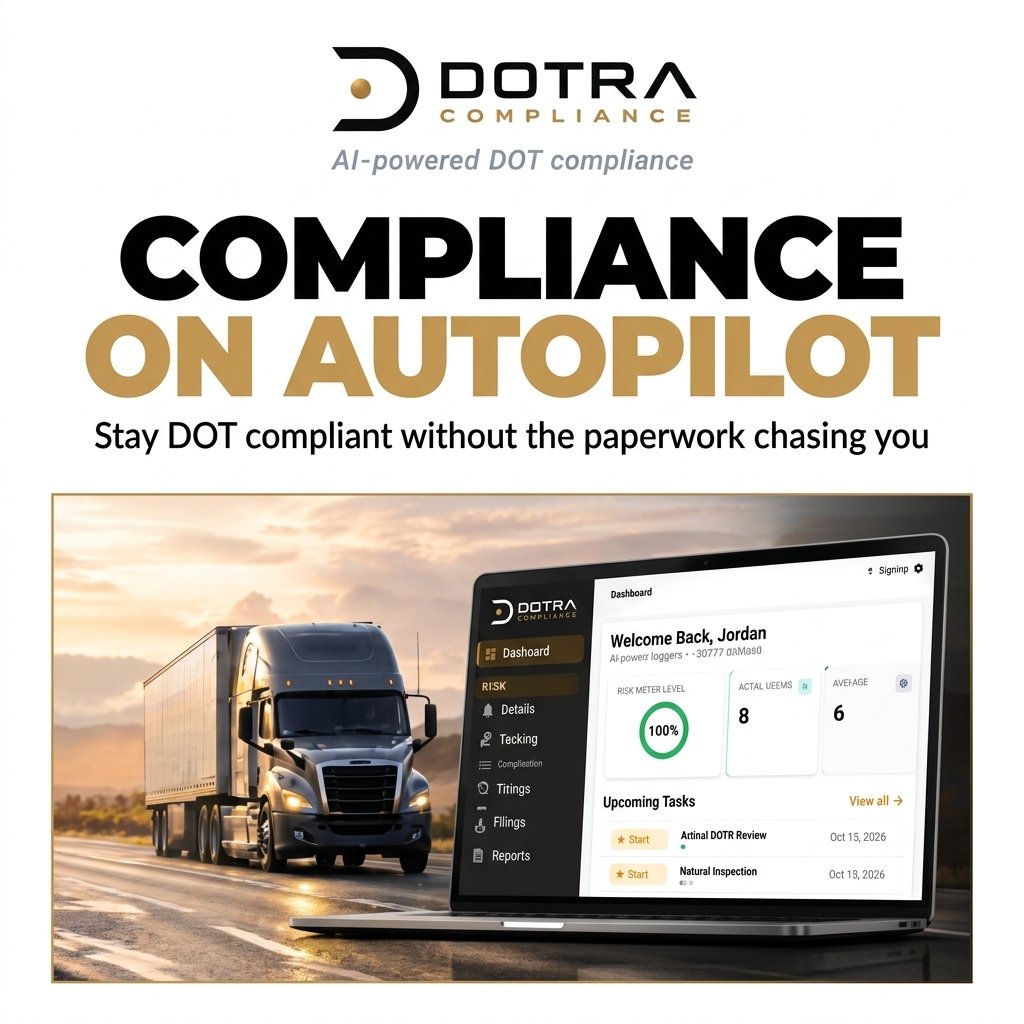
Instead of discovering missing documents only after receiving an audit notice, carriers can review outstanding items through the platform’s dashboard and address gaps before they become more serious problems.
When a broker or auditor requests evidence, Dotra can generate a readiness packet from records already maintained in the system.
Vincent said this capability is becoming increasingly important as brokers face greater scrutiny over their carrier-selection decisions.
“Brokers now need to show they vetted the carriers they hire, and a carrier who can hand over a clean packet the same day makes that easy for them,” he said.
The ability to produce organized documentation quickly can therefore support both regulatory preparedness and commercial relationships.
Non-CDL fleets also face federal compliance obligations
Dotra is not limited to conventional trucking companies. Vincent said the platform also addresses a widespread misconception among contractors, landscapers and other businesses operating pickup trucks with trailers: that the absence of a CDL automatically exempts them from federal transportation requirements.
“A landscaper or contractor running pickups with trailers assumes no CDL means no DOT,” he said. “But federal rules start at 10,001 pounds in interstate commerce, and a one-ton pickup towing an equipment trailer crosses that easily.”
Once an operation falls within the applicable regulatory requirements, many core obligations can apply regardless of whether its drivers hold CDLs. These may include obtaining a USDOT number, maintaining driver qualification files, securing DOT medical certificates, complying with hours-of-service rules and completing annual vehicle inspections.
Drug and alcohol testing requirements generally remain specifically tied to CDL drivers.
To accommodate these businesses, Dotra developed a separate onboarding process that produces requirements tailored to private, non-CDL fleets rather than applying a standard trucking-company checklist to every operator.
“It’s a big part of why we call Dotra transportation compliance, not just trucking compliance,” Vincent said.
Compliance becomes a competitive requirement for fleets
The regulatory demands facing a 200-truck carrier and a three-truck landscaping business may differ in their practical implications, but smaller operations are not automatically exempt from the rules that apply to them.
Dotra combines AI-assisted document reading, deadline management and regulatory monitoring to give fleets of different sizes access to tools traditionally associated with dedicated safety departments.
For Vincent, the objective is to make compliance an ongoing operational process rather than a series of urgent administrative exercises triggered by inspections, regulatory changes or broker requests.
As brokers become more demanding about the carriers they select and the documentation supporting those decisions, the ability to demonstrate compliance may increasingly influence whether a fleet wins access to freight in the first place.