



For most drugs the path is fairly simple: they leave a manufacturing site and eventually arrive at the patient. But the road to CAR-T cell therapy is far more complicated. It begins with cells taken from the patient, moves to a specialized laboratory to be genetically modified and multiplied, and then returns to the hospital as a personalized cancer treatment.
This round trip makes extraordinary demands on pharmaceutical logistics. CAR-T products are living cells that are manufactured for a specific patient, unlike traditional pharmaceuticals. If a shipment is delayed or subject to a temperature excursion, there is no easy substitute. For patients with advanced cancer, a logistics failure can mean longer waits for a treatment that has taken weeks to make.
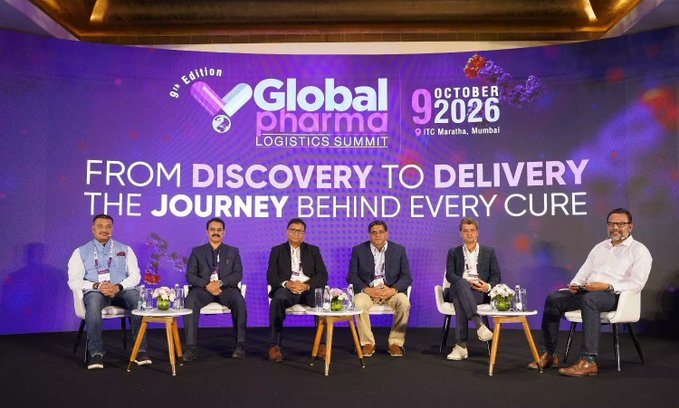
These challenges were addressed on October 9 during Business Session 1, “What it takes to go beyond generics and build supply chains for biopharma”, at the ninth edition of the Global Pharma Logistics Summit (GPLS) 2026, held at ITC Maratha in Mumbai.
Panelist comprised Shirish Arya, Co-founder and Director – Corporate Strategy and Business Development, ImmunoACT; Mukesh Kumar Regar, Specialist SCM and Logistics, Immuneel Therapeutics; Chandan Shirbhayye, Vise President and Head of Supply Chain and Operational Excellence, Aragen Life Sciences; Kaifeel Shaikh, Vise President – EXIM, Global Logistics and Domestic Distribution, Indoco Remedies; and Manoj Singh, Group Chief Executive Officer, MSN Air Service. The discussion was moderated by Reji John of STAT Publishing Group.
India has begun developing its capabilities in this domain, but the number of certified providers is limited. Arya said ImmunoACT and Immuneel Therapeutics are the only CAR-T cell therapy companies approved by CDSCO in the country. ImmunoACT has treated 1,000 patients so far, he said, with no failures in treatment related to logistics.
That feat requires a complex network of hospitals, specialized couriers, airport operators and ground handlers. These operations are rarely seen by the patients but their reliability is crucial to the success of the treatment.
CAR-T therapy turns logistics into an extension of medical treatment
T-cells are white blood cells that naturally help the body fight cancer. As Arya explained, these cells can lose their ability to recognise tumours in people with cancer. CAR-T therapy addresses this problem by collecting the patient’s T-cells, genetically modifying them to express a protein that helps identify cancer cells, multiplying them and reinfusing them into the patient.
The treatment is generally considered when cancer has advanced or returned after other treatment options have been exhausted. Once the decision to proceed has been made, the timing becomes critical. The patient undergoes conditioning treatment in preparation for the infusion while the personalised therapy is still being manufactured, leaving little room for changes to the schedule.
The process involves two separate shipments.
The first carries the patient’s cells from the hospital to the manufacturing facility. Collection is followed by transport, preferably within 24 hours, at a temperature between 2°C and 8°C. At the laboratory, the cells are isolated, activated and genetically modified using a viral vector. They are then multiplied from millions into billions of cells.
Manufacturing takes seven to eight days in a controlled environment. The resulting product then undergoes approximately ten days of quality testing while being maintained at minus 80°C. Around the 18th day, Arya said, ImmunoACT contacts its logistics partner to prepare for the return shipment.
The second journey carries the finished therapy back to the hospital at minus 80°C. By this stage, the patient’s conditioning treatment has been scheduled around the expected arrival of the cells, making any disruption particularly consequential.
ImmunoACT operates a single laboratory in Mumbai, receiving samples from approximately 150 hospitals across India, from Trivandrum in the south to Kashmir in the north and Guwahati in the east. Shipments move by road and air, sometimes combining several transport modes within a single journey. Arya identified Marken as the company’s primary logistics partner and credited the vaccine industry with helping establish the capabilities needed to support such specialised operations.
Route rehearsals and contingency plans help prevent failures
At Immuneel Therapeutics, the logistics process is managed through third-party providers, but responsibility does not end when the shipment is handed over. Regar explained that the company works closely with its partners to identify potential weaknesses before they affect patients.
One of its principal safeguards is a full operational rehearsal before shipments begin from a new hospital or location. These dry runs take place without involving a patient and are designed to expose potential problems along the entire route.
The team maps each stage, including the hospital ward, the collection location, the hospital exit, the vehicle, the person responsible for transferring the shipment to the airport and the flight carrying it to its destination.
Contingency planning is built into every route. If a flight is cancelled or an unexpected incident occurs at a hospital, the team must already have alternative arrangements in place. Regar said the objective is straightforward: logistical problems must not become a source of suffering for the patient.
Physical handling is another area of concern. Cryogenic shipping containers can be tilted or subjected to thermal and mechanical shocks. Immuneel therefore uses tilt indicators that change from green to red when a container has been mishandled. Although the device cannot prevent an incident, it helps establish whether improper handling occurred and supports investigations into where it happened.
Airport security procedures present a separate challenge. Regar warned that conventional X-ray screening can destroy the product. Immuneel works with airlines and airport authorities to provide the documentation and explanations needed to ensure cryogenic containers are handled differently from ordinary cargo and are not subjected to routine cargo X-ray screening.
The company also maintains two essential safeguards throughout the shipment process: chain of identity and chain of custody. The first ensures that the therapy reaches the correct patient, while the second restricts collection, transfer and handover to authorised personnel.
Hospital employees and logistics partners receive training on these requirements. Written procedures govern each check-in and handover to reduce the risk of errors as the shipment moves between organisations.
The system has also supported urgent international movements. Regar cited a shipment originating in the Middle East that was collected from a patient on a Sunday, flown out of Oman on Monday and cleared in India the following day. The entire operation was completed within 48 hours.
For Regar, the experience demonstrates why coordination between the manufacturer, hospital and logistics provider must extend to every stage of the journey. When all parties control their respective responsibilities, the reliability of the process becomes part of the treatment itself.
Airport handling remains a critical weak point
Despite improvements in pharmaceutical logistics infrastructure, the airport environment continues to expose CAR-T shipments to risks that are not always visible to manufacturers.
Singh of MSN Air Service argued that airports must no longer be regarded simply as transit points for cell and gene therapies. They should instead be treated as critical components of the treatment chain.
He identified five stages at which problems can arise.
The first is shipment acceptance, when ground handlers must verify the condition of the cargo, inspect its packaging and establish whether any delays or temperature excursions occurred before arrival.
The second is offloading and staging, when shipments may be exposed to unsuitable conditions while waiting to move to the next stage.
The third involves cargo build-up, during which shipments are prepared for transport. Temperature records must be maintained and shared with the customer.
The fourth is the transfer from a controlled environment towards the aircraft. The fifth is the airside operation, where flight delays, ramp-related problems or decisions to offload cargo can leave sensitive shipments waiting.
According to Singh, the industry does not consistently monitor minor exposures at these stages. Cargo may remain in staging areas without sufficient verification that it is in the correct temperature zone, while customers may not receive timely information about temperature excursions.
He does not believe that a shortage of cold rooms is the main issue. Infrastructure at Indian airports has improved over the past decade, supported by standards and certifications such as Good Distribution Practice (GDP) and the CEIV programme.
The more significant weakness lies at the points where responsibility passes from one organisation or controlled environment to another.
Singh described the problem as one of accountability between two control environments. His proposed solution is to assign a single accountable owner to maintain shipment timelines, temperature information and visibility data in one place. This would make it easier to establish responsibility when an incident occurs.
Arya identified a similar problem from the manufacturer’s perspective. Within ImmunoACT’s facilities, staff, infrastructure and procedures are documented and audited by regulators such as the Central Drugs Standard Control Organisation (CDSCO). Once a shipment leaves the facility, however, that level of direct oversight ends.
The company relies on data loggers to monitor conditions during transport. If the logger records no temperature excursion, the shipment is considered acceptable. But this does not necessarily reveal what happened at the airport, how much physical agitation the container experienced or how screening equipment affected it.
Arya described the arrangement as a form of “blind trust” in logistics partners.
He believes logistics providers should apply the same scientific discipline used by pharmaceutical manufacturers. While drugmakers routinely publish studies establishing the shelf life of their products, he wants logistics companies to produce validated, peer-reviewed research demonstrating how their handling procedures affect product quality and where those procedures can be improved.
He also called for customs officials and airport personnel to receive a better understanding of the hazard classifications and time sensitivity associated with these molecules.
Biologics supply chains face sourcing, temperature risks
The challenges are not limited to the finished CAR-T therapy. The raw materials, culture media and reagents used in the manufacturing of biologics must also be managed under specific conditions of storage.
“ImmunoACT sources culture media and reagents from international suppliers and each product has its own shelf-life and temperature needs,” Arya said. Some can be kept at room temperature, some have to be kept at about 20°C, or at 2°C to 8°C.
For manufacturers it gets even more complicated to ensure that these conditions are fulfilled by more than one supplier and transportation route.
“Biologics require a completely different approach to the supply chain management,” said Shirbhayye, Aragen Life Sciences. India’s contract research, development and manufacturing organizations have traditionally focused on small molecules produced by chemical synthesis. These products generally last two to three years.
Biologics, by contrast, are living systems. Their materials may be sensitive to temperature, air, light and physical stress, which puts more pressure on inventory management, shelf life and batch control.
Sourcing introduces more vulnerabilities. Shirbhayye said 90% to 95% of the materials and consumables used in the biologics manufacturing sector in India are imported. These include cell culture media, resins, single use bags and associated hardware.
They may also depend on original equipment manufacturers for consumables, which can limit their flexibility in the event of a shortage. Lead times quoted to global competitors can be two to three months, while backorders for items such as single-use bioreactors and chromatography resins can run to six to nine months. These delays mean Aragen loses projects, Shirbhayye said.
He also described an incident involving the shipment of cell culture material to India via a European transit airport. A strike that halted resupply of the cold-integrity material disrupted operations. The data logger then recorded a temperature excursion.
Tests showed that the material had not degraded as badly as originally feared, but the result could have been different.
The incident brings out one of the key drawbacks of monitoring technology: a data logger can log a failure after the fact, but it cannot prevent the conditions that cause it.
Shirbhayye called for more end-to-end shipment visibility, including beyond India’s major metropolitan areas. “Organisations need enough reliable data to anticipate disruptions and prevent them rather than investigate problems after the consignment has arrived,” he said.
The international expansion will test logistics network
ImmunoACT is gearing up for expansion outside India. Arya said the company is planning clinical trials in Mexico and South Africa, and is in talks with Saudi Arabia, Turkey and other Middle Eastern countries.
Since it is not possible to build a manufacturing site in each market, centralized production sites will have to serve patients across borders. This expansion would increase the number of shipments involving living cells and add additional regulatory and operational requirements into the supply chain.
“The main problem is not demand,” Arya said. There are still thousands of patients with unmet medical needs. But more pressing are questions of regulation and trust: can logistics providers be trusted to reliably shuttle living tissue back and forth, and will foreign patients and regulators have confidence in the process?
“Temperature control is important, but so too are administrative procedures,” Shaikh said, stressing he was speaking in his personal capacity.
He said that import and export pre-clearance involving the CDSCO, customs authorities and the Directorate General of Foreign Trade (DGFT) should be consolidated through a single digital window. It could reduce lead times and facilitate cross-border movements, he said.
Shaikh also called on logistics providers to take more ownership of training staff across the supply chain. A single shipment can pass through 10 to 12 handling points before it reaches its final destination. That’s a lot of opportunity for things to go wrong if there’s no uniformity in the process.
Logistics companies should be partners, not just a transport service, he said.
Regar mentioned three other priorities for logistics providers: invest in last-mile infrastructure for tier-two and tier-three cities, develop packaging in India that is suitable to local operating conditions, and deploy modern tools to improve real-time traceability.
The packaging used to ship these packages now comes largely from the United Kingdom and the United States. Developing solutions domestically could help the industry address the specific challenges of India’s geography and transport environment.
Equally important is real-time visibility. His team often discovers the delays or deviations only after a shipment reaches its destination and the monitoring report has been reviewed, said Regar. After the event, the investigation then looks at root cause determination.
He wants logistics partners to send alerts in real-time while a shipment is on the road so teams have a chance to intervene before a problem compromises the therapy.
A shift from cargo management to patient-centred logistics
The discussions at GPLS 2026 highlighted a growing mismatch between the precision required by advanced therapies and the fragmented visibility that can characterise their transport.
India has developed specialised capabilities, and ImmunoACT’s experience demonstrates that complex domestic and international movements can be completed successfully. However, the next stage of growth will require more consistent airport handling, stronger accountability at operational handovers, better regulatory coordination and technology capable of identifying problems before they become irreversible.
For CAR-T therapy, the stakes are particularly high because every shipment is linked to an individual patient and a treatment schedule that cannot easily be changed. Improvements in infrastructure alone will not be enough if temperature exposures, physical handling and transfer responsibilities remain difficult to monitor.
Regar’s message to logistics providers captured the central issue: “Change the mindset and don’t treat it as cargo.”