




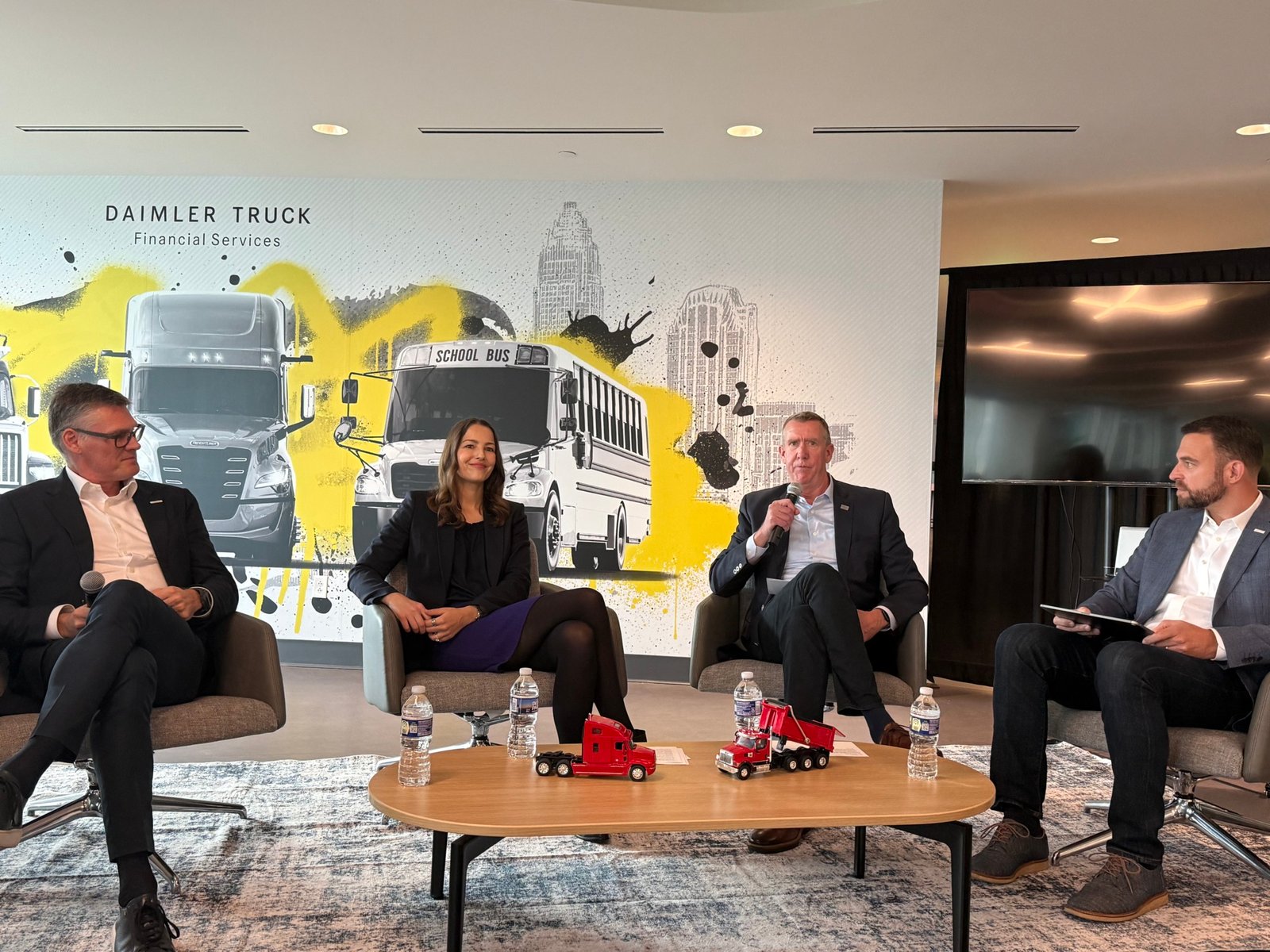
Leaders from Daimler Truck provided a candid look at the challenges and opportunities facing the trucking industry during a panel discussion at Daimler Truck Financial Services’ new North American headquarters in Charlotte, North Carolina. The conversation focused on regulatory developments, the state of the freight market, cost of financing, alternative powertrains and the company’s timeline for autonomous trucks.
The panel was moderated by Goetz Johanning, Head of Strategy and Realization, North American Financial Services Business, and featured Daimler Truck Holding AG Chief Financial Officer Eva Scherer, Daimler Truck Financial Services Chairman Stephan Unger, and Daimler Truck Financial Services USA LLC President and CEO Kevin Bangston.
Executives skipped the typical corporate presentation and talked about issues that matter to carriers, from owner-operators driving a single truck to large fleet operators making long-term equipment investments.
EPA 2027 Compliance Moves Forward Without Major Pre-Buy Spike
Daimler Truck is planning to launch a Detroit engine that satisfies all EPA 2027 requirements. Scherer said the company is planning to address the new standards head-on, rather than using emissions credits or non-conformance penalties.
A lot of the current generation will be carried over to the new engine. Two-thirds of its parts will be shared with the current engine, a design philosophy intended to boost reliability while reducing the risks of an all-new platform. Daimler is also introducing the engine at a competitive price point and expects fuel economy to improve by about 3%.
But the anticipated rush to buy trucks before the new regulations has not yet happened.
Daimler announced its 2027 pricing in September, but this did not lead to a jump in orders. In the past, changes in regulation have motivated fleets to purchase vehicles with existing engines before the time that new standards become effective. This time, concerns over the final 2027 rules, engine strategies and possible penalties have many buyers hesitant to sign up.
All of the major manufacturers are booked out for the rest of the year, Scherer said, and customers are beginning to position themselves for orders in the upcoming year. But there are many still waiting to make firm decisions.
Smaller carriers have less immediate pressure to replace equipment to beat the regulatory deadline because of the absence of a strong pre-buy. Operators can also assess their finances, equipment needs and operating costs prior to potentially expensive purchases.
Freight Market Conditions Improve, But Diesel Still a Threat
Daimler’s financial services executives said the long freight recession has been a drag on the company’s credit portfolio. Bangston said the recovery that is starting to show has been driven more by capacity leaving the market than a significant rise in freight demand.
As capacity tightened, carriers started to reassert pricing power. Freight rates renegotiated began flowing through the financials of on-highway customers in the second quarter and the portfolio materially outperformed after an earlier period of stabilization.
The improvement shows that surviving small and midsized carriers are beginning to reap the benefits of firmer rates. But the recovery is vulnerable to rising operating costs, particularly fuel costs.
Fuel surcharges allow carriers to recover about 70% of the cost of their diesel, Bangston estimated. The other 30% has to be absorbed by the operators themselves, leaving them potentially with significant margin pressure when the price of fuel increases.
Concerns have grown that fuel prices may rise further, because of pressure from geopolitical developments. For owner-operators and smaller fleets with less negotiating power, the share of diesel costs that can’t be passed on can make a big difference to annual profitability.
The message is that freight rates are getting better and they are helping the sector but they do not counterbalance the financial risks coming from unpredictable fuel costs.
Higher interest rates changing truck financing options
Another major theme of the conversation was the cost of capital. Higher global interest rates, wider credit spreads and high levels of sovereign debt were creating a more expensive financing environment and this would continue, Unger said.
Daimler’s captive financing arm is gaining more support from customers as borrowing becomes costlier. Therefore, a manufacturer-backed lender that specializes in trucks rather than a general-purpose bank can customize financing arrangements according to the changing market conditions and operating cycles of the industry.
Daimler Truck Financial Services points to its A credit rating and what it calls a solid balance sheet as benefits to assist customers through tough times.
The firm is also expanding its focus on integrated service packages. Instead of financing a truck through a standalone loan, a growing number of customers are combining financing with maintenance, repair contracts, insurance, telematics, extended warranties and residual-value arrangements under a more comprehensive payment structure.
An established example of this approach is Europe. Daimler offers more than 6,000 trucks through Charterway, on short-term and long-term rental arrangements. Also on the rise in the region are full-service leasing and rental.
The company does not have fleets in North America but offers full-service leasing through partnerships with Penske and Ryder.
But Bangston warned the North American market has not made a fundamental shift from ownership to leasing. Demand for bundled services is increasing but the overall mix of ownership versus leasing has remained broadly the same.
So carriers have a lot of choices in terms of acquiring their next vehicle, whether that’s buying a truck with the intention of selling it three years down the road, taking an operating lease, or going with a package that combines equipment and ongoing services. The best option depends on the cash flow, operational flexibility and appetite for predictable costs of each company.
Daimler Targets Autonomous Truck Commercialization at Scale by 2028
Autonomous driving emerged as one of the most forward-looking subjects of the discussion, with Daimler providing a concrete timeline for its development program.
Scherer said the company expects to put its first autonomous truck on a route without a driver by the end of this year, followed by further mileage accumulation as testing and development progress. Daimler is targeting commercialization at scale toward 2028.
The system combines an autonomy-ready Freightliner Cascadia, equipped with redundant braking and steering, with a virtual driver developed by Torc Robotics, Daimler’s autonomous-driving subsidiary.
The architecture is designed to be modular rather than permanently tied to a single autonomous-driving provider. This could allow the redundant vehicle platform to work with different virtual-driver systems as the technology evolves.
The commercial model also introduces a different approach to paying for autonomous equipment. Customers would purchase or finance the truck and chassis through conventional arrangements, while the virtual driver would be supplied as a software-as-a-service offering charged on a per-mile basis.
This separates the physical vehicle from the autonomous-driving technology, creating an additional recurring cost tied to mileage. Daimler says it intends to provide financing solutions suited to the eventual business model.
Scherer also highlighted advances in the technology’s training methods. Autonomous systems are moving beyond older imitation-based approaches toward reinforcement learning, which can help trucks handle routes they have not previously encountered.
Deployment will initially remain restricted to defined routes, with the operating network expanding progressively as safety requirements are met. Nevertheless, Scherer indicated that development is accelerating and that the next two years should bring tangible progress.
Diesel, Electric and Hydrogen Follow Different Regional Timelines
Daimler described its powertrain strategy as a dual-track approach, reflecting differences between North American and European markets.
In North America, the immediate priority remains improving diesel efficiency. The EPA 2027-compliant engine is the next major step, with additional efficiency improvements planned for 2030 and beyond.
Europe is moving more aggressively toward zero-emission trucks because of regulatory pressure. Daimler is advancing electric vehicles in the region while also investing in hydrogen technologies intended for the 2030s.
Scherer cited the performance of the company’s flagship long-haul electric truck in Europe, saying it holds a 38% market share in its segment there, a share substantially higher than Daimler’s overall position in the market.
She also said the latest battery technology used in European vehicles could be incorporated into North American products, including the electric Freightliner Cascadia, relatively quickly once sufficient customer demand emerges.
The company’s approach, described as the “speed of right,” is to prepare for different technological outcomes without forcing customers to adopt solutions before market conditions justify the transition.
Charging infrastructure follows a similarly measured strategy. Daimler does not intend to commit large amounts of capital to building a broad charging network itself. Instead, it plans to help customers establish charging capabilities at depots and warehouses while encouraging wider development through selected partnerships.
What Daimler’s Outlook Means for Trucking Companies
The executives’ comments point to several forces that will shape equipment and financial decisions over the coming years.
The new EPA 2027 engine is expected to deliver approximately 3% better fuel economy while retaining roughly two-thirds of the current generation’s components. Yet the lack of a major pre-buy surge indicates that regulatory uncertainty continues to influence purchasing decisions.
At the same time, the freight market is showing signs of recovery as capacity exits the sector and negotiated rates improve. That progress remains exposed to diesel volatility, with carriers estimated to absorb around 30% of fuel costs even after surcharges are applied.
Financing presents another challenge. Higher borrowing costs are making equipment purchases more expensive and increasing the importance of evaluating ownership, leasing and bundled-service alternatives according to each operation’s financial requirements.
Autonomous trucking introduces a longer-term change to the economics of fleet operations. Daimler’s planned separation of vehicle financing from a per-mile virtual-driver service could establish a new model for purchasing and operating trucks as commercialization advances toward 2028.
For small carriers and owner-operators, the immediate priority is to calculate break-even costs carefully, avoid rushed equipment decisions driven solely by the EPA 2027 deadline, and account for both fuel exposure and higher financing payments.
The longer-term question is how autonomous technology will affect operating costs and vehicle ownership. As Daimler’s plans develop, the way carriers pay for trucks could increasingly extend beyond the traditional purchase price and loan to include software and services tied directly to miles driven.
This article is based on a panel discussion at Daimler Truck Financial Services’ North American headquarters in Charlotte, North Carolina. Participants included Eva Scherer, CFO of Daimler Truck Holding AG; Stephan Unger, chairman of Daimler Truck Financial Services; Kevin Bangston, president and CEO of Daimler Truck Financial Services USA LLC; and Goetz Johanning of DTFS USA, who moderated the session. Figures and forward-looking statements reflect information presented by the executives.