



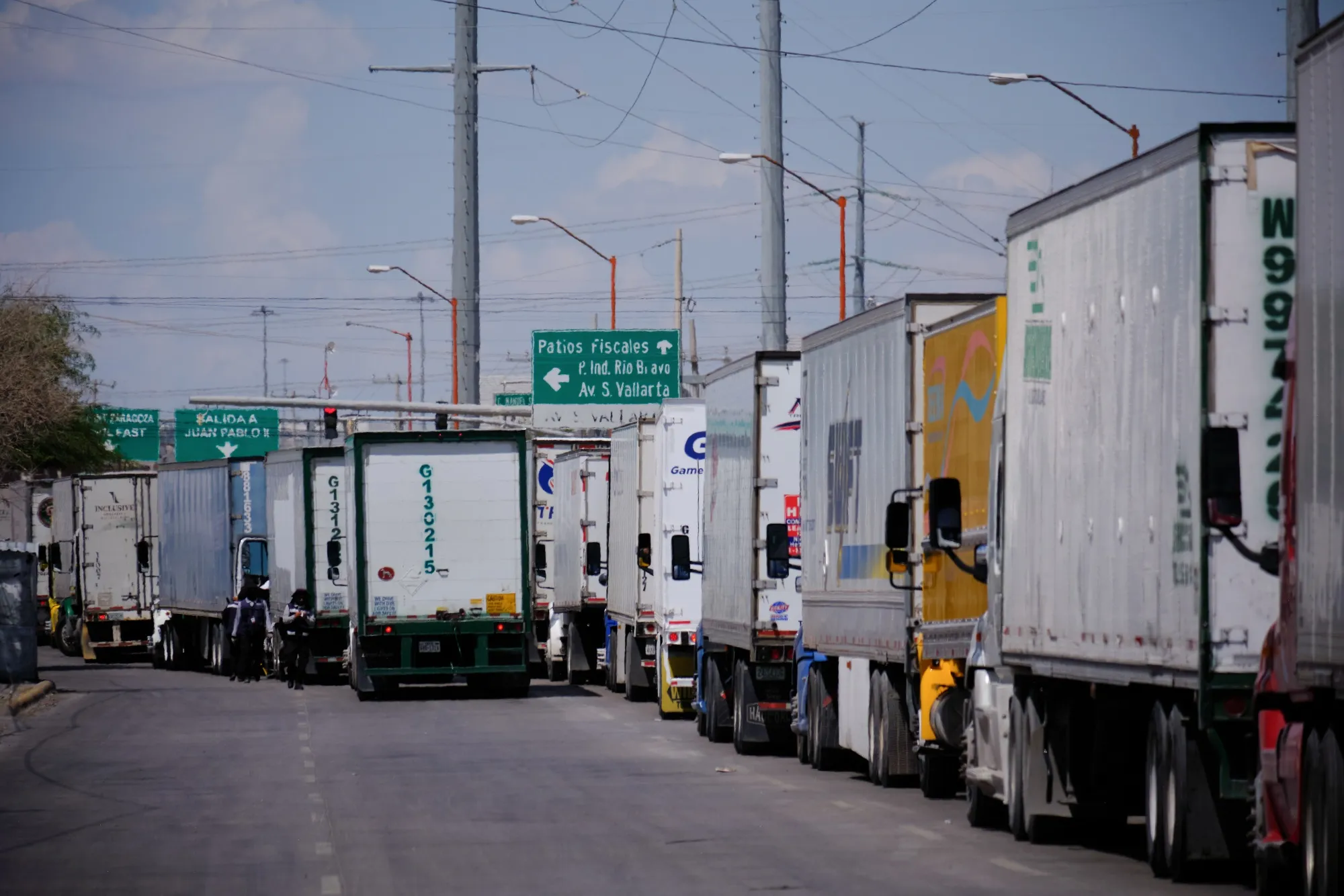
Stricter U.S. Trucking Rules Put Cross-Border Freight Operations Under Pressure
Efforts to tighten enforcement of U.S. trucking regulations are raising concerns across the North American freight industry, with transportation leaders warning that stronger oversight must not create unnecessary barriers for carriers operating legally between the United States and Mexico.
The issue took center stage during two panel discussions at the International Road Transport Union’s (IRU) North American Transportation Forum, held alongside the 2026 National Convention of Mexico’s National Chamber of Freight Transportation (CANACAR) in Cancún.
Representatives from the American Trucking Associations (ATA), U.S. Customs and Border Protection (CBP), Werner Enterprises and CANACAR examined growing scrutiny of cabotage violations, B-1 business visas, English-language proficiency and commercial driver qualifications. Although participants broadly supported stronger enforcement, they cautioned that inconsistent interpretations of federal rules could reduce driver availability, increase delays and complicate freight movements across the U.S.-Mexico border.
These concerns come as visa restrictions and driver shortages continue to put pressure on cross-border trucking capacity.
Werner Enterprises supports stricter compliance rules
“We need stronger enforcement to keep foreign drivers from illegally hauling domestic freight in the United States,” Werner Enterprises chairman and CEO Derek Leathers said.
Foreign drivers may haul qualifying international shipments into and out of the country, but typically can’t transport domestic freight between two U.S. points under federal cabotage restrictions.
Leathers also backed federal efforts to crack down on the abuse of B-1 business visitor visas by drivers involved in illegal domestic trucking.
He praised the Federal Motor Carrier Safety Administration (FMCSA) for increasing enforcement of English-language proficiency standards. He said that drivers working inside the United States need to be able to communicate clearly with law enforcement officers and other personnel.
The Trump administration has also promoted greater oversight of driver licensing and training and beefed up enforcement of English-language requirements for commercial drivers.
Leathers’ stance is in line with growing support among U.S. trucking officials for cracking down on carriers and drivers who fail to meet federal standards. But industry discussions also highlighted the risk that legitimate Mexican carriers could face further difficulties as scrutiny intensifies.
ATA calls for consistent and proportionate rule enforcement
“Regulatory enforcement must be consistent and proportionate, especially as cross-border freight activity returns,” said Bob Costello, chief economist at the American Trucking Associations.
“North American cross-border trade rebounded in 2026 after a modest decline in 2025,” said Costello, emphasizing the significance of preserving efficient transportation links among the United States, Mexico and Canada.
Costello also asked if all U.S. enforcement personnel are fully aware of the complex nature of cabotage regulations, Mexican transportation publication Revista Transportes y Turismo reported.
Mexican trucking firms that are allowed to operate in the United States could find themselves facing uncertainty due to different interpretations of the rules. Costello called for continued collaboration between industry associations, regulators and transportation representatives to make sure enforcement targets violations without unduly interrupting legitimate freight movements.
Mexican trucking companies warn of border bottlenecks
CANACAR’s Augusto Ramos Melo, president of the association, stated that while the need to combat illegal cabotage is recognized, ramping up border enforcement could result in further delays and operational issues for Mexican carriers.
He said there was a need to have closer coordination between transport companies, customs officials and other supply chain participants to improve border efficiency.
Mexican trucking operators already face increased scrutiny of driver documentation, visa eligibility and compliance with U.S. transportation requirements. The extra inspections and paperwork can make it difficult for companies that move freight through the southern U.S. border to schedule drivers, position equipment and meet delivery commitments.
Martin Rojas, IRU senior adviser for the Americas, moderated the discussions. He stressed the need to balance regulatory oversight with the availability of a sufficient pool of qualified drivers to maintain the capacity of cross-border transportation.
The key challenge for policymakers is to increase compliance without hurting the trucking network that supports trade across North America.
CBP outlines trade-processing and cargo-security initiatives
Liliana Flores, CBP’s port director in Del Rio, Texas, outlined efforts to improve trade-information processing while expanding programs intended to strengthen cargo security, according to Revista Transportes y Turismo.
Her remarks covered developments involving the Customs Trade Partnership Against Terrorism (CTPAT), a voluntary public-private partnership designed to improve international supply chain security.
Flores encouraged Mexican trucking companies to join CTPAT and participate in CBP’s Electronic Export Manifest pilot program.
The pilot’s testing phase is scheduled to end on October 23. Information gathered during the trial is expected to help CBP refine its systems before a broader rollout.
Both initiatives are intended to strengthen cargo security and improve the exchange of shipment information. Nevertheless, carriers continue to face increased scrutiny of their cross-border operations.
B-1 visa requirements add to driver and carrier challenges
The second panel focused on the effects of regulatory changes on commercial drivers and transportation companies.
Justen Thomas, a representative of the U.S. Consulate General, advised drivers applying for or renewing B-1 visas to prepare carefully for their consular interviews. He noted that English-language proficiency is among the factors that can influence visa decisions.
B-1 visas are commonly used by eligible Mexican commercial drivers transporting international freight into the United States. They do not, however, authorize drivers to undertake domestic cabotage operations.
Iro Doumani, president of the IRU Goods Transport Council, provided a European perspective on the issue. Doumani explained how coordinated regulatory frameworks and digitalization can help governments maintain effective enforcement while supporting efficient international freight transportation.
Driver shortages remain a challenge for transportation operators even in regions with more integrated cross-border systems, Doumani noted.
Panelists agreed that closer cooperation among regulators, customs agencies and trucking companies would be essential to preserve efficient freight movements while ensuring compliance with applicable rules.
M2 Global Logistics opens 830,000-sq-ft Houston campus
Meiborg Companies and Morales Capital Group have partnered to develop M2 Global Logistics, a new third-party logistics (3PL) provider based on an 830,000-square-foot industrial campus in the vicinity of downtown Houston.
The companies announced the venture Thursday, describing a platform that would blend Meiborg’s trucking and warehousing operations with Morales Capital Group’s expertise in international trade and investment.
Houston site is 27 acres with access to major freight corridors, intermodal hubs and port connections. Operations are expected to start in the coming months with further expansion into additional markets planned.
“We are taking a proven regional operation and turning it into a truly global 3PL brand,” said Zach Meiborg, CEO of Meiborg Companies, in a statement.
Founded in 1981 and based in Rockford, Illinois, Meiborg operates more than 550 trucks and controls over 4 million square feet of warehouse space in Illinois and Texas.
M2 Global Logistics plans to combine a range of services under one operating platform including domestic trucking, international freight transportation, customs related logistics, warehousing, fulfillment and distribution.
Zach Meiborg, Nick Gibbons and James Cooper will lead the new business, along with executives from Morales Capital Group.
The Houston launch extends the partners’ logistics ambitions by linking transportation and storage infrastructure with international trade and investment capacity. The company’s proximity to major freight routes, intermodal facilities and port connections is expected to benefit the company’s planned services as it prepares to begin operations.
Cutter & Buck Opens Its 4th North American Distribution Center in Texas
Apparel maker Cutter & Buck has opened a new distribution center in Grand Prairie, Texas, to expand its fulfillment network and add capacity for customers in the central and southern United States.
The facility, which opened Oct. 7, is the company’s fourth North American distribution center, the company said in the announcement.
Merchandise from Cutter & Buck, Clique and Craft will be available at the Dallas-Fort Worth metro area center. The extra inventory space is designed to help speed up the processing of orders and delivery to customers across the country.
The site offers weekday UPS and FedEx pickups, local customer pickup services and access to the company’s Share Ship order fulfillment program.
Cutter & Buck will also add in-house embroidery and heat transfer services at its Texas facility in the first quarter of 2027. “We are testing the operation now and expect the service capacity to increase in the coming months.”
The new center adds another distribution node to the company’s North American network and space for additional fulfillment services as the business grows.
The significance of these developments
More stringent enforcement of U.S. trucking regulations could put further pressure on driver availability, border processing and delivery timelines for companies moving freight between the United States and Mexico. Industry leaders support action on violations, but warn that uneven enforcement could disrupt legitimate carriers and add new uncertainty for North American supply chains.
Continued investment in warehousing, distribution and fulfillment in Texas includes M2 Global Logistics’ opening in Houston and an expansion by Cutter & Buck in Grand Prairie. The developments indicate two important directions for logistics operators: the need to keep cross-border transport efficient and the extension of infrastructure to enable freight and order fulfillment.