



The tanker market could be entering a new phase of fleet consolidation, with International Seaways’ proposed acquisition of Bruton Ltd highlighting how listed shipping companies can use their shares to secure additional tonnage as vessel values and market conditions strengthen.
Announced in recent days, the transaction would see International Seaways (INSW) acquire all of the Norwegian-listed Bruton’s shares through a share-for-share arrangement. The deal is expected to be completed before the end of 2026 and would bring four 300,000 dwt very large crude carriers (VLCCs) into INSW’s fleet.
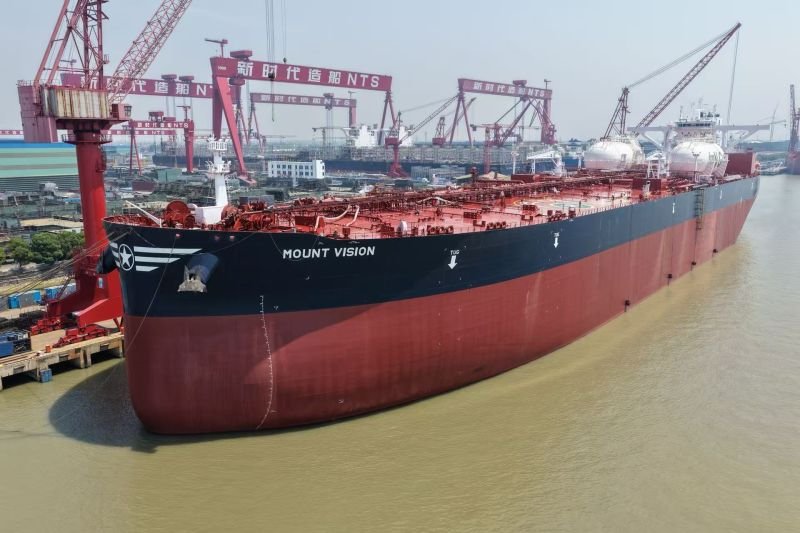
The vessels comprise one dual-fuel ship already in service, a sister vessel capable of running on liquefied natural gas (LNG) scheduled for delivery later in 2026, and two conventionally fuelled VLCCs due for delivery in the third quarter of 2027. The latter pair is being built by New Times Shipyard in Jingjiang City, China.
“Charter commitments provide visibility of earnings
A major aspect of the deal is the commercial arrangements attached to the vessels. Bruton’s latest investor presentation shows that its first vessel, Mount Vision, is on charter to a third party until Q1 2027 at a daily rate of $95,000. It is then expected to be operated under an index-linked charter until 2031.
The second vessel, Mount Horizon, is scheduled for delivery soon, and has employment contracted until the fourth quarter of 2027 at $105,700 per day.
Bruton was founded in 2023 and controlled by Norwegian shipping investor Tor Olav Troim. In August 2026, the business was split into two separate companies. Bruton is the counterparty in the transaction with INSW, while OMC Tankers, also listed in Oslo, has an orderbook of eight VLCCs.
INSW to Fund Most of Transaction Using Own Stock
The stock price of New York-based shipowner International Seaways, which has a fleet of more than 70 vessels, has soared. Shares surged as high as $125 in mid-October before falling back to around $105.
The company said the series of deals would value Bruton at about $370 million. INSW expects to pay about 96% of the total consideration in about 3.12 million shares of its own stock, with the balance paid in cash.
The transaction is expected to be rolled out in phases. As part of a share exchange, which is expected to be approved on October 20, approximately 50.5% of the new shares will be offered directly to existing Bruton shareholders. The rest of the Bruton shares will be acquired through another exchange of INSW stock, probably after a special meeting of Bruton shareholders at the end of October.
More details of the proposed allocation were provided in a new report for investment clients from Deutsche Bank analyst Chris Robertson. His calculations revealed that INSW’s 3.12 million shares were worth more than 10,000 shares of Bruton stock. Those below that level will instead receive a cash payout of $15 million in aggregate.
Vessel valuations cast doubt on deal pricing
The valuations of ships provide another perspective on the transaction. Deutsche Bank values the four vessels at about $810 million based on its generic last-deal-done methodology.
This valuation is in line with recent figures from shipbroker Poten, which values second-hand VLCCs at about $210 million each. Shipyards are booming with orders for VLCCs and newbuildings are priced at $129 million apiece, but presumably these estimates are based on delivery schedules some three years away.
Deutsche Bank’s report did not provide a specific net asset value (NAV) estimate for International Seaways shares. However, Robertson believes the deal is a fair price and a good example of a successful stock-based acquisition given the fact that INSW’s stock is trading at a premium to the bank’s estimated NAV per share.
In a strong shipping market the difference is big. For listed owners trading at or near their net asset values, share issuance can be an alternative to using existing cash reserves or taking on more debt to fund fleet expansion.
A strategy previously applied in the dry bulk market
Equity in a trading company for ships is nothing new in the business. Some of the most notable examples came during periods of strength in the dry bulk market, both in the 2010s and in the 2020s.
One of the companies that has adopted the approach has been Star Bulk. Star Bulk’s Hamish Norton explained the logic of acquiring vessels with shares during an investor call in 2021 when dry bulk shipping was doing well in the aftermath of the Covid-19 pandemic and the Baltic Dry Index was approaching 6,000 points.
As he put it, the strategy was to issue stock when conditions were favorable and use it to buy ships in ways that improved earnings per share, net asset value per share and dividends per share, while reducing financial leverage and the average age of the fleet.
That logic may now be coming back into play in the tanker business. With market conditions improving and International Seaways deploying its equity to buy VLCC capacity, the Bruton deal shows how share-based transactions can help expand the fleet without all cash or new borrowing.
Whether the deal will spur similar acquisitions across the tanker market is not yet known. But as ship values rise along with the value of the ships themselves, the use of equity as a currency for fleet consolidation could become an increasingly attractive option.