




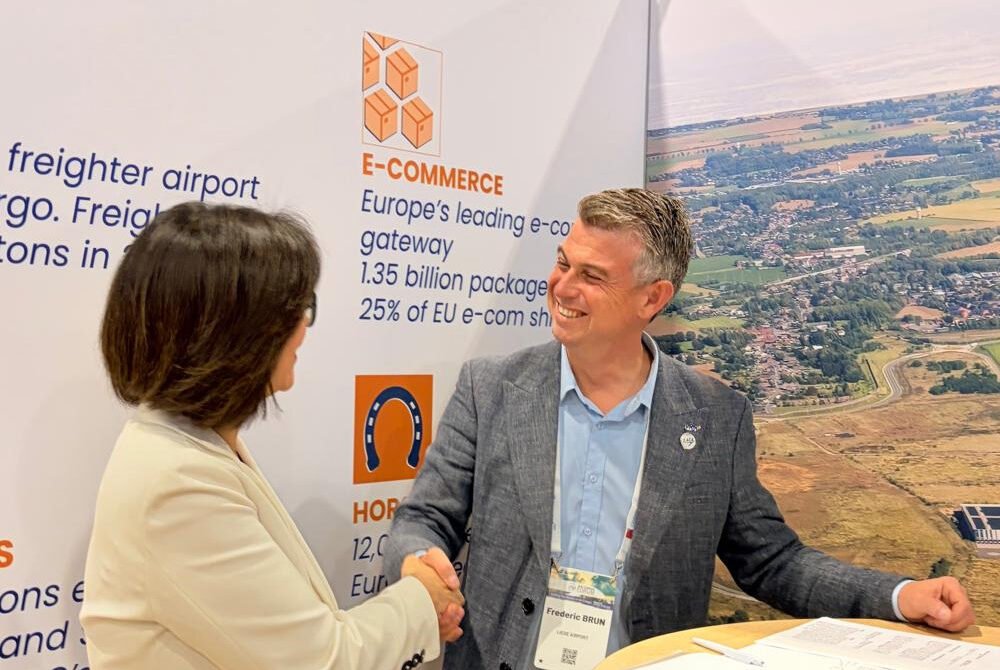
Belgium’s Liege Airport and Brazil’s Viracopos International Airport are teaming up to create new air cargo links between Europe and South America. The two airports are looking to drive greater freighter operations, pool their logistics strengths and open up new avenues for airlines, freight forwarders and shippers working in both markets through a commercial partnership.
The agreement is in the form of a Memorandum of Understanding (MoU) and will be signed at Air Cargo Forum Miami on October 27, 2026. The airports are jointly formalizing their ambition to develop the Liege-Viracopos corridor and strengthen their role as strategic gateways for international freight.
The memorandum will be signed by Frederic Brun, Vise President of Sales & Marketing of Liege Airport and Maria Fan, Chief Commercial Officer of Viracopos International Airport. First, they will seek to identify common commercial opportunities and establish regular communication between the business development teams of the two airports.
The initiative will incorporate market intelligence, coordinated promotional campaigns and joint engagement with potential airline partners. The parties will also look at potential commercial incentives and carry out technical and operational assessments to determine the feasibility of new all-cargo services.
“This partnership combines two airports with a clear commitment to developing cargo business around customer needs. Working with Viracopos allows us to identify opportunities across Europe, Brazil and onward markets, bringing together our networks and specialist handling capabilities. “Our first priority is to build relationships with airlines and forwarders that can support sustainable route development, while providing shippers with efficient connections for pharmaceuticals, technology and other valuable cargo moving between these important trading regions in both directions,” said Brun.
Specialized facilities for freight and complementary networks
Both airports are equipped with dedicated infrastructure for freighter operations, including direct access between aircraft handling areas and cargo warehouses. Their experience with time critical, temperature sensitive shipments provides a solid basis for developing services where handling standards and predictable transit times are important to customers.
Liege already has a well-established network between Asian and European markets, while Viracopos offers access to Brazil and the wider South American region. The partnership will seek to increase direct cargo traffic between Europe and Brazil and possible links for shipments traveling between Asia and Latin America via Liege.
One of the main areas of cooperation will be pharmaceutical logistics. Viracopos says the value of its pharmaceutical imports increased 43 percent in 2026. The Brazilian airport is also constructing a dedicated cold-storage warehouse that will double its capacity to store pharmaceuticals.
Liege meanwhile will bring its experience in pharmaceutical air freight and its established relationships with specialized logistics providers. The combination of these capabilities can help both airports meet the needs of customers transporting sensitive healthcare products between the two continents.
“Viracopos is investing in the facilities and capabilities to support the next stage of Brazilian air cargo growth. Our partnership with Liege provides an opportunity to link that investment with a complementary European gateway. Together, we will engage with airlines, forwarders and shippers, understand their needs and develop practical solutions. “We see particular potential in pharmaceuticals, technology and international e-commerce where reliable handling and connectivity are essential to supporting our customers and their businesses,” said Fan.
New prospects created by technology imports and tax incentives
The other good development opportunity for the Brazilian airport is freight related to technology. Viracopos is responsible for 45% of high-tech airborne imports into Brazil.
The demand for data center infrastructure is being driven by the expansion of digitalization, artificial intelligence and cloud computing. This trend is driving higher demand for imports of server racks and related equipment, opening up business opportunities for airlines and logistics providers that service Brazil’s tech industry.
The Brazilian airport also expects the country’s REData tax regime to spur further investment in the sector. The measure would impose a five-year moratorium on federal taxes for qualifying purchases of data center equipment. It could also potentially encourage more imports, which would increase opportunities for air cargo operators and logistics providers working on technology supply chains.
E-commerce capacity boosts Viracopos’ logistics offering
The airports’ joint commercial strategy will also include international e-commerce. Viracopos has already put into operation an additional dedicated warehouse with an area of 20,000 square meters.
The facility enhances the airport’s X-ray inspection capabilities and offers direct access to the aircraft apron. These upgrades will be complemented by the airport’s logistics center upgrades to support growing international e-commerce volumes.
Also helping to reduce customs bottlenecks is the operational partnership between Viracopos and government agencies. These enhancements, along with Liege’s European cargo network and onward connections, could provide businesses with more efficient distribution solutions into Brazil and other Latin America markets.”
Joint commercial strategy for airlines and cargo owners
The airports plan to create a common list of target customers and share market intelligence to turn the partnership into concrete business opportunities. Regular conference calls and face-to-face meetings will keep their commercial teams in sync as they evaluate potential routes and customer requirements.
They also will coordinate their participation at industry events and share exhibition activities to provide a unified message about the corridor’s capabilities and commercial potential.
Miami was selected for the agreement because the event is a meeting place for business communities from Europe and the Americas. The Air Cargo Forum is a gathering of airlines, airports, freight forwarders and other supply chain stakeholders. Both partners get the chance to present their plans directly to potential customers and commercial partners.
For now, discussions on potential services are being kept under wraps. Neither airport has announced airline commitments or launch dates for new routes.
The immediate challenge is to translate identified market opportunities into commercially feasible operating propositions. This will be done through the creation of handling solutions adjusted to the needs of the customers, strengthening relations with shippers and airlines, and coordinating the commercial development between the two gateways.
The success of the initiative will ultimately depend on the ability to align market demand with the needs of airlines and to prove reliable operations, effective connectivity and sustainable long-term commercial value for all participants in the corridor.