Air Nov 23, 2026
Airbus and Air India explore a pioneering voluntary SAF programme for Indian businesses
The two partners are assessing a corporate sustainable aviation fuel initiative designed to encourage voluntary SAF procurement, support aviation decarbonisation and establish a scalable framework for companies operating in India.
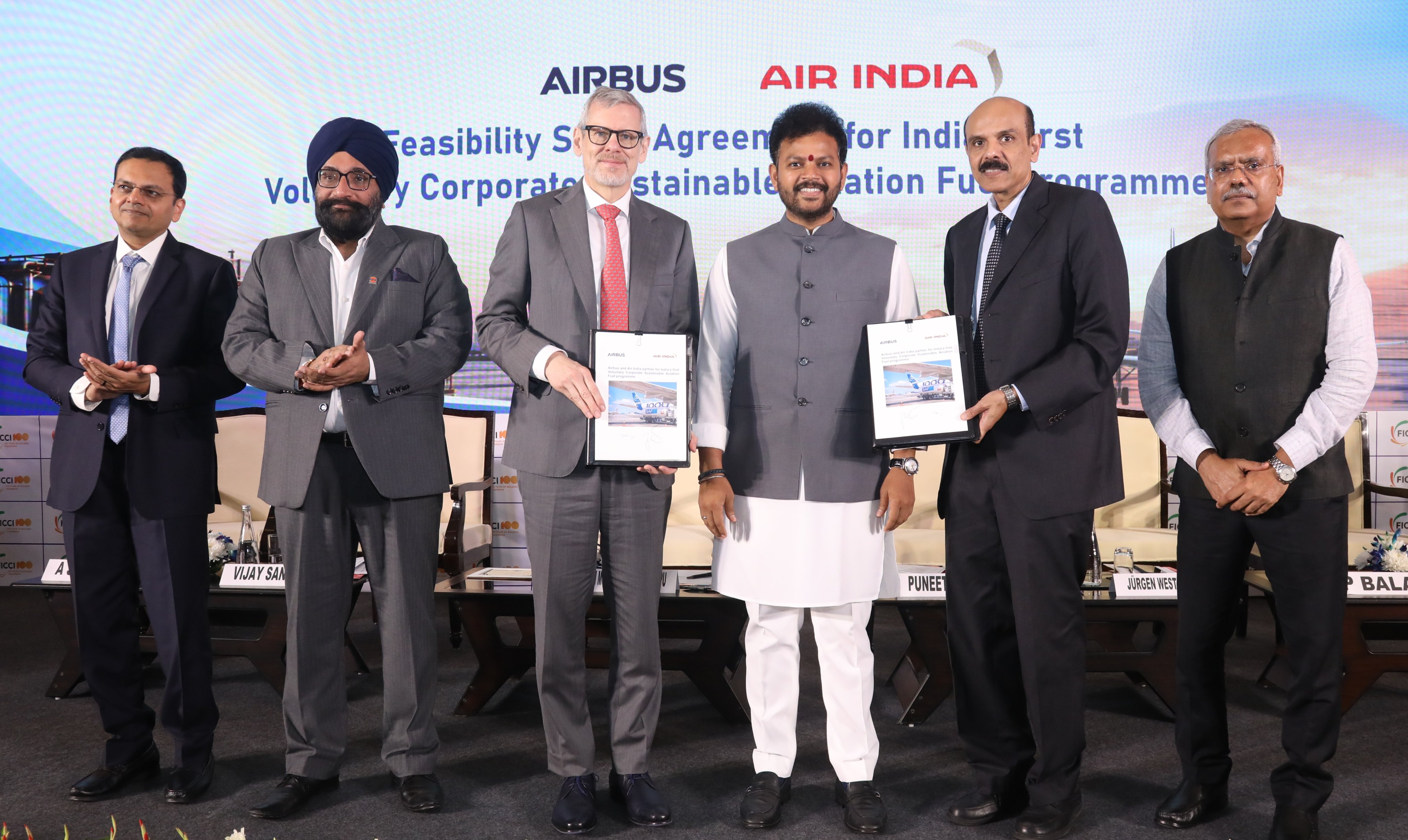
Airbus and Air India have launched a feasibility study into the development of India’s first Voluntary Corporate Sustainable Aviation Fuel (SAF) programme, a programme aiming to encourage companies to get involved directly in cutting carbon emissions from aviation.
The project will establish a structured framework to help organisations in their uptake of sustainable aviation fuel. The initiative aims to stimulate voluntary procurement and accelerate the decarbonisation efforts of the aviation sector by offering a corporate SAF offer to interested companies.
The formal signing of the Feasibility Study Agreement was between P. Balaji, Group Head – Governance, Risk, Compliance & Corporate Affairs, Air India and Jurgen Westermeier, President & Managing Director, Airbus India & South Asia. The signing ceremony was attended by Shri Rammohan Naidu Kinjarapu, Honble Minister of Civil Aviation, Government of India and other dignitaries.
The planned cooperation focuses on the development of a corporate SAF offering, based on the voluntary purchase and use of sustainable aviation fuel on selected routes. Under the model being studied, Air India would be able to sell or transfer the Scope 3 SAF certificates (SAFc) associated with it to eligible customers. If implemented, the programme will be India's first voluntary corporate effort of its kind.
This mechanism would offer participating organisations an opportunity to support the transition to lower-emission air transport, while addressing the environmental contribution associated with their participation.
Tewolde Gebremariam, CEO & MD of Air India, underlined that for the aviation sector to achieve its decarbonisation targets, a collaborative approach across the industry is critical.
“Decarbonisation of aviation is a journey that requires collective action across the ecosystem. This partnership with Airbus is exploring a credible mechanism that enables corporations to support the uptake of SAF and reduce emissions from business travel. “To scale up production and create a sustainable aviation ecosystem in India, it is also important to expand the demand for SAF, and we are happy to help lead that effort,” he said.
“Sustainable aviation fuel is of strategic importance for the environmental transition of the industry,” said Jürgen Westermeier, President and MD, Airbus India & South Asia.
“Sustainable Aviation Fuel is the most realistic opportunity to decarbonise aviation. We at Airbus are privileged to play a catalytic role in galvanising the SAF ecosystem through our global collaboration with regulators, airlines, airports, fuel producers and research bodies. “The partnership with Air India is a key milestone to accelerate SAF adoption in the region. “Decarbonising aviation is a task that requires cooperation across the industry and we welcome other corporates to join the programme,” he said.
A framework based on measurable emission reductions
The feasibility study will also explore how the environmental benefits associated with the use of SAF can be measured and reported. Under the proposed framework, the emissions reductions would be calculated by comparing the lifecycle carbon footprint of sustainable aviation fuel with that of conventional jet fuel using internationally recognised standard methodologies.
These independently verified savings will allow participating companies to track and report their contribution to the aviation sector’s ambition to reach net-zero carbon emissions by 2050, as laid out by the Air Transport Action Group (ATAG), the International Air Transport Association (IATA and the International Civil Aviation Organisation (ICAO).
Airbus and Air India will go beyond the initial partnership and work on a model that can be expanded across various business lines. The aim is to spur wider corporate participation and to facilitate the creation of a strong domestic SAF ecosystem in India.
Part of Airbus’ wider decarbonisation strategy
The move also forms part of a broader, multi-pronged approach by Airbus to cut the environmental impact of aviation. Its strategy is based on a combination of complementary measures, including fleet renewal, developing more fuel-efficient next generation aircraft, operational improvements, increased adoption of SAF and market-based mechanisms.
Together, these actions are aimed at helping the aviation industry achieve its net-zero carbon emissions target by 2050.
In its existing progress in this area, all Airbus aircraft are currently certified to operate with up to 50% blends of sustainable aviation fuel. The partnership with Air India is another push by the manufacturer to advance the use of SAF and involve more corporate stakeholders in aviation’s energy transition.
END OF REPORT