Tech Nov 5, 2026
BattMan: Can the US build a more secure and self-reliant battery supply chain?
The Energy Department’s new Battery Manufacturing Accelerator is designed to address domestic shortages of battery materials and components over the coming years, as US demand for batteries is projected to nearly quadruple by 2035.
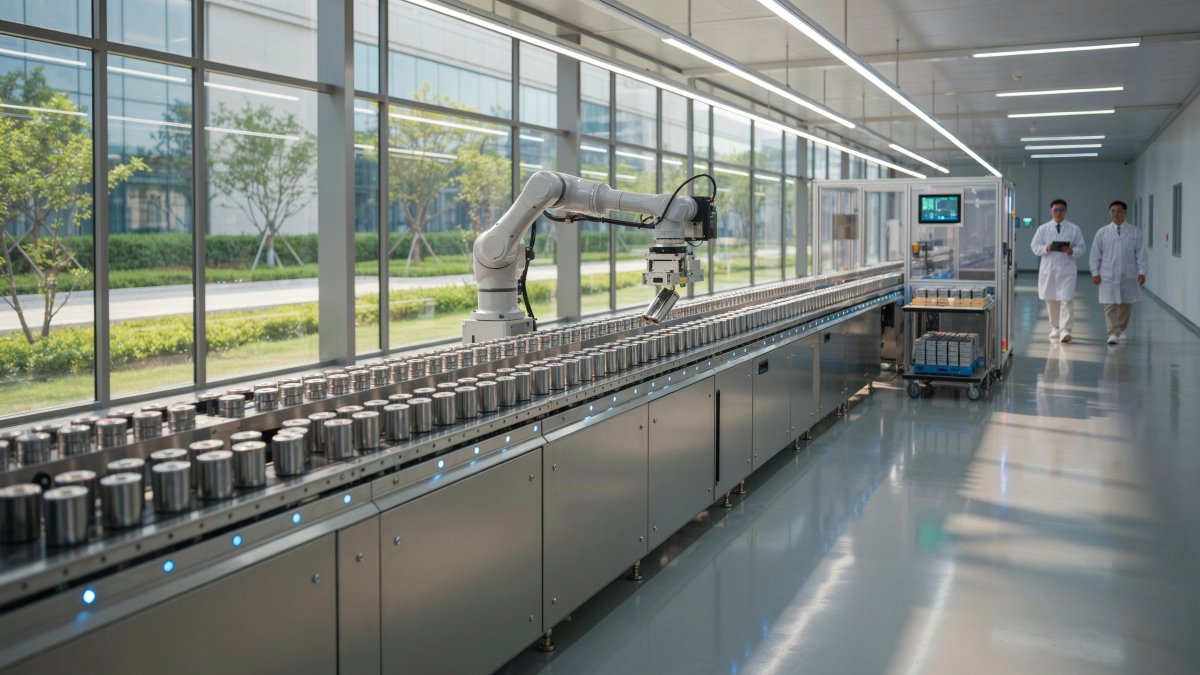
The United States is seeking to strengthen its position in the global battery industry by addressing weaknesses in its domestic manufacturing supply chain. The Department of Energy (DOE) is launching the Battery Manufacturing Accelerator, known as BattMan, a new initiative intended to accelerate the development and deployment of advanced battery technologies while reducing reliance on overseas suppliers.
DOE Assistant Secretary Audrey Robertson outlined the programme in an interview with Utility Dive. According to the department, the initiative will focus on strengthening domestic supply chains for battery materials and components, lowering manufacturing costs and shortening the time needed to bring new technologies to commercial markets. The programme was announced on Wednesday.
The urgency of this effort is reflected in projections for the US market. Battery demand across transportation and electricity grid management applications is expected to rise from 179 GWh in 2025 to 707 GWh in 2035. These figures come from a BloombergNEF analysis published in June and cited by the DOE in a white paper released last month.
Grid requirements and the growth in demand for data centres are also increasing the pressure
The Department of Energy’s white paper, A National Strategy for American Leadership in Batteries, states that establishing a secure domestic battery supply chain that can ramp up production is crucial for the nation’s future economic growth and national security.
Electricity utilities are also placing more importance on battery storage. They help make the grid more reliable and balance electricity use, especially in areas where growing data centre use risks disrupting the flow of power.
The demand for batteries is set to be particularly important from data centres. One forecast, cited in the DOE’s white paper, from research firm Benchmark Mineral Intelligence, estimates they could make up a quarter of all US battery demand by 2030.
But the United States remains heavily reliant on foreign trading partners for materials and components needed to build batteries. China is especially dominant in this market, which the DOE sees as a major source of supply chain risks.
The department also cites a recent imbalance in domestic investment. The United States has increased its manufacturing capacity for battery cells and packs, but investment in the production of precursor components has not kept pace. This has resulted in gaps in the country's supply chain.
“There’s a lot of work that needs to be done to make sure we have the materials and the manufacturing capacity for lithium-ion batteries,” Robertson said in an email.
And she said China dominates 60% to 100% of worldwide production capacity at different critical stages of battery material and component production. Concentration like that is a big vulnerability for American industry and national security, she said.
It’s a particularly strong dependence in Asia’s manufacturing base. The DOE said China and other Asian countries accounted for nearly all of the world’s lithium-ion battery cathode, anode and separator manufacturing capacity in 2024 and nearly 93% of electrolyte manufacturing.
A research consortium funded by a university and a national laboratory
BattMan is supported by the DOE Office of Critical Minerals and Energy Innovation. “This initiative will build on the Trump administration’s efforts to boost domestic sources of battery materials and components,” Robertson said.
The consortium is led by Pacific Northwest National Laboratory (PNNL). Participating national laboratories include Argonne National Laboratory, Oak Ridge National Laboratory and the National Laboratory of the Rockies, formerly the National Renewable Energy Laboratory.
The research partnership also includes five universities: the University of Alabama, Arizona State University, Binghamton University, the University of Michigan–Dearborn and the University of Washington.
The DOE wants to use this network to connect scientific research and industrial development to break down barriers that have kept promising technologies developed in the United States from being produced commercially.
Three objectives define BattMan's industrial strategy
The department has established three strategic priorities for the consortium.
The first is to create a domestic supply chain covering the entire production process, from mining to market, by 2030.
The second involves developing battery technologies that are more affordable, longer-lasting and higher-performing, while reducing their dependence on critical minerals.
The third is to expand the deployment of advanced battery technologies in sectors considered essential to national security.
Robertson said the department is particularly interested in technologies that use more abundant materials available in the United States. The objective is to reduce dependence on foreign supply chains while ensuring that these solutions can be manufactured competitively on American soil.
$500 million allocated to critical minerals, manufacturing and recycling
BattMan also builds on previous federal funding commitments to strengthen the domestic battery industry.
In August, the Department of Energy announced $500 million in funding for seven projects covering critical minerals and materials processing, battery manufacturing and recycling.
Among the selected recipients is a California-based company working to expand its lithium-ion battery anode manufacturing capacity using materials sourced in the United States.
Another company is conducting a pilot project involving battery production based on ultra-thin lithium-metal films and prelithiated materials. Robertson said this technology could make it possible to develop batteries with higher energy capacity and faster charging capabilities.
According to the Pacific Northwest National Laboratory, BattMan will seek to overcome the barriers that have so far prevented promising US-developed energy storage technologies, including innovations of this kind, from reaching commercial scale.
Digital twins and AI tools to reshape battery manufacturing
The consortium's work will extend beyond the development of new materials and technologies. It will also focus on improving the economics, manufacturing processes and validation methods associated with energy storage systems.
PNNL says BattMan will adopt a cost-focused research and development approach, taking performance, manufacturability and scalability into consideration from the earliest stages of development.
Another priority is to broaden technological innovation beyond lithium-ion batteries. The consortium plans to use platform technologies that can be applied across different energy storage chemistries, allowing research to extend to a wider range of battery technologies.
Manufacturing processes will also be targeted for modernisation through the use of digital twins and other artificial intelligence-enabled tools.
Finally, the programme will work on developing reliable, data-driven frameworks to validate emerging energy storage technologies. These frameworks are intended to provide consistent methods for assessing new solutions and supporting their progression towards commercial deployment.
By combining supply chain development, research partnerships, manufacturing innovation and technological validation, BattMan is intended to address several of the structural weaknesses affecting the US battery industry. Its central challenge will be to turn domestic research capabilities and industrial investment into a more complete and competitive manufacturing supply chain.
END OF REPORT