



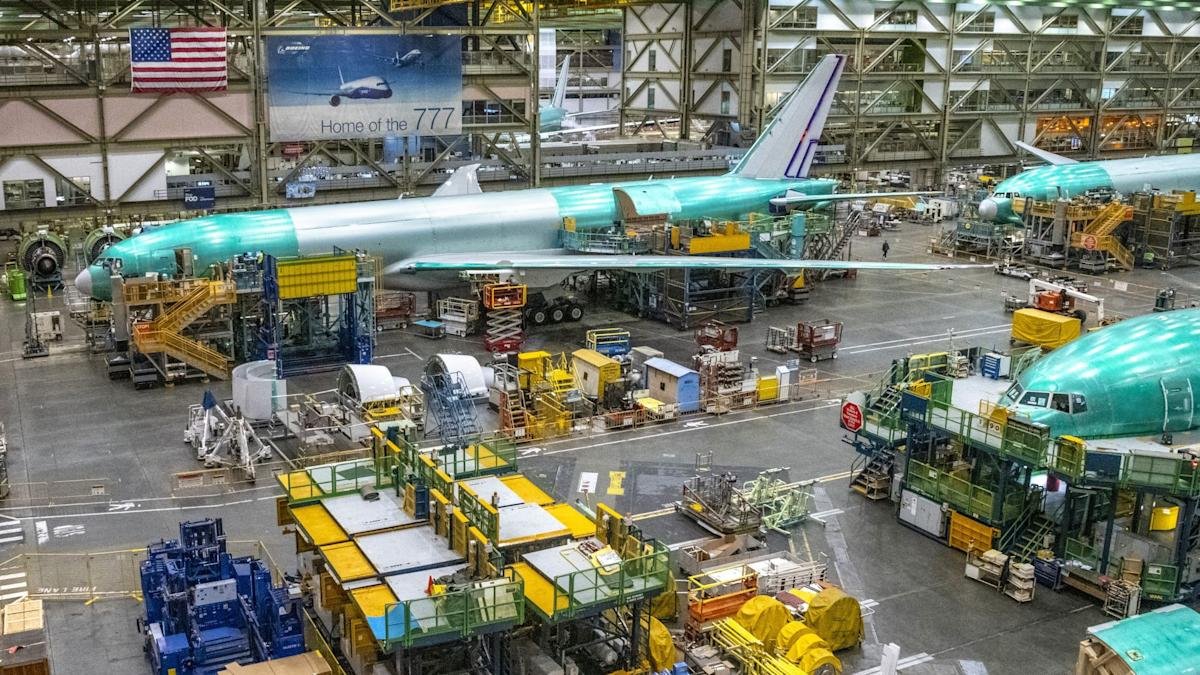
Boeing has reached an important production milestone on its 777-8 freighter programme, with assembly teams joining the aircraft’s mid-fuselage to its composite wings for the first time.
The wing-body join marks one of the most significant stages in aircraft assembly. On the 777-8F, the composite wings span 235 feet, or 72 metres, underlining the scale of the programme as Boeing works toward bringing its next-generation freighter to market.
As the major sections of the first aircraft entered Boeing’s Everett complex in Washington, assembly installer Pedro Landa described the moment as one the team could take pride in. He said the aircraft represents a completely new freighter that customers are eager to receive, and that Boeing employees are equally proud to build.
Alongside the wing-body join, Boeing teams at the 777/777X final assembly facility in Everett have also started installing systems and wiring in the forward and aft fuselage sections.
Jens Biemann, design engineer lead, said the company is building on the success of the legacy 777 Freighter and believes the new model will give customers another strong platform for their cargo businesses.
Boeing began production of the 777-8F in July 2025. The aircraft had originally been expected to enter the market in 2027, but Boeing confirmed in October 2024 that the programme would be delayed until 2028.
Despite the revised timeline, demand remains firm. Since the programme was launched in 2022 with Qatar Airways as the launch customer, the 777-8F has secured 68 orders from airlines and operators around the world.
The development comes as Boeing also seeks a regulatory bridge for its current freighter line-up. In December, Air Cargo News reported that the manufacturer was pursuing an emissions exemption from the US Department of Transportation to continue selling 777 freighters beyond the end of 2027 until the 777-8F becomes available.