Tech Nov 17, 2026
Boston Dynamics Unveils Stretch Gen 2 With Major Upgrades for Automated Trailer Unloading
The second-generation mobile robot features 81% less internal cabling, a redesigned robotic arm, smarter suction technology and faster maintenance, drawing on more than 100,000 operating hours and millions of boxes handled by the original platform.
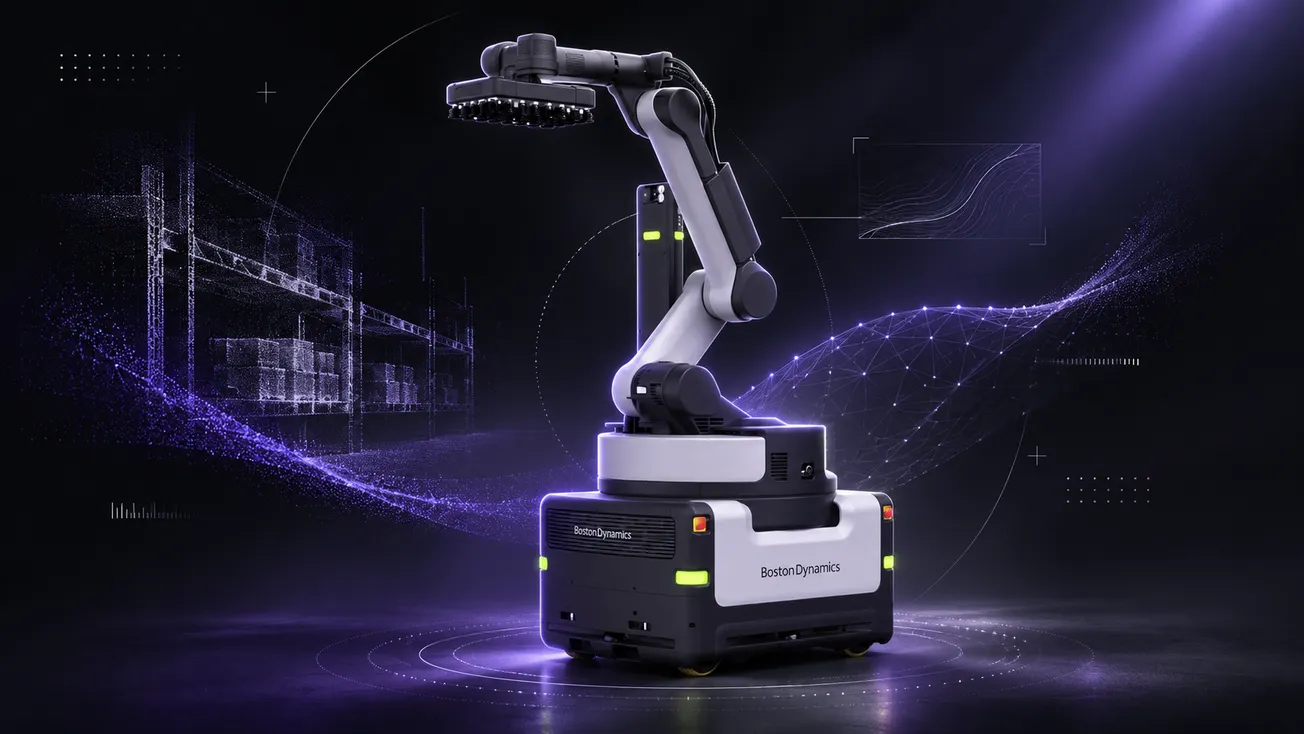
Boston Dynamics has launched a second version of its Stretch robot, a major upgrade to the automated unloading of trailers and shipping containers. Stretch Gen 2, announced on 3 November 2026, retains its original purpose, but also includes significant engineering improvements to increase operational reliability, productivity and ease of maintenance.
One of the most obvious changes is the removal of some 800 meters of internal cabling. Boston Dynamics has cut the robot’s wiring by 81% to increase productivity and reduce maintenance and repair times.
Stretch is an autonomous mobile manipulation system that picks boxes from trailers and containers and places them on a conveyor belt to move the boxes into a warehouse. A robotic arm with a suction-based gripping system is mounted on a wheeled mobile base, enabling it to reach cargo spaces and handle boxes without manual unloading.
Five years of commercial experience with the original and here comes the new generation. In 2021, Boston Dynamics unveiled Stretch, and in January 2022, DHL became its first commercial customer with a 15 million dollar investment (around 13 million euros at the current exchange rate).
On January 31, 2023, the logistics group announced the first deployment of the robot in its warehouses. The partnership then broadened: On 13 May 2025 the two companies signed a memorandum of understanding that opens the door for more than 1,000 additional units worldwide. The deal also opened up the possibility of using technology to pick individual packages for order fulfillment.
The latest redesign is the result of this operational experience. Boston Dynamics says it has looked at tens of millions of boxes handled by Stretch and more than 100,000 hours of operation. It took about two and a half years to develop the second generation. The first model was about getting a working product to customers fast, but Gen 2 is more about simplified engineering, durability, manufacturability and serviceability.
Simplify wiring for reliability
The redesign is focused on reducing the amount of cabling by 81%. The first generation of robots suffered from intermittent electrical faults and wear, mainly due to cables and electrical connections, according to Boston Dynamics. Repeated robotic arm movement leads to continuous cable flexing and potential failure points over time.
The balance of the wiring is now done with reinforced automotive type connectors that have retention systems that survive vibration from uneven warehouse floors and impacts from material handling.
Hyundai has also helped beyond its role as a corporate shareholder, helping Boston Dynamics source better wiring through its automotive supply chain. The South Korean firm could eventually own Boston Dynamics outright. Hyundai said in July 2026 it had agreed to buy SoftBank’s remaining stake, which was still dependent on the relevant regulatory approvals.
A redesigned arm and a more intelligent gripping system
The robotic arm is another major improvement. The joints now feature continuous rotation. That means they can rotate further than 360 degrees without hitting the mechanical end stops that limited rotation in the first generation.
In the past, these physical limits might have put more stress on components. This allows freeing the software of the robot to compute motion trajectories . In particular , there are paths that were not possible before due to the mechanical constraints of the arm .
But the redesigned gripping head is one of the most practical innovations for warehouse and loading-dock operators. Each suction cup is now monitored individually by valves and sensors to determine if they have made good contact with a box. The vacuum is activated only for properly sealed cups . Others remain inactive .
This approach leads to two important operational benefits.
First, it speeds up the unloading process by using a process called multipick, in which the robot can grab multiple boxes at once and place them individually on the conveyor. As a significant part of each operating cycle is spent traveling from the cargo wall to the conveyor and back, processing multiple packages per cycle increases throughput without the need to increase the speed of the arm’s movement.
Second, the selective activation of suction cups saves energy, because the vacuum pump does not waste power sucking air through cups that are not in contact with a package.
Maintenance times cut dramatically
Boston Dynamics has also redesigned the robot to make servicing considerably faster. Replacing an entire swerve drive module, which combines traction and steering functions in the mobile base, previously required a full working day. With the new modular architecture, the operation can now be completed in approximately one hour.
Standardised fasteners further simplify maintenance by reducing the need to switch between different tools. Onboard diagnostic equipment has also been improved, enabling customers' technical teams to carry out a greater number of routine interventions without waiting for external support.
The exterior structure has been adapted using lessons learned from actual loading-dock operations. New, more durable materials have been introduced for the external panels. The emergency stop button has also been lowered and recessed into the body. Its previous position made it more vulnerable to boxes falling from the cargo wall, potentially causing damage or triggering accidental shutdowns.
Longer operating capacity and continuous software improvements
The battery provides enough energy for two working shifts, according to Boston Dynamics. When connected to a fast charger, it can reach 90% charge in approximately 75 minutes.
The robot also includes integrated lighting for working inside poorly illuminated trailers, alongside a pre-trained vision system capable of recognising most types of packaging without requiring specific initial programming.
Its onboard computing architecture has been redesigned as well, providing the processing capacity needed to support the manufacturer's ongoing software updates. These improvements cover box recognition, conveyor and container-wall detection, movement planning, gripping strategies and environmental modelling.
Boston Dynamics releases these updates approximately once a month. Their impact can be significant even for robots already in operation. The latest update, for example, increased unloading speeds across the first-generation fleet by 24%.
Up to 1,000 boxes per hour
Stretch can handle up to 1,000 boxes per hour, although actual performance depends heavily on package weight and how cargo is arranged inside the trailer or container.
The second-generation model is already operating at several customer sites. For facilities that already use the first-generation Stretch, introducing Gen 2 takes approximately two weeks.
DHL initially deployed the technology in North America in 2023 before expanding its use to the United Kingdom and other European markets.
On 9 November 2026, just six days after the new robot's unveiling, DHL announced that its Stretch robots had collectively unloaded more than 10 million packages. The milestone covers the platform's overall deployment within DHL Supply Chain, whose global network operates more than 9,000 robots across different technologies.
The launch of Stretch Gen 2 marks another step in the automation of warehouse loading and unloading, with Boston Dynamics placing particular emphasis on the practical lessons gained from years of industrial deployment rather than simply increasing the robot's handling speed.
END OF REPORT