



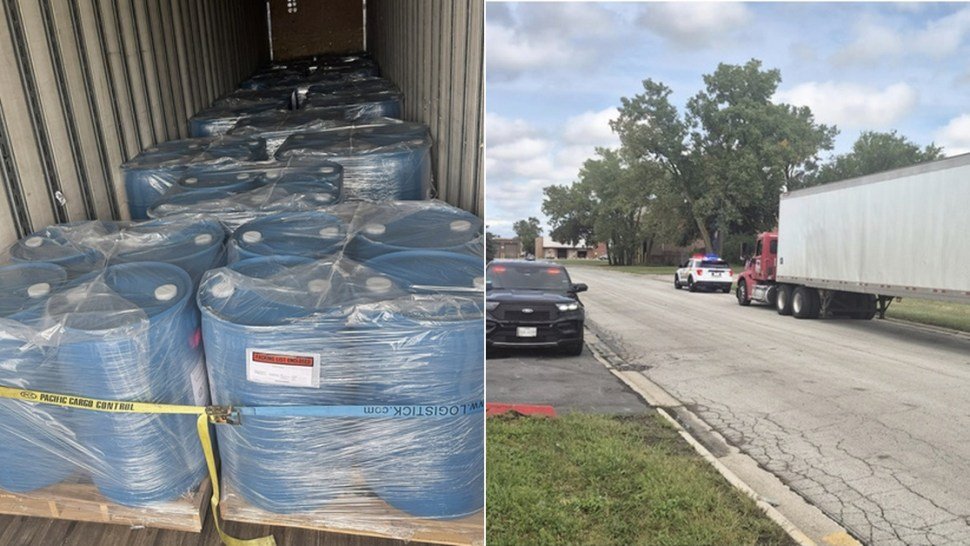
A driver pulled into Thornton, Illinois, with 41,336 pounds of glycerin and paperwork that looked perfectly in order. It wasn’t. According to Cook County investigators, someone had cloned the details of the $60,000 shipment, and the 75 drums on board were heading not to their rightful destination but to a suspected fraudulent cross-docking operation.
The load had started in Hammond, Indiana, and was bound for 16850 Canal Street in Thornton. Authorities say each container held 99.7% USP/FCC-grade glycerin. The alarm was raised when intelligence about the suspected theft reached the Organized Retail Crime and Cargo Theft Task Force. Investigators quickly got hold of the bill of lading and started picking apart the details of the delivery.
Detectives went through the carrier information, the documentation and the intended destination while following the commercial vehicle. That work led them to the tractor-trailer once it entered Thornton, where police made a traffic stop before anyone could unload or distribute the product. The merchandise was secured, its lawful owners were contacted and its return was coordinated. The task force knows this playbook: it previously investigated suspected carrier impersonation in a $586,000 copper shipment case.
A driver caught in a larger scheme
Preliminary findings suggest the driver had no idea the shipment had been stolen, and investigators have found nothing showing he knowingly took part. The inquiry instead centers on fraudulent access to, or manipulation of, a transportation system. The offenders apparently used legitimate details to clone the load and reroute it, a method that made the transaction look genuine while valuable freight was steered somewhere else. Cook County investigators dealt with a comparable fictitious pickup involving $647,000 in Nike products.
Commander Michael Ware, who leads the Cook County Sheriff’s Police Organized Retail Crime and Cargo Theft Task Force, sees the case as a textbook example of increasingly sophisticated strategic cargo theft. Criminals, he explained, now exploit transportation systems rather than simply breaking into trailers, and investigators regularly encounter cloned loads, fraudulent companies and cross-docking locations. “This recovery demonstrates how sophisticated strategic cargo theft has become,” Ware said. He credited timely intelligence and immediate action: “Because our investigators received timely intelligence and acted immediately, we recovered the entire $60,000 shipment.”
75 drums recovered before the handover
Glycerin is a workhorse ingredient across several major industries. Colorless, odorless and of low toxicity, the highly refined substance is used in pharmaceuticals, skincare products, hand sanitizers and food production, which gives it value in a wide range of markets.
Every drum tied to this shipment was recovered. According to Cook County, the interception prevented any unlawful transfer or distribution, and detectives verified ownership before arranging the return of the goods, preserving the complete $60,000 load.
The investigation is far from over. Authorities are still looking into the company linked to the suspected operation, as well as unauthorized system access, cloned documentation and the possible cross-docking site. No suspects have been publicly identified, and Cook County has shared no further details while the case remains active.
Why it matters
Strategic cargo theft can redirect legitimate freight without criminals ever touching a trailer door. Transportation professionals need verification processes able to catch manipulation before a convincing transaction turns into an expensive loss.
A word on prevention
In my view, Certified Fraud Compliance Officer (CFCO) training could help head off schemes like this one. Human-level verification can stop spoofed identities and unauthorized users from reaching sensitive shipment information. Confidence should come from verification, not assumptions.