Air Nov 20, 2026
Cathay Cargo to Become First Airline Connected to Hong Kong’s Port Community System
The agreement will bring air freight into Hong Kong’s multimodal digital platform, with an initial IATA ONE Record data-sharing pilot scheduled for December and full production targeted for 2027.
Cathay Cargo is set to become the first airline to join Hong Kong’s Port Community System (PCS), following a new partnership with the Hong Kong SAR Government and two logistics technology organisations. The initiative marks an important step in extending the city's digital port infrastructure beyond maritime and land transport to include air cargo operations.
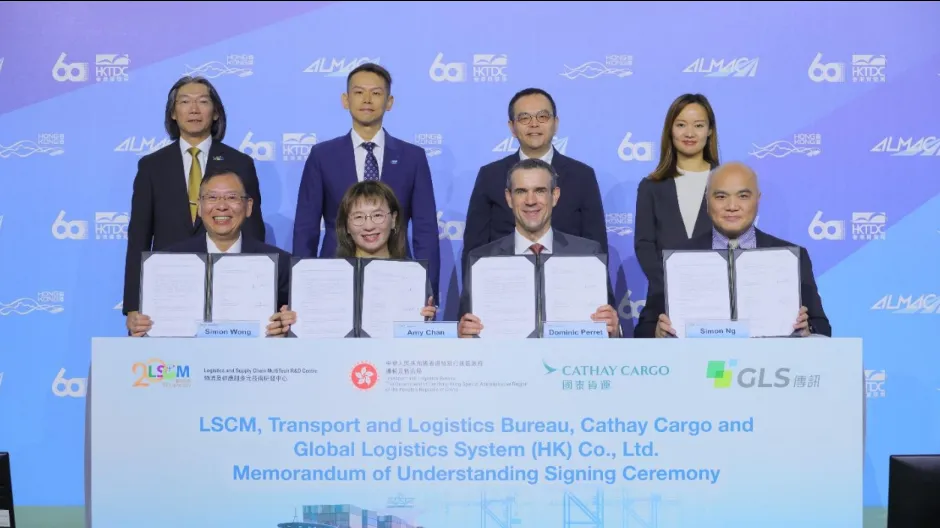
The agreement was formalised through a Memorandum of Understanding (MoU) signed with the Transport and Logistics Bureau (TLB) of the Hong Kong SAR Government, the Logistics and Supply Chain MultiTech R&D Centre (LSCM), and Global Logistic System (HK) Co. Ltd (GLS).
The signing took place on 17 November during the Asian Logistics, Maritime and Aviation Conference, held as part of Hong Kong Maritime Week. Under the arrangement, Cathay Cargo will connect to the PCS, opening the way for closer data integration between the different transport modes operating across Hong Kong.
The MoU was signed by Amy Chan, Deputy Secretary for Transport and Logistics of the Hong Kong SAR Government; Dominic Perret, Cathay Director Cargo; Simon Wong, Chief Executive Officer of LSCM; and Simon Ng, Chief Executive Officer of GLS, an air cargo technology provider.
A central element of the partnership will be the study and implementation of the International Air Transport Association (IATA) ONE Record standard for air cargo. The parties also intend to develop data-sharing services through the PCS for the wider port community and organise pilot trials involving other logistics stakeholders.
Longer term, the objective is to create integrated digital ecosystems for the whole logistics chain. ONE Record is an open global data standard that allows airlines, freight forwarders and other supply chain participants to share shipment information in a common format, yet maintain secure controls over data access.
“The PCS is a flagship digital infrastructure developed under the smart port strategy of the Hong Kong SAR Government,” said Amy Chan. The platform is built to bring together information from maritime, land and air transport, supporting a more connected multimodal logistics environment.
She emphasized the significance of IATA ONE Record in bridging the current gaps between air and land transport data. Chan said the cooperation would help speed up the development of the PCS ecosystem and enhance the efficiency of intermodal transshipment, to further bolster Hong Kong’s role as a leading international maritime center and aviation hub.
The move also gives Cathay Cargo a chance to improve coordination across the city’s transport networks. “The airline is seeking to bring air, sea and land logistics operations in Hong Kong closer together, especially with its place as home carrier at the world’s busiest cargo airport,” Dominic Perret said.
The PCS connection will start with a targeted pilot using an open standard that can be adopted and expanded later by the broader logistics community, he explained. As more partners join the platform, the benefits are expected to grow, making it easier and more efficient for customers to ship through Hong Kong.
LSCM’s Chief Executive Officer Simon Wong also highlighted the significance of the agreement. “This partnership between TLB, Cathay Cargo and GLS is an important step forward for global supply chain visibility,” he said. The initiative will help in the digitalization and development of the logistics ecosystem, he said, moving the industry toward more technological, collaborative and efficient operations.
1. Top priority is shipment visibility
The first implementation phase will focus on delivering key shipment milestones from Cathay Cargo Air Waybills (AWBs) through the PCS for cargo carried on Cathay flights. This will enhance visibility across Hong Kong’s multi-modal logistics network.
GLS will be responsible for the technical integration and implementation of the project, ensuring that the relevant shipment information can be integrated into the platform.
The project timeline provides for technical testing in November, and a targeted pilot in December. Production is expected to be fully operational by 2027.
With the addition of more logistics partners and use cases, the PCS will offer freight forwarders and logistics service providers a more complete and coordinated view of the movements of shipments.
But it should also aid more integrated data exchanges and earlier detection of operational exceptions. This would enable stakeholders to detect possible disruptions earlier and to better coordinate their responses.
Tim Wong, Cathay’s General Manager Cargo Service Delivery, stressed that reliable and connected information is key to delivering a seamless customer experience.
He said linking Cathay Cargo to the PCS would improve tracking of shipments, help identify exceptions earlier and aid better coordination when transport plans change. He also mentioned digitalization as a key enabler to provide more reliable and transparent services as well as enhancing Hong Kong’s international logistics connectivity.
Part of wider ONE Record initiatives
The Hong Kong partnership forms part of Cathay Cargo’s broader digitalization strategy and follows other initiatives to broaden the use of common data standards across the air cargo industry.
Separately, the airline has recently signed a MoU with Civil Aviation Administration of China Information Center and China Unidata. The agreement seeks to develop further ONE Record-compatible data exchanges with Chinese Mainland airports.
In combination, these partnerships illustrate Cathay Cargo’s commitment to promoting mutual, open data standards across the logistics chain. The airline said it will promote a more seamless and transparent exchange of information to strengthen cooperation between industry players and improve the services offered to customers and partners.
These initiatives are part of Cathay Cargo’s broader efforts to promote a more connected and transparent logistics environment.
END OF REPORT