



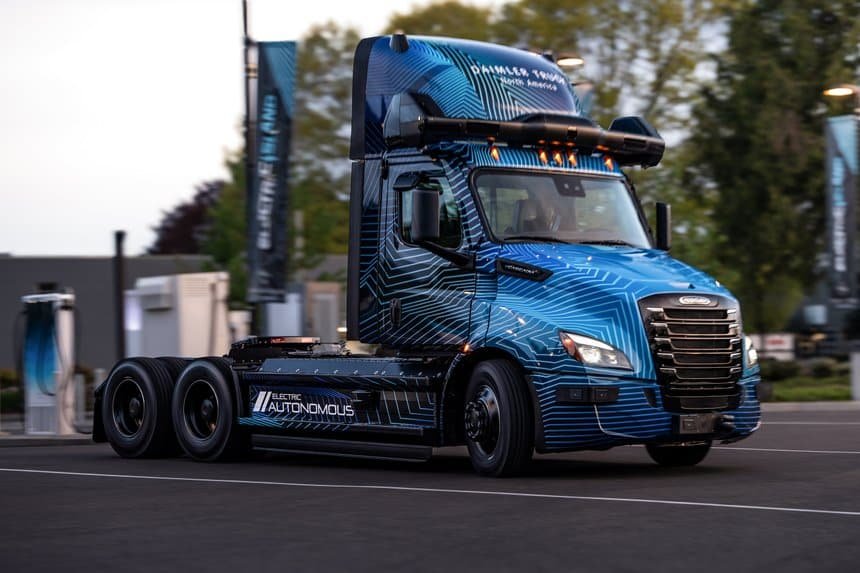
Daimler is integrating autonomous capabilities into its trucks from the ground up
Daimler Truck is gearing up for the next step in autonomous freight transport by installing the necessary hardware into its production Freightliner Cascadia trucks. The maker is installing cars with the underlying systems required for autonomous operation built into the chassis, instead of treating self-driving technology as an aftermarket add-on.
That’s a broader concern for fleet operators thinking of their next equipment purchases: Will today’s trucks still be viable as autonomous technology progresses, or will they need costly retrofits to keep up? Daimler’s strategy is designed to build a base that can evolve with future progress, without requiring customers to commit early to a particular autonomous-driving system.
Daimler emphasized during a recent meeting with the company’s leadership that its Cascadia, which is designed to be autonomous, is already being produced with factory-installed capabilities that are meant to enable driverless operation. “The hardware is intended to be a long-term platform and then you add the software and other technology needed for autonomous driving as needed for operations.”
That difference is significant to fleet managers and financial decision makers. Designing trucks to be able to run autonomously from the start could help minimize the need to replace or do major rebuilds on equipment as driverless freight operations become more common.
Technical Basis Redundant Braking and Steering
Autonomous trucking requires more than just clever software. The vehicle must be able to continue safe control, and to respond to catastrophic component failures in a safe manner, without a human driver ready to take over.
autonomy-ready Daimler’s The Freightliner Cascadia meets this requirement with a redundant chassis architecture with backup capabilities for both braking and steering. These critical systems are designed with redundancy so that if the primary system is unavailable , there is a secondary path to control .
The approach provides the hardware foundation necessary for a computer-based driving system to operate the truck without requiring a human to take over in an emergency.
Eva Scherer, chief financial officer of Daimler Truck Holding AG, said the duplicated platform was one of the key pillars of the company’s competitive position in North America, where Daimler is the market leader.
The factory-built architecture also separates the Cascadia from conventional trucks, which often require significant modifications before they can support autonomous technology. As opposed to converting a standard vehicle and then adding the critical systems retroactively, Daimler is designing the needed prep work into the manufacturing process.
It enables fleets to purchase equipment that is already designed to operate automatically, even if they don’t immediately adopt a driverless system.
An Open Platform Avoids Dependence on One Autonomous Provider
Beyond the hardware itself, Daimler is making a strategic decision about how autonomous technology will be integrated into its trucks. The company is not designing the redundant Cascadia around an exclusive relationship with a single self-driving technology provider.
Daimler is currently working with Torc Robotics, its subsidiary specializing in autonomous driving, and its virtual-driver technology. However, Scherer explained that the underlying chassis is being developed to support virtual drivers from different autonomous companies.
This modular architecture separates the truck’s core systems from the technology responsible for driving it. On top of the redundant chassis, an autonomous-vehicle kit provides the sensors and computing hardware needed for driverless operation. The precise configuration of that kit depends on the requirements of the autonomous-driving provider selected for the vehicle.
The result is a common vehicle platform that can be adapted to different autonomous systems rather than one permanently tied to a single supplier.
That flexibility matters in a sector where the commercial leaders have yet to be definitively established. Autonomous-driving developers are competing to prove their technology, expand their operational capabilities and bring driverless freight services to market.
For a fleet committing substantial capital to new equipment, choosing a truck that depends entirely on one provider could introduce additional risks. If that supplier falls behind, changes its strategy or fails to establish a sustainable business, the fleet could find itself with equipment that is difficult or expensive to adapt.
Daimler’s provider-agnostic approach is intended to reduce that exposure. By preserving the option to integrate different virtual-driver technologies, the manufacturer can help protect the value of the chassis while giving customers greater freedom to respond to changes in the autonomous-trucking market.
The principle is straightforward: the truck’s fundamental hardware investment does not have to depend entirely on which autonomous software company ultimately succeeds.
From Factory Readiness to Commercial Deployment Around 2028
Daimler’s autonomy strategy is not limited to preparing vehicles for a distant technological shift. Company leadership has outlined a development path that moves from initial driverless operations toward broader commercial deployment.
The manufacturer expects to remove the driver from a first route by the end of 2026, then progressively increase the mileage covered by its autonomous trucks. The longer-term objective is to move toward commercialization at scale around 2028.
Deployment is expected to begin on defined routes, with the network expanding gradually as the technology develops. Safety will remain the central condition governing each stage of that progression.
The pace of development is also being influenced by changes in how autonomous trucks learn to operate. Scherer described a transition away from older imitation-based training methods toward reinforcement learning, an approach that can help autonomous systems develop the ability to handle routes they have not previously encountered.
This shift could reduce the extent to which autonomous trucks depend on painstaking preparation for every individual route. If the technology can generalize more effectively to unfamiliar roads and operating conditions, geographic expansion could become faster.
Scherer expects progress over the next couple of years to be rapid. That outlook gives the autonomy-ready Cascadias currently leaving the factory a more immediate potential role in commercial operations, rather than positioning them solely as equipment intended for a much more distant future.
Nevertheless, the planned milestones remain dependent on technological progress, operational readiness and the safety requirements governing driverless freight transport.
New Business Model for the Truck and its Virtual Driver
Daimler’s approach to modular engineering also has implications for financing and pricing autonomous trucking services.
Rather than bundling the vehicle and the autonomous-driving feature into one package, the company is considering a model that treats them as separate parts of the whole package.
In this approach a fleet would purchase or finance the truck and its chassis with conventional equipment financing. Then, the autonomous-driving capability would be offered separately, with the virtual driver available as a software-as-a-service model that would be billed on a per-mile basis.
This structure is a reflection of the separation built into the vehicle itself. The truck is still a capital asset, but the autonomous system is an ongoing service that has a cost based on how far the vehicle drives.
For operators, this could help separate the economics of autonomous operations from the initial equipment purchase. It could also help fleets determine when certain routes and operating conditions make sense for the technology by being able to calculate the cost of the truck separate from the ongoing cost of a virtual driver.
Daimler said it was still working on the commercial model. The company is ready to provide financing solutions based on the likely structure of the offering, and its approach is developing in line with the market.
Consequently, final arrangements will be determined by the evolution of autonomous freight services and customer take-up. But the principle behind this is already clear: the investment in the car, and the decision to turn on autonomous-driving services, don’t have to be treated as one single, irreversible commitment.
Flexibility Could Protect Fleet Investments
Daimler’s strategy comprises three closely intertwined elements: autonomous capability from the factory, redundant braking and steering systems and a modular architecture that is open to many autonomous driving providers.
The combination allows fleet operators to get ready for autonomous trucking without having to lock in a definitive software partner until the market has matured. The chassis provides the technical base, and the autonomous-driving kit and virtual-driver software are adaptable to the provider and operating model ultimately chosen.
This approach also more clearly separates equipment procurement from technology adoption. Fleets are now able to choose when to replace trucks and how to finance them, while keeping the door open to adding autonomous services when the technology, routes and business case are right.
That flexibility could prove an important consideration for operators as the sector develops, as they balance long-term capital expenditure with uncertainty over which autonomous-driving platforms will win out.
By building autonomy into the Freightliner Cascadia at the factory and not relying on just one software provider, Daimler is positioning its trucks as adaptable platforms instead of fixed products. The plan envisions initial driverless operations by the end of 2026 and larger-scale commercialization around 2028, and aims to bridge today’s equipment investments with the next stage of autonomous freight transport.