Air Nov 12, 2026
Etihad Cargo transports UAE space mission probe to the United States ahead of 2028 launch
The specialised shipment from Abu Dhabi to Colorado marks a major milestone for the Emirates Mission to the Asteroid Belt, as the probe prepares for final integration with the MBR Explorer spacecraft ahead of its planned launch from Japan.
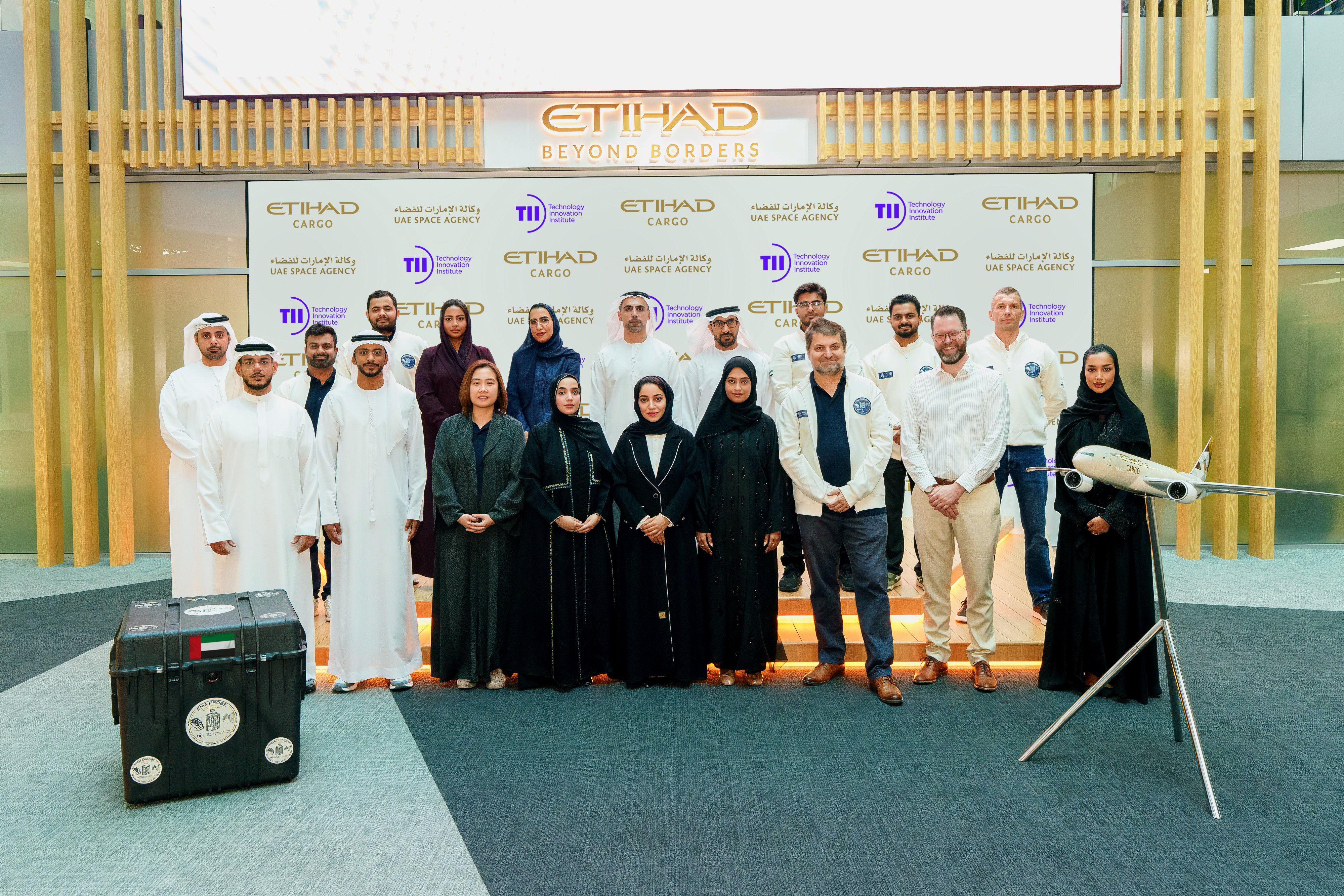
Etihad Cargo has completed the transportation of a space exploration probe developed for the United Arab Emirates’ Emirates Mission to the Asteroid Belt (EMA), delivering the specialised equipment from Abu Dhabi to the United States as preparations advance for the mission’s next phase.
The cargo division of Etihad Airways coordinated the shipment to Colorado, supporting the transfer of the probe following the successful completion of its design, development, assembly and testing in the UAE. Its arrival in the United States represents an important transition towards final integration with the MBR Explorer spacecraft, ahead of the mission’s scheduled launch in the first quarter of 2028.
The probe was developed by the Technology Innovation Institute (TII), through its Propulsion and Space Research Centre. As part of the mission, it will image two planets and seven asteroids, conducting flybys of six asteroids in the main belt before reaching its final destination, 269 Justitia. The mission aims to achieve a rendezvous with and landing on the seventh asteroid. If successful, Justitia will become only the seventh asteroid in history to be reached on its surface by a probe.
According to Dr. Najwa Aaraj, Chief Executive Officer of TII, the MBR Explorer spacecraft is expected to cover approximately five billion kilometres over an eight-year journey. Its trajectory will include gravity-assist manoeuvres around Venus, Earth and Mars, alongside close encounters with six asteroids before reaching 269 Justitia.
The spacecraft is scheduled to depart from Japan in March 2028, within a narrow three-week launch window determined by interplanetary conditions. Since MBR Explorer cannot safely approach within a few kilometres of the asteroid's surface, the dedicated probe will separate from the spacecraft, make contact with the surface and provide the mission's closest observations.
The Emirates Mission to the Asteroid Belt is led by the UAE Space Agency, which finances the programme and oversees its implementation in cooperation with national and international partners.
Eng. Mohsen Al Awadhi, Mission Director of EMA, described the probe's transfer from Abu Dhabi to the Laboratory for Atmospheric and Space Physics (LASP) at the University of Colorado as a significant step in the programme. The move signals the transition from development, assembly and testing in the UAE to final integration with MBR Explorer and verification of the combined systems ahead of launch.
He also highlighted the achievement of developing the probe and bringing it to flight readiness in less than two years, attributing this progress to the technical expertise of the mission team and close cooperation between national institutions and specialised partners. Coordination with Etihad Cargo was an integral part of these preparations.
The transportation operation followed eight months of coordination among the parties involved. Etihad Cargo moved the probe from Abu Dhabi to Chicago on 2 November 2026, as a specialised shipment, before it reached Colorado safely on 5 November. Engineers, researchers, flight specialists and representatives of Etihad, the UAE Space Agency and TII attended the preparations for its departure in Abu Dhabi.
Backstopping the next phase of the mission.
“The mission reflects the ambition of the UAE to drive scientific research, technology and innovation,” Stanislas Brun, Chief Cargo Officer at Etihad Airways, said. He highlighted the role Etihad Cargo played in the safe and reliable transportation of highly specialized equipment internationally, and said the airline was proud to support a project that showed the country’s growing prowess in advanced technology and space exploration.
The mission’s ultimate destination is 269 Justitia, which the probe will reach after traveling about five billion kilometers and visiting seven asteroids. Finally the probe will separate from MBR Explorer and will continue on its own toward the asteroid, taking detailed pictures to allow scientists learn more about the physical properties of the asteroid.
"The completion of the design, construction, assembly and testing of the probe in the UAE was a major achievement for the development team," said Dr Anton Ivanov, Principal Investigator and Executive Director of TII’s Propulsion and Space Research Center.
With the equipment in Colorado, engineering activities will focus on integrating it with MBR Explorer and testing that the spacecraft hardware, software and communication systems operate as intended.
EMA is the UAE’s second interplanetary mission and the first where the spacecraft component has been designed, engineered, assembled and tested entirely in the country.
The program is also part of a wider national strategy to boost the UAE’s position in the international space industry. The Supreme Space Council approved a AED 1 billion International Space Cooperation Program in May 2026. The initiative aims to forge stronger links between UAE research institutions with their international counterparts, support the localization of advanced space technologies and develop Emirati talent, in line with the National Space Strategy 2031.
Preparing to meet 269 Justitia
MBR Explorer is expected to spend roughly seven months in orbit around the asteroid once it reaches Justitia, the destination for the spacecraft. It will first operate at an altitude of 250 kilometers before gradually descending through a series of lower orbits.
The probe is set to be deployed on a low-altitude pass in early 2036. It will then descend toward the surface of the asteroid, landing and constantly taking images and sending the data to the MBR Explorer, which will remain in orbit above it.
These observations should provide scientists with information about material beneath the surface layer of the asteroid, and insights that cannot be obtained from orbital observations alone.
“The real engineering challenge is not just to get to Justitia,” says Dr. Elias Tsoutsanis, chief researcher at TII’s Propulsion and Space Research Center. The probe has to survive the eight-year journey and perform correctly in the final encounter.
Thus its hardware, thermal engineering and onboard software have been designed and tested to survive the rigors of the extended journey and critical operations required at the surface of the asteroid.
The probe’s arrival in Colorado marks a major milestone for the UAE program. The Emirates Mission to the Asteroid Belt is on track for its scheduled launch in 2028, and the focus now is on spacecraft integration and system verification.
END OF REPORT