





For years, the freight industry’s technology investments have largely favored its biggest players. Major carriers and large brokerage firms have been able to deploy sophisticated transportation management systems (TMS), supported by dedicated engineering teams and extensive software integrations. Smaller logistics businesses, however, have often been left working with aging platforms, sometimes more than a decade old, or paying enterprise-level prices for tools that do not reflect the realities of their operations.
That divide is the problem Evolutionary Operating System, Inc. (Evos) aims to address. The autonomous AI operations company launched publicly on October 14, positioning its technology as an alternative for small and medium-sized logistics businesses that have struggled to benefit from the same level of technological investment as larger competitors.
According to founder and CEO Urav Shah, decades of software development have largely overlooked this segment of the market. As a result, many smaller operators are still relying on systems that can manage routine processes but struggle to accommodate the individual decisions and exceptions that shape everyday freight operations.
These limitations become particularly apparent when a situation falls outside a predefined workflow. Someone on the operations team must recognize the issue, determine the appropriate response and complete the work manually. For businesses with limited staff, that dependency creates a capacity problem that becomes more pressing as experienced dispatchers, fleet managers and other seasoned professionals leave the workforce.
“There’s been twenty to thirty years of big tech ignoring the small and mid-market,” Shah said. “That’s created a real capacity gap. Evos is the only company that does the work instead of just showing you the work.”
From AI assistants to executing operations
Evos is designed to do more than just flag an exception or suggest a course of action. Its platform learns about the way a particular logistics company operates, what sorts of unusual situations its employees face, and then uses that knowledge to do the work for them.
And this difference sets the company apart from the AI copilots and assistants that are being added to bigger TMS platforms more and more. These tools can find problems, give status updates or offer recommendations but usually a person still has to look at what they put out and do something about it. They also are less effective in confronting the exceptions that make up a substantial portion of the daily work at smaller logistics businesses.
Evos, in contrast, is an execution layer on top of a company’s existing tech. Its autonomous operators are able to handle entire operational functions, such as dispatch, track-and-trace and billing, instead of relying on employees to manage each individual task.
The challenge, Shah said, is not just in creating software that can move. It’s training the software to make decisions in a way that mirrors the practices of a particular company.
No two logistics operations will approach the same situation in the same way. The reason that calls that appear to be simple to make are usually based on customer priorities, availability of vehicles, timeframes for delivery and a variety of other factors that you would not normally see in an operating procedure.
While onboarding, Evos attempts to discover these decision making patterns by asking questions about particular operational choices. Why was that load given to one truck and not to another available truck? It could be that the customer gets priority service. Why wasn’t a newer truck chosen instead? It may already be committed to a spot load with a tighter deadline.
These explanations can be repeated across the many decisions a dispatcher makes . This provides the configuration information needed to reproduce the company ‘s own operational judgment, rather than to impose a generic workflow on every customer .
Customer-specific AI designed to protect operational knowledge
Evos has also made a deliberate architectural choice in how it develops its technology. Rather than relying on large language models, or LLMs, the company uses what it calls large action models. These systems learn from decision-making patterns and operational behavior instead of primarily learning from text.
Each customer receives an individual model trained exclusively on that company’s historical data. There is no shared central model pooling information from different customers, and reinforcement learning takes place using anonymized behavioral patterns specific to the individual operation.
This approach responds to a concern Shah says he regularly encounters among smaller logistics providers: the risk of disclosing proprietary knowledge to an external AI platform.
Keeping each model separate is intended to ensure that a company’s internal practices remain its own. Operational knowledge is not mixed with the behavior of other businesses, while the separation also helps address concerns about intellectual property infringement.
The company’s model architecture is also intended to give it greater control over operating costs. Shah contrasts Evos with many automation tools that rely on large, advanced AI models supplied by major AI laboratories. The costs of those products can fluctuate with the prices charged by their underlying providers.
Because Evos develops, trains and operates its own models rather than routing requests through frontier models, Shah argues that its cost structure remains fixed rather than being directly exposed to those pricing changes. He expects this distinction to become increasingly important as AI providers adjust prices to better reflect their actual computing expenses.
Preserving the experience of retiring dispatchers
The ability to capture operational judgment is particularly relevant as logistics companies confront an aging workforce and difficulties replacing experienced employees.
When a veteran dispatcher or fleet manager retires, years of practical knowledge can leave with them. Some of that experience may involve knowing when to escalate an issue, which workaround to use when a standard process fails, or how to weigh competing priorities under tight deadlines. Often, these decisions have never been formally documented, making them difficult for a new employee to learn.
Evos aims to capture that accumulated expertise before it disappears from the business. By learning from the decisions and behavior of existing teams, its autonomous operators are intended to preserve institutional knowledge while increasing the amount of work those teams can handle.
Implementation speed is another part of the company’s proposition. Traditional enterprise software deployments can take months, a timeline that may be impractical for smaller operators seeking immediate relief from capacity constraints.
Evos says a new autonomous operator can be operational in less than 24 hours after the initial conversation, without requiring the customer to migrate existing data. The company attributes that timeline to a library of more than 150 prebuilt integrations with commonly used freight systems.
Human oversight remains part of the learning process
Evos introduces automation gradually rather than expecting customers to hand over complete control immediately.
Initially, an autonomous operator takes responsibility for a portion of a workflow while sending judgment calls to a human for approval, rejection or revision. Those corrections then inform the system’s subsequent decisions, allowing it to adapt to the company’s preferences over time.
Shah offered the example of choosing a truck for a load with a demanding deadline. If an employee instructs the system to avoid an older vehicle because it requires more frequent fuel stops, the operator can learn to account for that consideration when evaluating future assignments. The same trade-off would not need to be explained repeatedly.
One application under development illustrates how the approach could help smaller carriers make better use of available capacity. The planned operator would examine scheduled routes to identify potential backhaul opportunities, such as a truck traveling from Chicago to New York without a load booked for the return journey.
The system would identify matching loads and present them to a dispatcher for confirmation. Today, Shah said, carriers often search for such opportunities manually, sometimes assembling return loads at the last minute. In other cases, the available capacity may go unused because a suitable backhaul is never identified.
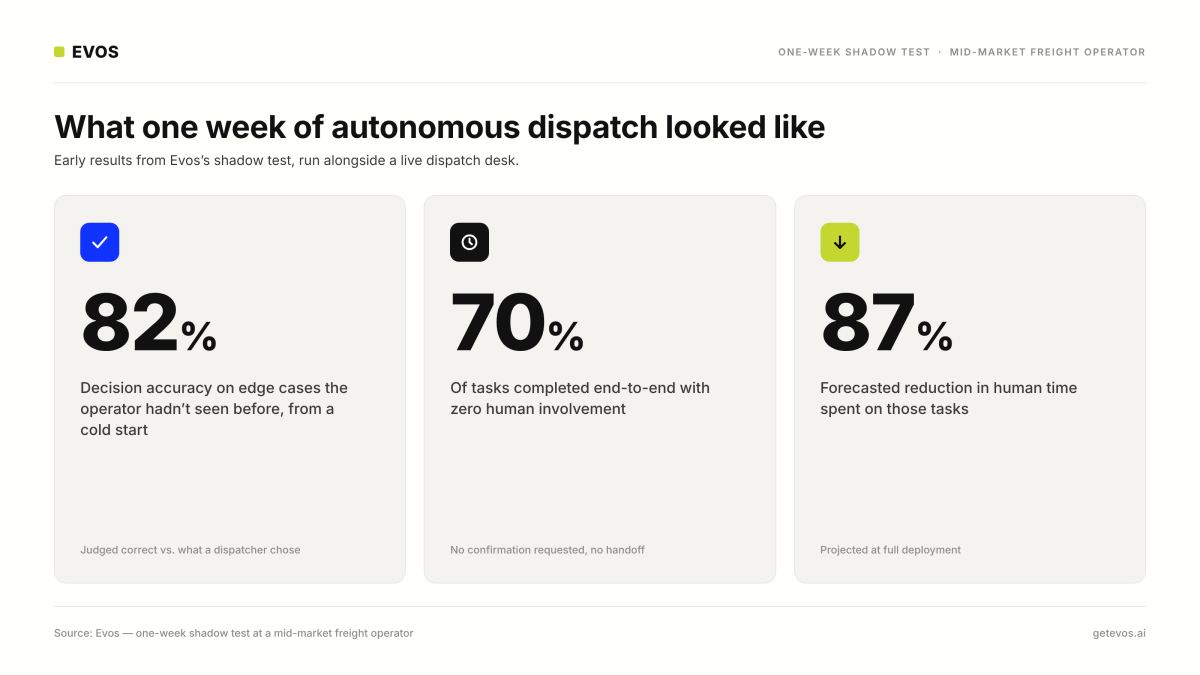
The broader idea is to change how employees interact with automation. Many AI tools still depend on repeated prompts: someone must ask a question, evaluate the response and decide what to do next. An Evos operator, by contrast, receives an assigned function rather than an individual prompt. The objective is for logistics teams to manage the results of the work instead of directing every input.
MyFreightWorld reports 97% accuracy in invoice audits
Evos points to its work with freight brokerage MyFreightWorld as an example of how autonomous operators can be applied to an existing operational process.
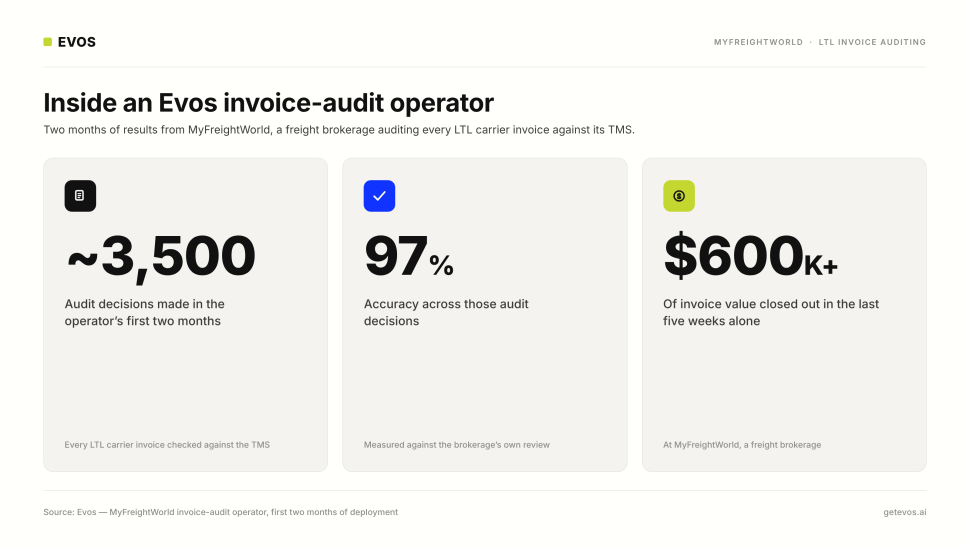
The brokerage uses an Evos operator to audit every less-than-truckload (LTL) carrier invoice against its transportation management system. During its first two months, the operator made nearly 3,500 audit decisions with 97% accuracy. Over the five weeks preceding the company’s report, it also closed out more than $600,000 in invoice value.
Mike Chalfant, president of MyFreightWorld, said the implementation had changed the company’s billing process without requiring an upfront investment and was deployed within days and weeks rather than through a lengthy rollout.
“Evos has helped us revolutionize our billing process with zero upfront investment, and also at an impressively fast speed measured in days and weeks,” Chalfant said.
He added that the technology had improved accuracy and substantially increased efficiency, contributing to a better customer experience. The operator’s performance has also given the brokerage confidence to expand its capabilities, explore additional applications and continue developing its partnership with Evos.
Chalfant described adding the technology to the company’s software stack as a positive development, with further growth planned for the collaboration.
A different automation model for smaller logistics businesses
For Shah, the MyFreightWorld results reinforce a wider argument about the technology gap across the freight industry. In his view, the imbalance reflects years of investment focused on the needs of large enterprises, leaving smaller businesses without tools tailored to their operating conditions.
“We’re the only company that does the work instead of just showing you the work,” Shah said.
While the largest carriers continue to invest heavily in automation, Evos is targeting the small and medium-sized operators that need a solution adapted to their own workflows and decision-making processes.
Its autonomous operators are intended to address two connected challenges: limited operational capacity and the potential loss of institutional knowledge as experienced employees retire. By learning how each business works and executing tasks within its existing systems, the company aims to help logistics providers expand what their current teams can accomplish without depending entirely on additional hiring or extensive software replacements.