Tech Nov 6, 2026
Humble Robotics secures $51M to bring its cabless electric haulers into pilot operations
The Series A, led by Obvious Ventures with backing from existing investors Eclipse and Energy Impact Partners, brings the startup’s total funding to $75 million as it prepares to test its driverless Hauler on port and warehouse routes.
Humble Robotics has raised $51 million in a Series A round to advance the development and deployment of its cabless, electric Humble Hauler. The funding will support customer pilot programmes focused on port drayage and warehouse transport, marking a new stage for the San Francisco-based startup’s autonomous freight strategy.
Obvious Ventures led the investment, joined by existing backers Eclipse and Energy Impact Partners. The latest round takes Humble’s total funding to $75 million, roughly six months after the company emerged from stealth with a $24 million seed investment and unveiled its driverless truck, designed without a conventional cab.
Founded by Eyal Cohen, Humble is pursuing a different approach to autonomous trucking. Rather than initially targeting long-distance highway operations, the company is concentrating on shorter, more predictable freight movements, including port-to-warehouse transfers and shuttles between industrial facilities. Cohen believes these environments offer more manageable conditions for introducing electric, driverless vehicles.
According to the company, the new capital will finance customer pilots, testing and validation, initial manufacturing activities, and the expansion of its vehicle range around a modular platform. Humble previously told FreightWaves Today in September that it intended to sell its haulers to third-party operators.
The company is focusing on regional routes of fewer than 250 miles. These journeys represent a substantial share of domestic freight activity: according to a US Department of Energy analysis based on 2021 federal data, 87% of the country's truck freight tonnage travelled less than 250 miles that year. Trucks transported nearly 12 billion tons of domestic freight in total, while shipments covering fewer than 100 miles alone accounted for 44%.
Humble says it is now working alongside customers, industry partners and regulators to prepare the technology for commercial operations.
“We’ve spent years proving that a truck can drive itself. The harder question is how to make autonomy something a freight operator can depend on every day,” Cohen said in the company's announcement.
Shorter routes offer a more practical starting point
Humble’s focus on regional freight reflects Cohen’s experience developing autonomous trucking technology. In his earlier work on long-haul operations, he concentrated on routes such as Dallas–Houston and Dallas–El Paso in Texas. However, he subsequently identified an opportunity in short-distance freight, a sizeable segment of the market that had attracted comparatively little attention from autonomous vehicle developers.
The choice is also closely linked to the economics of electrification. Short-haul applications generally require less battery capacity and less extensive charging infrastructure than long-distance trucking.
“Short moves are served very well by electrification. Long haul is tougher in electrification, right? You are trying to figure out a massive battery and a massive charging system,” Cohen said during an August interview with FreightWaves.
Humble's website identifies four intended applications for the Hauler: port drayage, movements between plants and warehouses, transfers within rail yards, and short-distance trips connecting a carrier's own terminals. The vehicle is listed with a maximum range of 200 miles and a top speed of 55 mph.
Operating within a limited geographical area could also make autonomous deployment easier to manage when technical or operational issues arise. A vehicle travelling a short, familiar route can remain closer to a depot and to the engineering teams responsible for its operation.
Cohen has pointed out that sending a large autonomous vehicle over a distance of 1,000 miles leaves little room for error, particularly when safety is involved. Shorter routes, by contrast, offer a more controlled operating environment, with nearby facilities and technical support available when needed.
Removing the cab changes the design of the freight vehicle
Humble’s Hauler also differs from conventional autonomous trucks in the way it handles freight. Traditional drayage operations generally rely on a day-cab tractor pulling a container mounted on a chassis. Many autonomous trucking systems focus on automating the tractor, leaving the connection between the tractor and trailer as a separate technical challenge.
That configuration also creates limitations for onboard perception systems, since sensors mounted on the tractor cannot provide an unobstructed view of everything behind the trailer.
Cohen considers automated trailer coupling a particularly difficult problem. Developers have explored robotic arms and other mechanical systems to connect tractors and trailers without human intervention, but he believes the process remains complex.
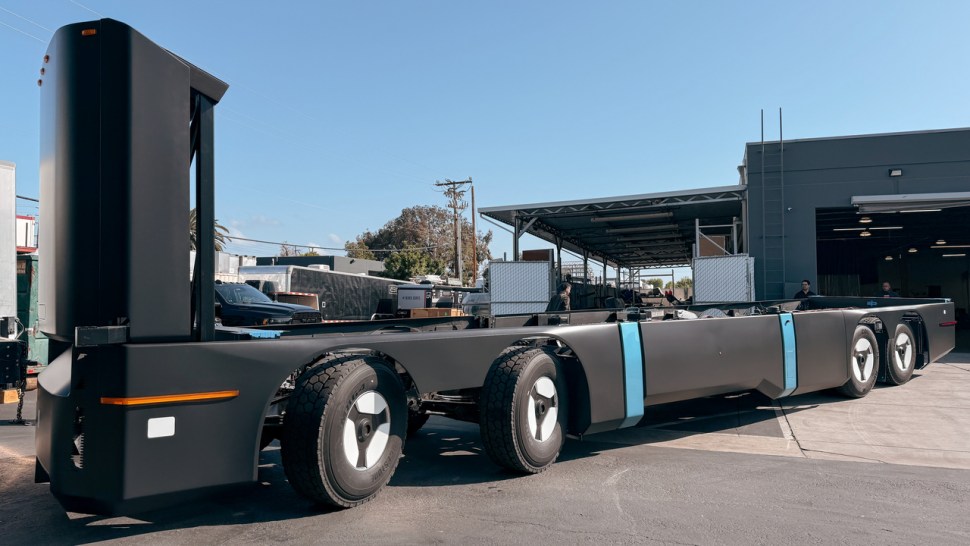
Humble has taken another route by integrating the vehicle and its freight-carrying structure into a single, flat platform resembling a skateboard chassis. Instead of a conventional cab and separate trailer connection, the container is placed directly onto the platform.
The standard configuration is designed to accommodate both 40-foot international containers and 53-foot domestic containers. According to the company's website, camera, lidar and radar equipment is installed in sensor pods to provide 360-degree visibility around the vehicle.
The underlying concept emerged from a broader design question Cohen posed: what would a freight vehicle look like if autonomous driving technology worked perfectly?
He described the ideal solution as a simple platform onto which a container could be placed, rather than a conventional tractor that would need to be coupled to a separate trailer.
Removing the cab and adopting this integrated structure also reduces vehicle weight. Humble advertises the Hauler as 20% lighter than a traditional tractor-and-trailer combination. That reduction is central to the company's commercial proposition, as it could allow more cargo to be transported during each movement.
Cohen says the objective is to use the available weight capacity more efficiently, increasing the amount carried per trip while lowering the cost per mile.
Existing investors back the move towards commercial testing
The Series A also sees Eclipse return as an investor after leading Humble's initial seed financing. The firm views the company's approach as part of a wider transformation of freight transport, in which both vehicle architecture and the software controlling operations need to be reconsidered.
“Modernizing freight requires rethinking the entire system, from the vehicle itself to the intelligence that powers it,” said Jiten Behl, a partner at Eclipse.
Humble is entering a market where other autonomous freight operators have already made progress. Gatik, for example, operates driverless routes of up to 400 miles between distribution centres and retail stores. In August, the company secured $200 million in a Series D round after completing 85,000 fully driverless orders, according to FreightWaves.
However, Humble still has important milestones to reach before its commercial proposition can be assessed. Its funding announcement did not identify any customer participating in the planned pilots.
In August, Cohen said the company was aiming to begin customer pilots within the following 12 months, setting a target that extends through August 2027. The startup must also contend with the relatively slow adoption of electric trucks in the United States, despite stronger momentum in some international markets.
“The electric trucks famously have not really taken off in the United States, but they’re taking off elsewhere internationally,” Cohen said.
From Otto's autonomous truck programme to Humble Robotics
Cohen's path to founding Humble spans several stages of development in electric and autonomous mobility. He began his engineering career working on the electrification of buses, tanks, cars and excavators for a decade before moving to Apple.
He subsequently joined Otto as one of the company's first engineers and remained with the team through its acquisition by Uber. His career later took him to Pronto, followed by a three-year period at Waabi, before he established Humble Robotics.
During his time at Otto, Cohen contributed to the autonomous trucking programme behind a notable demonstration in October 2016. A self-driving truck transported a shipment of Budweiser beer for 120 miles along Interstate 25 in Colorado without anyone in the driver's seat, as reported by Overdrive.
That experience offered a clear view of both the potential and the limitations of autonomous technology at the time. Cohen recalled that engineers could see how transformative the systems might become, while also recognising how far the technology remained from handling everyday road conditions reliably.
The difficulty lay in accounting for the many unpredictable situations encountered on US highways, from a flat tyre to a pedestrian entering the road. At the time, engineers often had to programme individual scenarios into the vehicle's software. Cohen later described the realisation of how difficult this approach would be as his “reverse aha moment” in 2016.
A second turning point came with the development of large language models, including the technology behind tools such as ChatGPT. These advances suggested a new way for autonomous systems to interpret and reason about their surroundings, without requiring developers to enumerate and programme every possible situation individually.
“There is now technology that allows us to reason about the world without having to individually list every single use case out there and try to solve it,” Cohen said, describing the change as a significant development for autonomous vehicle software.
With $51 million in fresh capital, Humble is now moving from its initial technological proposition towards customer validation and early manufacturing. Cohen described the investment as the next step in the company's effort to deliver freight operations that are safer, more reliable and less expensive at scale.
Why it matters
For drayage operators moving containers between ports, rail yards and nearby warehouses, Humble's approach could introduce a new type of driverless electric vehicle into fleet planning. The Hauler's integrated, cabless design is intended to remove the need for automated tractor-trailer coupling while reducing vehicle weight. The crucial test will be whether customer pilots demonstrate that the platform can operate reliably and carry more freight per movement at a competitive cost. Humble's stated 12-month target for customer pilots, announced in August, extends through August 2027.
END OF REPORT