Cargo Nov 3, 2026
Pamt Corp. remains in the red in Q3 as truckload operating ratio deteriorates to 109.1%
Higher driver recruitment expenses and rising diesel prices continue to weigh on profitability, as the company's truckload division records its 12th consecutive quarterly operating loss despite improved revenue.

Truckload carrier Pamt Corp. is still under severe financial pressure, posting another quarterly net loss as ongoing cost inflation and higher fuel prices offset gains in customer pricing. The company’s third quarter results underscore the challenges for trucking operators as costs continue to outpace freight rates.
In its earnings release after the close of trading Monday, Pamt (NASDAQ: PAMT) reported a net loss of $8.1 million, or $0.38 per share. That’s down from a loss of $0.27 per share in the same period last year.
Earnings were pressured by several factors during the quarter. • Equipment sales gains of $3.7 million year over year were lower and reduced earnings per share by $0.14. Non-operating income was down $3.2 million or another negative $0.12 per share. This includes changes in the value of the company’s stock portfolio.
“We have been working to adjust customer pricing to reflect the inflationary increases experienced over the past four years,” said President Lance Stewart. But he said cumulative operating expenses still are growing faster than pricing improvements to date.
Despite challenges to profitability, consolidated revenue painted a rosier picture. Pamt’s revenue in the third quarter was $163 million, 8% higher than a year ago. However, excluding fuel surcharges, revenue growth was just 2%.
Truckload division posts another Q4 operating loss
The company’s core truckload (TL) business remained under pressure. Revenue excluding fuel surcharges was flat year-over-year, with the 3% decline in average number of trucks largely offset by a 1.4% increase in revenue per truck per week.
Operational activity did pick up a bit. Loaded miles per truck increased 4 percent from the year-ago third quarter. But revenue per loaded mile, net of fuel surcharges, fell 1% compared to a year ago.
But revenue per loaded mile showed a sequential increase of 11% from the second quarter, suggesting some improvement in the division’s operating performance.
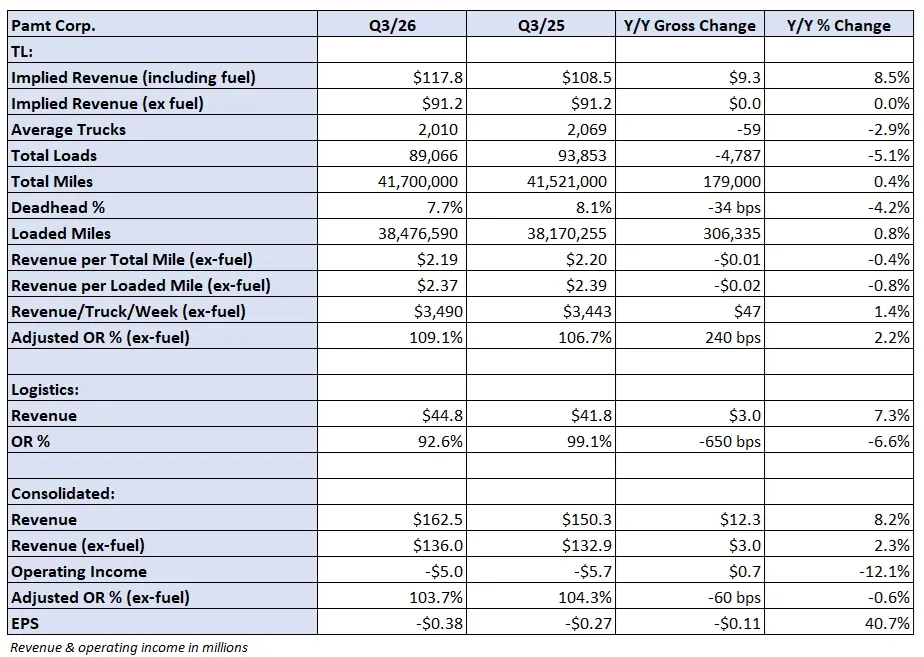
Nevertheless, the third quarter marked the 12th consecutive quarter in which Pamt's truckload division reported an operating loss. Its operating ratio, excluding fuel surcharges, reached 109.1%, deteriorating by 240 basis points compared with the same quarter last year.
An operating ratio above 100% indicates that operating expenses exceed revenue, underscoring the scale of the profitability challenge facing the division.
Logistics business posts stronger operating performance
Pamt’s logistics division added a more positive contribution to the company’s overall results.
The unit posted $45 million in third-quarter revenue, up 7% year over year. Its operating ratio improved to 92.6%, a 650-basis-point improvement on the corresponding period in 2025.
However, gross profit margins are not disclosed for this division. It does not provide detailed operational indicators such as load volumes or revenue per load, making it harder to evaluate the unit’s performance in more detail.
Liquidity and cash flow remain under pressure
Financial resources continued to be an important consideration in the first nine months of the year.
Pamt consumed $18 million in operating cash flow during that time. Total liquidity at the end of the third quarter was $102 million, which included cash, equity investments and availability to borrow under its credit facility.
That was a decline of $15 million from the second quarter.
At the same time, the carrier made strides in reducing its debt. Debt was down $10 million to $323 million.
Management expects operational improvements to underpin the recovery
Though the quarterly loss was a disappointment, the company's recent operational progress was somewhat encouraging to Stewart.
He said he was disappointed that rises in customer prices had been offset by ongoing cost pressures. But he did point to the step-by-step improvement in operating performance as a positive development.
The president also said company actions, as well as improved market conditions, may help generate stronger financial results in the coming quarters.
Why Pamt’s Results Matter For The Trucking Industry
Pamt’s third quarter results are symptomatic of a larger problem within the truckload transportation sector. Carriers are still trying to work through years of inflation on driver recruitment, fuel and other operating costs, while freight rates are still relatively weak.
The company's experience is that higher customer rates do not always translate into better profits if cost increases continue to outpace price increases.
“Re-establishing financial performance will continue to require the ability to control expenses, improve equipment utilization and obtain more sustainable freight rates for trucking fleets.
“Pamt’s findings are another confirmation of the pressure on carriers as the industry moves toward a more balanced relationship between operating costs and transportation pricing.
END OF REPORT