Maritime Nov 24, 2026
Samsung Heavy Industries joins international partnership to advance nuclear-powered LNG carrier
Samsung Heavy Industries, Tesser Atomics, DNV and NTNU are working together on a nuclear-powered LNG carrier concept designed for transatlantic trade, with safety, regulatory approval and commercial feasibility among the project's first priorities.
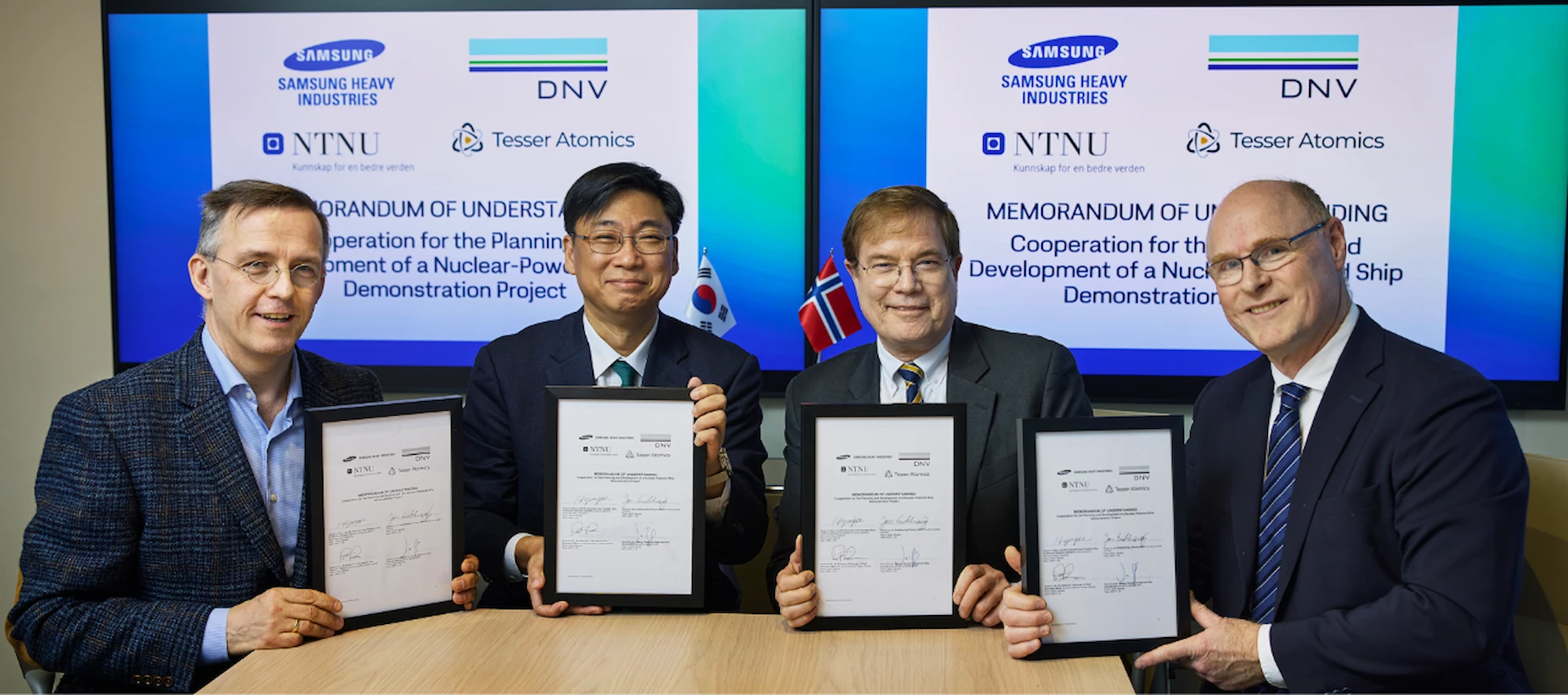
Samsung Heavy Industries (SHI) has partnered with US nuclear technology firm Tesser Atomics, classification society DNV and the Norwegian University of Science and Technology (NTNU) to further develop a nuclear-powered LNG carrier for trade between the US and Europe.
Four organizations signed a memorandum of understanding (MoU) to develop a demonstration vessel concept based on Tesser Atomics’ fluoride-salt-cooled nuclear reactor technology. The initiative is another step in exploring the potential role of nuclear propulsion in commercial shipping, especially for vessels traveling long distances.
Safety and regulatory approval at the heart of the first phase
The partners will create a detailed roadmap for the development before construction begins. This early work will involve safety assessments, regulatory approvals and the identification of a practical commercial pathway, leading to the eventual construction and commissioning of the vessel.
There is no construction timeline or targeted delivery date for the demonstration LNG carrier.
Each organization will bring specialist expertise to the project. SHI will design the ship and integrate the reactor, and will examine the feasibility of shipbuilding and possible construction methods.
Tesser Atomics will be the lead on the reactor development, along with the nuclear-specific licensing and safety requirements. DNV will develop the safety assessment and classification framework, while NTNU will coordinate research activities, funding proposals, feasibility studies, modeling and testing.
Norwegian research consortium backs development
The initiative will also contribute to the activities of SFI SAINT, Norway’s nuclear powered vessel research center run by NTNU. The center is working on a number of demonstration projects that would assist with the introduction of nuclear propulsion technologies into commercial shipping.
Bridging the gap between the well-established use of nuclear propulsion in military vessels and its limited use in the merchant fleet is one of the key challenges for DNV.
“This gap is important to fill as the industry looks at building a modern commercial vessel using nuclear energy,” said Ivar Håberg, DNV’s director of approval ship classification.
“One of the interesting things about nuclear power for shipping is that we have a long history of use in the naval segment, but that hasn’t translated to the commercial side. “This makes this project an important step toward the first modern full-size nuclear powered cargo vessel,” Håberg said.
Per Peterson, CEO of Tesser Atomics, also emphasized the role of the Norwegian research consortium, which he said has pushed forward solutions to several issues associated with the deployment of a first demonstration vessel.
“Our ability to work with the Norwegian SFI SAINT consortium has accelerated our progress across all of the areas one must address to deploy our first nuclear-powered demonstration ship, including legal, regulatory and insurance,” Peterson said.
A partnership building on an earlier agreement
The latest MoU follows a separate agreement announced on 19 November between SHI and Tesser Atomics. Under that arrangement, the two companies established an exclusive partnership covering shipbuilding and reactor technology for the demonstration project.
Samsung Heavy Industries is not entering the nuclear-powered LNG shipping segment without prior experience. The shipbuilder has already been working on several nuclear propulsion concepts for LNG carriers.
In September 2025, SHI obtained approval in principle from the American Bureau of Shipping (ABS) and the Liberian Registry for a 174,000 cu m LNG carrier equipped with a molten salt small modular reactor (SMR).
Kyunghee Kim, executive vice president and head of the future business division at SHI, said the new international collaboration would build on the company's existing research and technological capabilities in marine nuclear propulsion.
“Building on the technology and experience we have accumulated in the field of marine small modular reactors (SMRs), we will establish a meaningful stepping stone toward the commercialisation of nuclear-powered vessels together with partners that have expertise in their respective fields.”
Potential applications beyond LNG carriers
Beyond the development of the LNG carrier concept, the partners are also considering whether the proposed nuclear propulsion technology could be adapted to other commercial vessel categories.
Containerships and additional vessel types are among the potential applications being explored, suggesting that the collaboration could eventually extend beyond LNG transportation.
For now, the project's immediate objective remains the development of a technically viable, safe and commercially realistic demonstration vessel. Its progress will depend on addressing the regulatory, insurance and operational requirements that continue to distinguish nuclear-powered merchant shipping from established naval applications.
END OF REPORT