



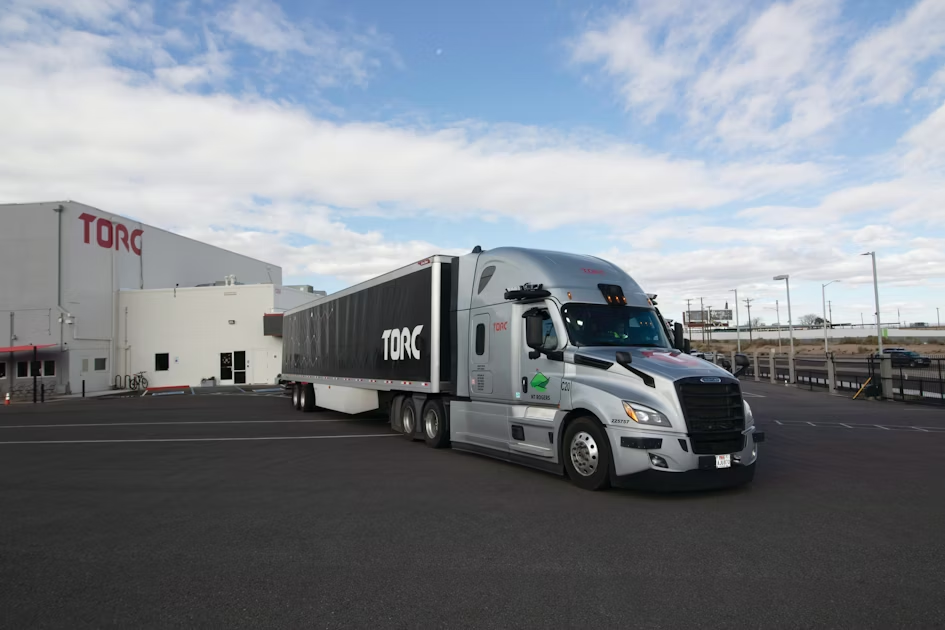
Autonomous trucking developer Torc Robotics is taking a significant step toward commercialization by expanding its testing program into one of the most challenging driving environments in North America.
The Daimler Truck subsidiary has announced plans to begin operating autonomous trucks on public roads around Ann Arbor, Michigan, exposing its systems to snow, ice and heavy rain — conditions largely avoided by many competitors in the sector.
Until now, most autonomous trucking trials have been concentrated in Sun Belt regions such as Texas and the southern United States, where weather conditions are more predictable.
Torc’s move into Michigan represents a strategic shift aimed at accelerating the development of technology capable of operating reliably across a broader range of environments.
The company already maintains testing operations in Blacksburg, Virginia, and in the Dallas-Fort Worth area. Its new initiative builds on the engineering presence it established in Ann Arbor last year, allowing research and development work to transition directly onto public roads.
According to Dave Anderson, Torc’s vice president of engineering, exposing autonomous systems to harsher climates is a critical milestone.
“It represents the next stage in our path toward commercialization,” Anderson said. “Operating in more complex environments allows us to validate both the hardware and software we’re developing.”
Michigan’s climate offers a wide variety of conditions rarely encountered in southern testing corridors. Snow-covered roads, icy surfaces and heavy rainfall all present unique challenges for autonomous vehicle systems.
To address these challenges, Torc’s trucks rely on a sophisticated sensor suite including cameras, lidar, radar and ultrasonic sensors capable of interpreting changing road conditions.
The data generated by these sensors feeds into the company’s next-generation autonomous software architecture known as AV 3.0.
Unlike earlier systems, AV 3.0 relies on an end-to-end machine learning framework designed to integrate perception, prediction and planning into a unified neural network.
Felix Heide, Torc’s head of artificial intelligence, said real-world testing remains essential to validating the system.
“Testing our hardware and software together on public roads is a crucial step in the long journey toward commercial autonomous trucking,” Heide said.
Michigan’s state authorities have played an important role in enabling the expansion. Torc secured support from the Michigan Economic Development Corporation, the Michigan Department of Transportation and economic development group Ann Arbor SPARK.
For state officials, the project reinforces Michigan’s ambition to remain a global leader in advanced mobility technologies.
“Torc’s continued growth in Michigan demonstrates the value of strong public-private partnerships in driving next-generation transportation innovation,” said Quentin L. Messer Jr., chief executive of the Michigan Economic Development Corporation.
Torc is also actively recruiting talent in the region, particularly in software engineering, artificial intelligence and machine learning.
The company is targeting the commercial deployment of its autonomous trucking technology by 2027 — a milestone that could mark the beginning of driverless freight operations on major transport corridors.