Maritime Nov 11, 2026
Transpacific Ocean Freight Rates Edge Lower as Peak Season Loses Momentum
Softer demand at U.S. ports is putting slight downward pressure on transpacific spot rates. However, shipping costs remain more than twice as high as they were a year ago, while port congestion and labor negotiations continue to pose risks to supply chain operations.
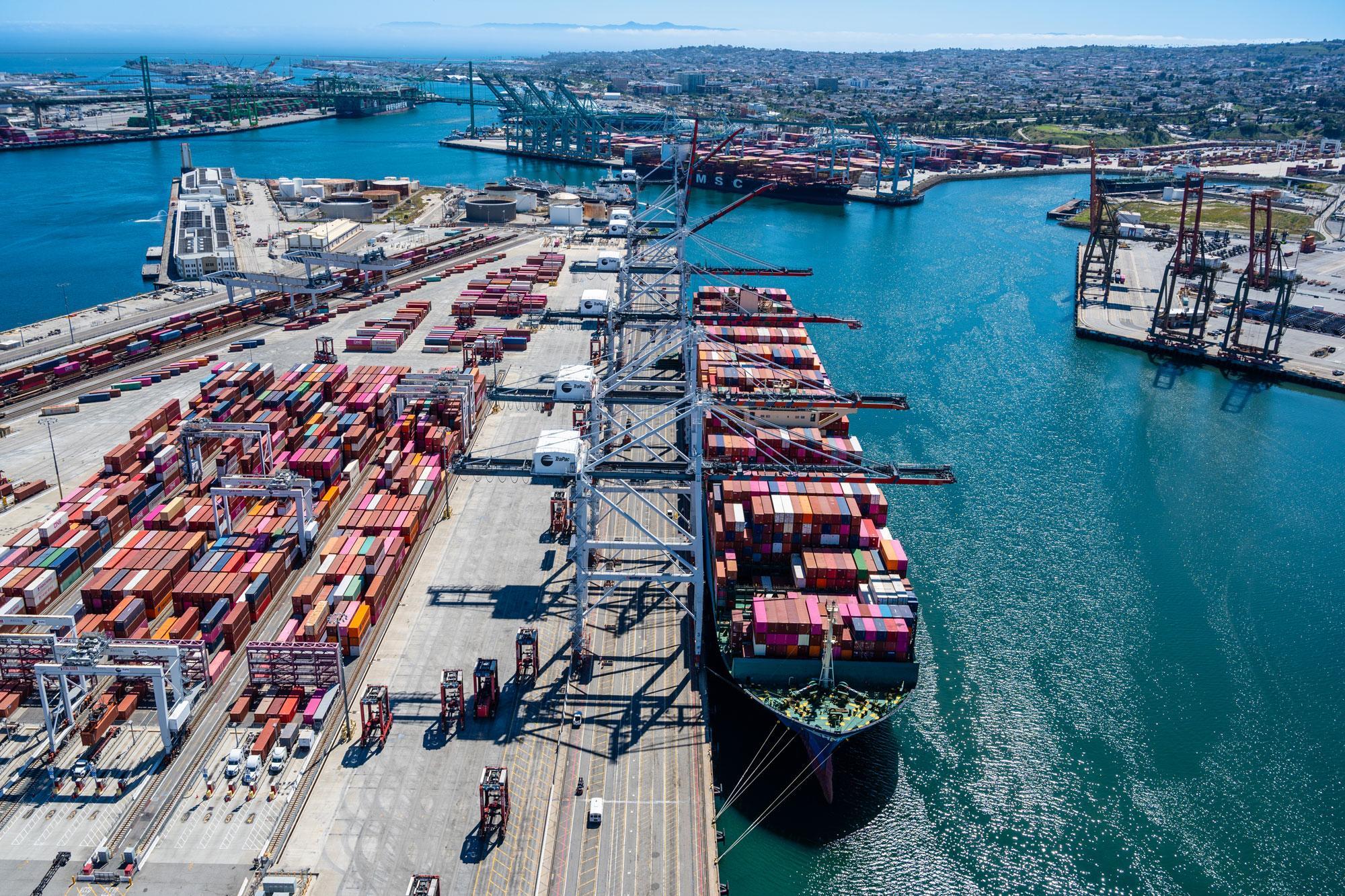
The peak shipping season is starting to subside and rates for shipping across the Pacific Ocean have dipped slightly. The latest market moves may have been driven by slower demand at U.S. ports. This is a decline but spot rates remain well above those in November 2025, highlighting ongoing pressure on international shipping costs.
Freightos said in its weekly market update on Nov. 10 that spot rates from Asia to the U.S. West Coast were down 1% week on week to $8,245 per forty-foot equivalent unit (FEU). Also, Asia-U.S. East Coast rates fell 2% to $9,708 per FEU, according to Freightos Baltic Index data.
However, the year-over-year comparison is quite different. Spot rates on the same routes were $2,958 per FEU to the U.S. West Coast and $3,513 per FEU to the East Coast in November 2025. Prices today are more than twice what they were this time last year.
Falling demand affects freight rates
Freightos says one factor for the latest rate adjustments is weakening demand. The market heads into the home stretch of the peak shipping season with relatively strong cargo volumes, says the Global Port Tracker released today by the National Retail Federation (NRF) and Hackett Associates.
A number of factors helped early shipping activity, including higher diesel prices and uncertainty over the U.S.-China trade truce that was initially due to expire in November but was extended. These developments led some importers to bring forward shipments, boosting cargo flows through key gateways, including the Port of Los Angeles.
Most of the holiday goods have already shipped from retailers, so shipping demand should decline in the next few weeks. “Retailers are working closely with their supply chain partners to help ensure that holiday merchandise continues to flow without interruption,” said Jonathan Gold, NRF Vise President for Supply Chain and Customs Policy.
U.S. import volumes expected to decline by year-end
U.S. ports have not yet released their official October import numbers, but Global Port Tracker forecasts volumes for the month at roughly 2.26 million twenty-foot equivalent units (TEUs). That would mark a slight decline from 2.37 million TEUs in September.
It is likely to continue falling for the rest of the year.” U.S. import volumes are projected to be 2.05 million TEUs in November and 2.03 million TEUs in December, the report said.
But the long peak season is already having an impact on port operations. Several gateways have been hit by congestion problems, particularly on the U.S. West Coast where containers have waited for long periods to get on to rail services amid strong cargo volumes.
Southern California ports report longer container delays
According to the Pacific Merchant Shipping Association (PMSA), a concentration of peak-season cargo drove up container dwell times at the Ports of Los Angeles and Long Beach in September.
The average container dwell time for local trucks in September was 3.18 days, up from 2.95 days in August. Rail dwell times also rose to 7.19 days from 6.75 days last month.
The numbers reflect operational issues at Southern California’s critical container gateways, where heavy cargo volumes have put a strain on terminal operations and inland transportation links.
November labor talks could add to uncertainty
But in addition to congestion and demand shifts, labor negotiations are looming as another potential disruption for the region’s maritime supply chains.
The International Longshoremen and Warehouse Union (ILWU) Local 26 and the Pacific Maritime Association (PMA) are in contract talks that began in July 2025. The talks involve about 250 watchmen who patrol six container terminals in the San Pedro Bay port complex.
Strike action has been postponed twice already and talks continue. The PMA said in a statement emailed to Supply Chain Dive that the most recent deadline has now been extended to Nov. 20.
The result of these negotiations could have an impact on port operations in Southern California, where terminals are still reeling from a protracted peak season.
Transpacific shipping market spot rates have fallen slightly, but this does not signal a return to normal in the market. Seasonal demand is starting to ease but freight rates are still well above year-ago levels. However, congestion, inland transportation delays and ongoing labor discussions continue to cloud the outlook for U.S. port operations.
Key figures:
$8,245 per FEU: Asia-to-U.S. West Coast spot rate, down 1% week over week.
$9,708 per FEU: Asia-to-U.S. East Coast spot rate, down 2% week over week.
2.26 million TEUs: Projected U.S. import volume for October.
2.05 million TEUs: Forecast U.S. import volume for November.
2.03 million TEUs: Forecast U.S. import volume for December.
November 20: Revised deadline in the ILWU Local 26 PMA labor negotiations.
END OF REPORT