Business Nov 4, 2026
UNHCR and ECHO join forces to make humanitarian supply chains more sustainable
A European Commission-funded initiative brings together UNHCR, the WREC Coalition and the Climate Action Accelerator to reduce waste, improve resource efficiency and accelerate greener logistics across humanitarian operations.
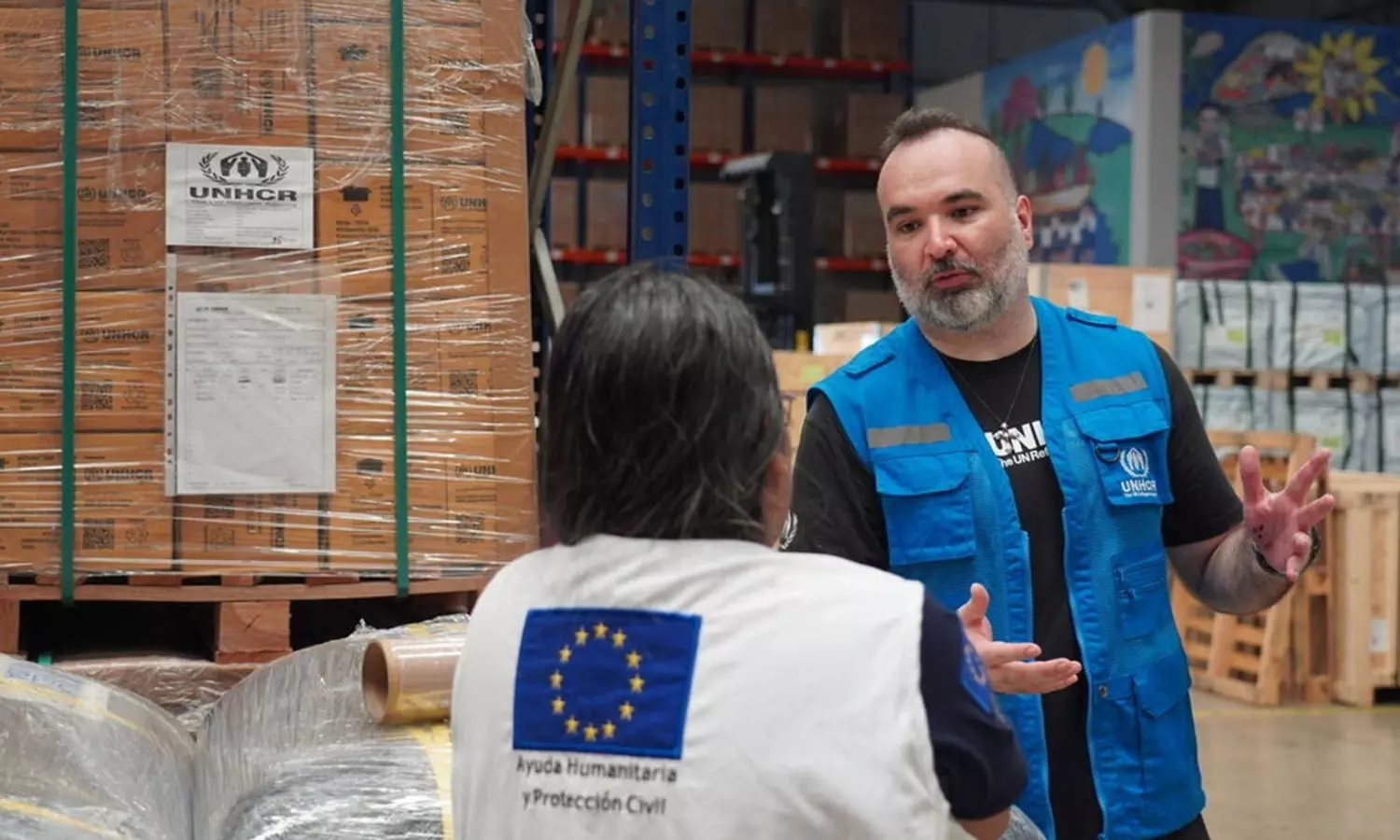
The humanitarian logistics sector is strengthening its environmental commitments with a new international partnership to curb the ecological footprint of aid operations. UNHCR, the UN Refugee Agency, has partnered with the Waste Management and Measuring, Reverse Logistics, Environmentally Sustainable Procurement and Transport, and Circular Economy Coalition (WREC Coalition) and the Climate Action Accelerator, led by the Logistics and Telecommunications Cluster (LTC), on a joint project funded by the European Commission’s Directorate-General for European Civil Protection and Humanitarian Aid Operations (DG ECHO).
The initiative aims to help humanitarian organisations drastically reduce waste and make better use of resources across their supply chains. As relief operations move into more complex environments, the partners plan to integrate environmental considerations into procurement, transportation, distribution and the management of materials after delivery.
In the traditional humanitarian supply chain, environmental concerns are often secondary to the urgency of the situation and the lack of infrastructure, which creates a high-pressure environment. The new programme seeks to turn this approach on its head by embedding sustainability in emergency responses as well as longer-term relief activities.
Based on an existing humanitarian coordination mechanism
The project builds on the work of the Humanitarian Leadership Group on Supply Chain (HLGSC), an initiative launched in early 2024 under the leadership of DG ECHO. It aims to promote coordinated action among major humanitarian organisations, while improving the efficiency and overall effectiveness of supply chain operations worldwide.
In this regard, UNHCR, the LTC-led WREC Coalition and the Climate Action Accelerator were recently announced as co-leads of the HLGSC Environmental Sustainability Thematic Working Group (ES TWG).
Their appointment recognises several years of collaboration and contribution to better environmental practices across humanitarian supply chains. The working group offers a forum to pool existing expertise, co-ordinate priorities and develop practical solutions that can be adopted across the sector.
ECHO supports the three partners to join forces in terms of capabilities, operational experience and logistics networks to improve cooperation among humanitarian organisations, increase consistency in sustainability standards and to turn common environmental objectives into measurable operational progress.
Transforming environmental commitments into operational actions
The partnership will work directly with participating humanitarian organisations to implement practical measures to address the environmental impact of their supply chains.
The approach encompasses the entire life cycle of humanitarian logistics from the acquisition of relief supplies to their transportation, use and eventual management after delivery. There are a number of identified operational priorities:
Measuring carbon emissions: improving the ability of organisations to measure and monitor emissions from their supply chain activities.
Life cycle assessment: assessing the environmental footprint of humanitarian relief items over their entire life cycle.
Sustainable procurement - promoting purchasing practices that give greater consideration to environmental performance and the responsible use of resources.
Reverse logistics: creating systems to recover, reuse and redirect materials instead of allowing potentially valuable resources to become waste.
Waste management: Improved methods of handling and reducing waste in humanitarian crisis areas, including those with minimal or no infrastructure.
These priorities are particularly relevant as humanitarian organisations increasingly face the challenge of delivering essential assistance while working in environments where waste collection, recycling and other basic services may not be available.
These objectives can be achieved through cooperation, said Benjamin Safari, Head of UNHCR Supply Management Service.
“UNHCR, as a member of the WREC Coalition led by LTC, is thankful for the opportunity to partner with the Coalition members and the Climate Action Accelerator in the wider HLGSC framework. “This partnership can support coordination through the Environmental Sustainability Thematic Working Group, bringing together knowledge and experience already present across the humanitarian community and facilitating the development of practical approaches that respond to shared environmental sustainability priorities across humanitarian supply chains.”
Growing humanitarian needs increase pressure on supply chains
The initiative comes as the number and scale of humanitarian crises continue to place growing demands on international aid networks. Organisations must deliver assistance rapidly and reliably while managing increasingly complex procurement, transportation and distribution requirements.
For DG ECHO, improving coordination and making better use of available resources are essential to addressing these challenges.
Leonor Nieto, Head of the Humanitarian Emergency Response Capabilities Unit at DG ECHO, European Commission, emphasised the need for a collective approach.
“As humanitarian needs grow, stronger collaboration and resource-sharing are key to more efficient supply chains. Over 60 humanitarian organisations have endorsed a concrete action plan recognising this need. Together with our partners, we aim to improve environmental sustainability, procurement, digitalisation, preparedness and localisation, so that aid can reach people affected by crises when and where they need it most.”
The endorsement of a concrete action plan by more than 60 humanitarian organisations underlines the growing recognition that improvements in supply chain performance require coordinated efforts across the sector. Alongside environmental sustainability, the broader priorities include procurement, digitalisation, preparedness and localisation.
ECHO funding supports a sector-wide transition
With financial and strategic backing from ECHO, UNHCR, the WREC Coalition and the Climate Action Accelerator will continue working closely with participating humanitarian organisations to advance the project's objectives.
The initiative represents an important step towards making humanitarian supply chains more efficient, resilient and environmentally responsible. Rather than limiting progress to general sustainability commitments, the partners intend to help organisations translate climate ambitions into practical changes across their daily logistics operations.
Through the HLGSC framework and the Environmental Sustainability Thematic Working Group, the project will also encourage knowledge-sharing and closer alignment between humanitarian actors.
Ultimately the partnership is about finding more sustainable ways to source, transport, manage and recover humanitarian supplies. With global crises becoming more acute, minimizing the environmental impact of aid delivery is becoming an increasingly important part of ensuring that humanitarian assistance remains effective, resilient and responsible.
END OF REPORT