Business Nov 6, 2026
Unilever raises prices again as commodity costs continue to rise
Improved visibility into the supply of key raw materials has given the consumer goods giant greater confidence to raise prices in the third quarter of 2026, following a largely stable pricing policy during the first six months of the year.
Unilever hikes pricing strategy to counter rising input costs
Unilever has stepped up pricing action as commodity markets come under increased pressure, hiking its average price by 2.3% across its portfolio in the third quarter of 2026. The change follows several months of relatively stable prices, as the group had initially chosen to take a cautious approach while watching supply conditions and the evolution of raw material costs.
Unilever bosses confirmed the rise on the company's October 28 earnings call as it looks to protect its margins from ongoing inflation hitting its procurement operations.
The impact has been particularly felt in its Home Care division. CFO Srinivas Phatak said that prices in this segment increased 3.6%, the strongest increase across the group's business activities. Household brands such as Comfort, which is known for fabric conditioners, and Sunlight, which specializes in dishwashing products, are represented in the portfolio.
Home Care is driving about half of the current cost inflation at Unilever, said Phatak. That concentration of cost pressure has driven the company to a more targeted pricing strategy, leveraging its pack and price architecture to manage impact on consumers and profitability.
Pricing adjustments differ across Unilever's business divisions
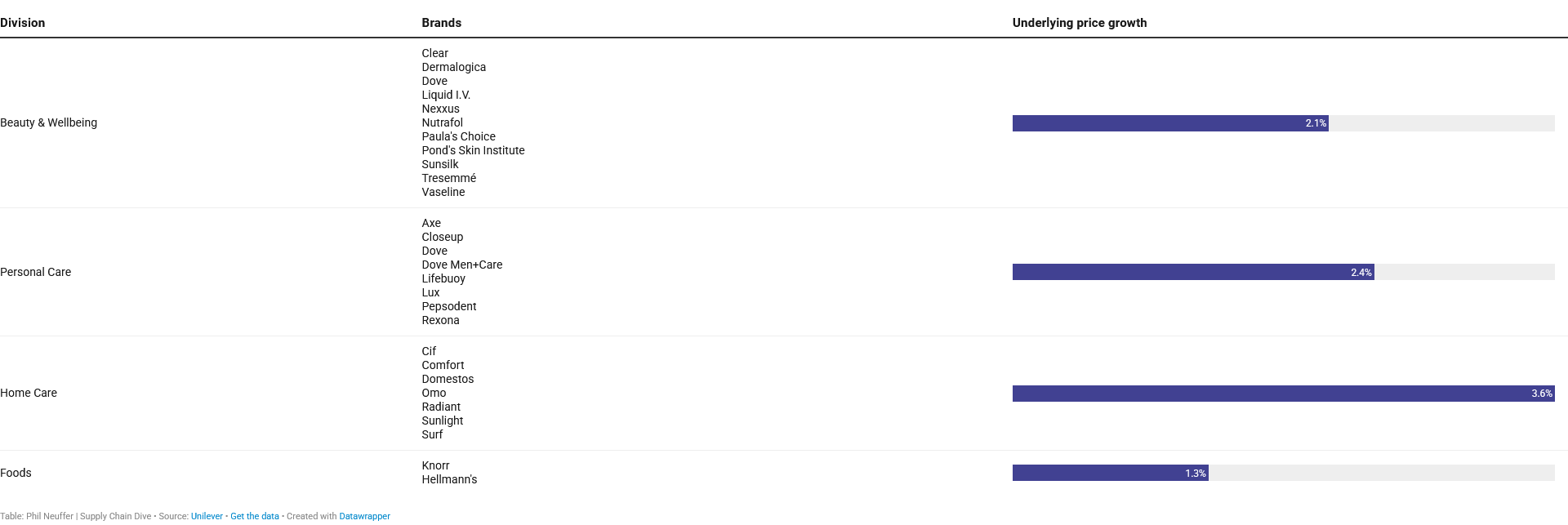
The company's third-quarter pricing strategy has not been applied uniformly. Each division recorded a different level of underlying price growth, reflecting its exposure to rising commodity costs and the measures taken to address them.
The breakdown across Unilever's four main divisions is as follows:
Division | Brands | Underlying price growth |
|---|---|---|
Beauty & Wellbeing | Clear, Dermalogica, Dove, Liquid I.V., Nexxus, Nutrafol, Paula's Choice, Pond's Skin Institute, Sunsilk, Tresemmé, Vaseline | 2.1% |
Personal Care | Axe, Closeup, Dove, Dove Men+Care, Lifebuoy, Lux, Pepsodent, Rexona | 2.4% |
Home Care | Cif, Comfort, Domestos, Omo, Radiant, Sunlight, Surf | 3.6% |
Foods | Knorr, Hellmann's | 1.3% |
These figures highlight the greater pricing pressure affecting Home Care, while the Foods division recorded the smallest increase, at 1.3%.
Commodity inflation weighs on manufacturers as supply conditions improve
The move comes amid a tough operating environment for the consumer packaged goods (CPG) industry, Unilever said. The sector’s companies have struggled through much of 2026 with rising commodity prices and economic uncertainty, exacerbated by the war in Iran and persistent inflation.
“One of the key factors impacting Unilever’s costs has been the cost of vegetable oils and palm oil, which have hit record highs,” Phatak said. The group also attributed other factors that have contributed to its rising commodity bill to higher kerosene prices, rising logistics costs and foreign exchange movements.
The supply environment, however, is slowly becoming more predictable. Unilever said supply conditions were returning to normal, giving it greater visibility on crude oil availability and inventories of other key commodities.
This improvement has helped management to re-think its pricing policy. After broadly stable pricing in the first half of the year, the group now believes it has enough information on supply security and the commodity cost environment to proceed with further increases.
CEO Fernando Fernandez said during the October 28 earnings call, “We were purposefully conservative until we could gain more visibility on these items. With visibility now improving, Unilever has decided to step up its pricing actions.
Unilever’s price reaction to higher commodity costs
Colgate-Palmolive also relies on pricing to combat inflation
Unilever is not the only one using price moves to absorb rising production and sourcing costs. Other big consumer goods makers are also rolling out similar moves to cushion the impact of inflation on their bottom lines.
Colgate-Palmolive, for instance, is combining price increases with productivity gains to offset higher costs. This approach was outlined by CFO Stanley Sutula during the company’s earnings call last week.
The strategy points to a broader trend in the consumer goods sector, where manufacturers are increasingly relying on pricing decisions and operational efficiency to absorb cost increases and protect their margins.
Cost pressures will persist through 2027
The improved outlook for commodity supply does not mean that Unilever sees inflation pressures easing in the short term.
The group expects further cost inflation in 2027, but anticipates this will slow as the year goes on. “Some of the pressures around crude oil are likely to linger in the near term,” said Fernandez.
Still, the CEO does anticipate conditions to stabilize somewhat in the second half of 2027, which could give manufacturers more leeway in managing their procurement costs.
For Unilever, the coming months will therefore continue to be about balancing pricing decisions, securing supply and managing costs. The group also has taken a more decisive stance on prices, due to better visibility, although the evolution of commodity markets and logistics costs will continue to shape its commercial strategy.
END OF REPORT