



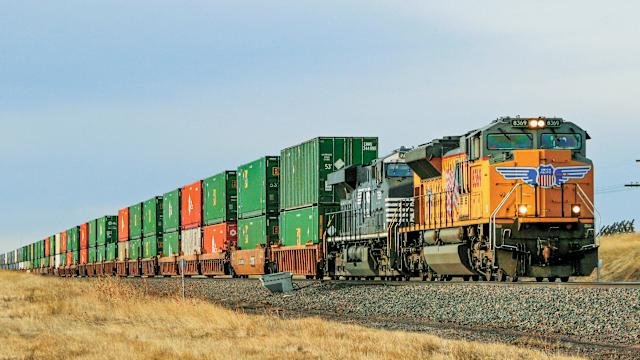
Union Pacific believes it has the network capacity needed to handle the traffic growth expected from its proposed merger with Norfolk Southern, according to chief executive Jim Vena, who said the railroad’s operating model has become significantly more efficient since the adoption of Precision Scheduled Railroading in 2019.
Speaking at the J.P. Morgan Industrials Conference in Washington on March 18, Vena said Union Pacific and Norfolk Southern expect their merger to generate an 11% increase in volume, including the annual diversion of 2 million truckloads from highway to rail.
He said questions about network capacity are central to the merger debate, but argued that Union Pacific is well prepared. Since 2019, the railroad has increased average train length by 25% while moving the same tonnage on 24% fewer active trains.
Union Pacific has also invested in terminal infrastructure, including improvements at its key Englewood Yard in Houston, to support additional volumes.
According to Vena, the company will be able to place those projected 2 million loads on the network without worrying about whether the railroad has enough capacity or whether major additional spending will be required.
Union Pacific and Norfolk Southern have told regulators they plan to invest $1.1 billion in main line and terminal upgrades. Most of the line-haul work would involve lengthening sidings and adding sections of second main track to improve the movement of longer trains on Norfolk Southern’s single-track former Wabash and Southern Railway routes. Terminal projects are expected to focus mainly on intermodal expansion.
Vena also pointed to improvements in service performance. Car velocity on Union Pacific, measured in car-miles per day, has risen 8% since 2019. He said customers benefit directly from that improvement because higher velocity means fewer railcars are needed to move the same volume of freight, and lower inventory levels can be maintained.
He added that the merger would take those service gains further by removing interchange touch points. Union Pacific and Norfolk Southern have said that eliminating interchange handling could cut 24 to 48 hours from the transit time of shipments the two carriers currently exchange, with some industry executives privately suggesting the time savings could be even greater.
Vena also sought to downplay concerns about the impact of traffic growth on communities along the railway. He said that while 2 million loads sounds significant, the actual increase in train numbers would be relatively modest once those containers are double-stacked and distributed across the network.
The railroads’ operating plan, which was included in a merger application rejected by federal regulators in January as incomplete, projected the launch of two dozen new trains, split equally between intermodal and merchandise services.
Vena also noted that while some question whether the merger can really generate 2 million additional loads, others have told the railroads the growth potential could be even higher.
He contrasted the proposed Union Pacific–Norfolk Southern tie-up with the Canadian Pacific Kansas City Southern merger, where CPKC remains behind its goal of converting 64,000 cross-border truckloads annually to rail. CPKC chief executive Keith Creel has also expressed doubts that Union Pacific can achieve its own merger growth target within three years.
Asked by J.P. Morgan analyst Brian Ossenbeck what makes the Union Pacific–Norfolk Southern combination different, Vena said the answer lies in the scale and structure of the network. Unlike CPKC, which is more strictly north-south, Union Pacific and Norfolk Southern connect much larger western and eastern systems.
Vena also reiterated his support for reciprocal switching, which allows sole-served customers to access a second railroad, and said Union Pacific and Norfolk Southern intend to let shippers choose their own interline routes rather than following the industry’s traditional preference for the longest haul.
That position has drawn criticism from BNSF, CN and CPKC, which argue that Union Pacific’s committed gateway program would apply to only a limited number of customers. Vena rejected the idea that these changes are minor, saying they represent a significant shift in how the rail industry could compete in the future.