Cargo Nov 23, 2026
Zim posts an $830 million profit in Q3 as freight rates climb 55%
Stronger freight pricing drives a sharp improvement in quarterly earnings, prompting Zim to raise its full-year financial targets. The carrier is also expanding its expedited services and strengthening its focus on shipments linked to artificial intelligence and data centres.
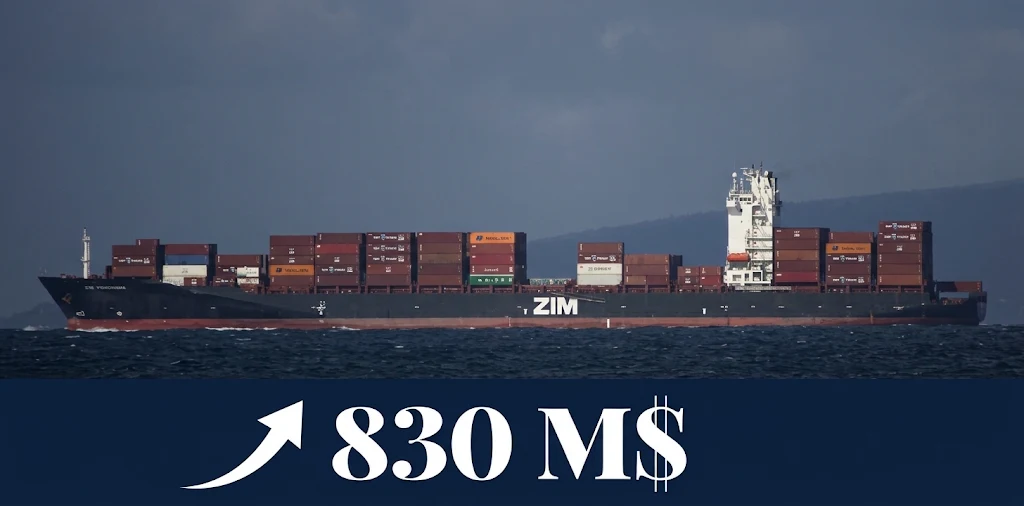
Zim Integrated Shipping Services said it turned profitable in the third quarter of 2026, with net income of $830 million compared with $123 million in the same period last year. The increase was driven by a 55% rise in average freight rates, leading the Israeli shipping company to raise its full-year earnings forecast once again.
For the three months ended Sept. 30, the Haifa-based container carrier posted revenue of $2.71 billion, up 53% from the year-ago period. Diluted earnings per share jumped to $6.88 from $1.02 in third quarter 2025.
Average freight rates rose to $2,480 per 20-foot equivalent unit (TEU) but volumes of cargo shipped increased just 4% to 962,000 TEUs. The figures indicate that Zim’s quarterly revenue growth was driven by higher pricing and not by a significant increase in the volumes of shipments.
Adjusted earnings before interest, taxes, depreciation and amortization (EBITDA) climbed 124% to $1.33 billion. Adjusted operating earnings (EBIT) were $993 million compared to $260 million a year ago. Meanwhile, the adjusted EBIT margin improved significantly, from 15% to 37%.
Zim President and Chief Executive Chen Lichtenstein said the results reflected the company’s operational approach and focus on profitable markets.
In the earnings release, he said the company hopes to help customers and create more growth opportunities by having an adaptable network and focusing on premium, profitable trade routes.
Freight market conditions remain uncommonly strong
Lichtenstein said on a conference call with analysts that freight rates on the U.S. West Coast and East Coast are holding up. This year, though, the Asia-U.S. trade lanes have not slowed in their typical late-summer manner.
The strong market was linked to ongoing congestion at ports, especially in China, and to the disruption of major sea shipping lanes, he said.
However, the company has experienced some moderation in market conditions of late. Some customers have pulled orders and delayed shipments to prevent getting products into the United States around Christmas and year-end, Lichtenstein said.
But he expects market activity to pick up in January ahead of the Chinese New Year period.
E-commerce continues to support the demand for faster trans-Pacific transportation services. Zargheba. Zim is also turning up the volume on nascent cargo opportunities associated with artificial intelligence and data center development. A specific task force has been set up to work with suppliers in these industries.
Management also sees another opportunity in moving some shipments traditionally moved by air to expedited ocean freight services, giving customers another option for time-sensitive cargo.
Lichtenstein also identified freight forwarders as a key part of Zim’s strategy. These intermediaries handle a large portion of the high-value cargo that the carrier is looking for and have been paying higher average freight rates than direct cargo owners on both U.S. coasts from Asia over the last three years.
Zim will continue to be selective in committing to annual volumes under contract, thereby retaining more flexibility in price discussions to remain responsive to market fluctuations.
Full year earnings guidance significantly increased
Zim has upgraded its full year financial outlook significantly after posting stronger than expected results in the third quarter.
The company is now forecasting adjusted EBITDA of $3.3 billion to $3.5 billion, up from a previous forecast of $2.7 billion to $3 billion. It also increased the outlook for adjusted EBIT by $800 million to a range of $2 billion to $2.2 billion, compared with the previous estimate of $1.4 billion to $1.7 billion.
This latest revision follows an upgrade to the forecast in October when Zim cited strong market demand and favorable developments in freight rates.
The company’s performance also reflects a wider improvement in the container shipping industry. “Hapag-Lloyd meanwhile reported a jump in profit in the third quarter, driven up by higher freight rates in the wake of relatively stable cargo volumes.
"Adjusted earnings and cash generation bolster financial position
Zim posted net income of $830 million, but its results included a non-cash reversal of an asset impairment it had previously recognized.
Adjusted net income, excluding this benefit and costs associated with the proposed acquisition, was $717 million compared with $124 million in the comparable quarter of 2025.
The reported profit was lifted by reversing the previous impairment of $155 million after tax, while the acquisition-related expenses amounted to $41 million after tax.
Cash generation was also robust. Zim produced operating cash flow of $1.24 billion and free cash flow of $1.22 billion in the quarter.
It reported net debt, including lease obligations, of $1.86 billion as of Sept. 30, down from $2.77 billion at the end of June.
The company’s board also approved a dividend of $2.01 per share for an overall distribution of about $243 million. This amounts to approximately 30% of the total net income generated in the first nine months of 2026.
Revenue for the January-September period rose to $5.89 billion from $5.42 billion a year earlier. Net income also increased to $808 million from $443 million in 2025.
But cargo volumes fell slightly to 2.75 million TEUs from 2.765 million TEUs in the same nine-month period last year.
Zim’s network boosted by new fast services
Zim continues to build out its premium shipping offering, adding additional services, in addition to its financial performance.
The carrier has rolled out ZX3, its third premium expedited service linking Asia and the U.S. West Coast. It has also launched Falcon, a service to deliver faster transit times from China to Argentina and southern Brazil.
Zim currently has a fleet of 112 containerships with a combined capacity of approximately 703,000 TEUs. It also has 13 car carriers in its fleet.
The network changes come as German shipping group Hapag-proposed acquisition of Zim Lloyd is still under regulatory review.
Hapag-Lloyd takeover pending renewed Israeli approval process
The proposed deal, which values Zim at $35 per share in cash, is still subject to regulatory approvals including from Israel under the special state share mechanism.
Zim confirmed that the original application submitted to the Israeli government had been canceled. Hapag-Lloyd plans to submit a new application shortly thereafter.
Israeli authorities have asked for a re-examination of the proposed takeover following objections to the original structure of the transaction.
The two shipping companies are expected to remain separate and independent companies until the transaction closes.
We expect to complete the acquisition in the first quarter of 2027 subject to receipt of the necessary regulatory clearances.
The latest developments in Zim give rise to two important considerations for cargo owners and freight forwarders. The addition of another expedited Asia-to-U.S. West Coast service is another premium routing alternative, while the revised financial outlook suggests management expects better full-year results in a favorable freight-market environment.
END OF REPORT