Cargo Nov 20, 2026
Hacis, HAFFA and Vietnam’s IILS join hands to boost logistics links with Hong Kong
The three organizations inked an MoU at ALMAC 2026, a new milestone in bolstering Vietnam-Hong Kong logistics cooperation, broadening commercial prospects and boosting regional cargo connectivity.
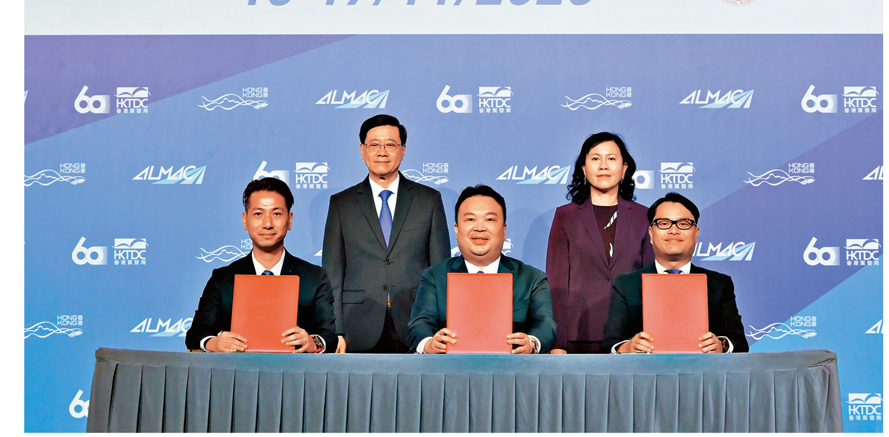
Hong Kong Air Cargo Industry Services Limited (Hacis) has signed a partnership agreement with the Hongkong Association of Freight Forwarding and Logistics (HAFFA) and Vietnam’s International Institute of Logistics and Supply Chain (IILS) to improve logistics connectivity between Vietnam and Hong Kong.
The three organizations signed a Memorandum of Understanding (MoU) at the Asian Logistics, Maritime and Aviation Conference (ALMAC) 2026 in Hong Kong. The agreement was witnessed by Chief Executive of the Hong Kong Special Administrative Region (HKSAR) John Lee and Secretary for Transport and Logistics Mable Chan.
The alliance reflects a common desire to strengthen ties between the two markets, open up new business opportunities and build stronger cooperation between their respective logistics industries.
The agreement coincides with the launch of the Vietnam-Guangxi-Hong Kong Land-Air Super Logistics Corridor, an extension of Hacis’ SuperLink China Direct land-air intermodal service to Vietnam. The service used to link Hong Kong to Chinese Mainland destinations via a Customs-bonded road feeder network operated by Hacis, the logistics arm of Hong Kong Air Cargo Terminals Limited (Hactl). It connects Hong Kong International Airport (HKIA) with cities in mainland China.
The Vietnamese extension was announced in September 2026 and tested with a pilot shipment of coffee beans from Hanoi. The trial proved the new route was operationally feasible, with the consignment being transported overland across the mainland of China via the Wuzhou Comprehensive Bonded Zone before entering Hong Kong through Shenzhen Bay Port under the Single E-lock Scheme.
The cross-boundary Customs facilitation arrangement is designed to streamline cargo clearance between the Chinese Mainland and Hong Kong, with security guarantyd throughout the entire transportation process.
The new Vietnam-Guangxi-Hong Kong corridor allows goods from Vietnam to reach Hong Kong by road through Guangxi in around 30 hours, the Hong Kong SAR Government said. Once arrived in Hong Kong, goods can be transshipped via HKIA’s international air transport network to destinations across the globe.
The pilot has shown that the corridor can also offer Vietnamese businesses more transport options for a wider range of goods beyond coffee exports, including electronics, technology components, garments and other manufactured products.
Pilot shipment has promise of multimodal connectivity
Hacis Director Bert Ng, speaking at the Vietnam-Hong Kong Air Cargo and Logistics Gateway Seminar held in conjunction with ALMAC 2026, shared the company’s experience in extending SuperLink China Direct to Vietnam.
He gave the example of the Hanoi-Hong Kong coffee shipment as a practical example of the capabilities of the multimodal service connecting Vietnam, the Chinese Mainland and Hong Kong through the Single E-lock Scheme.
Ng said the successful trial paved the way for further development and pointed out commercial opportunities that could arise from better transport links and increased cooperation across the logistics sector.
“This successful pilot is only the start. “We can create new business opportunities and attract new cargo flows via Hong Kong by improving connectivity and fostering closer industry collaboration,” he said.
Hacis said the company will continue to work with industry partners to turn the enhanced connectivity into tangible commercial opportunities, attract more cargo volumes and enhance Hong Kong’s status as an international air cargo hub.
ALMAC 2026 boosts Hong Kong’s international logistics status
The agreement between Hacis, HAFFA and IILS forms part of a broader package of cooperation initiatives announced at ALMAC 2026, held under the theme ‘Driving Inclusive Growth through Innovation and Sustainability’ as part of Hong Kong Maritime Week.
Chief Executive John Lee gave a special address at the conference, highlighting the government’s commitment to boosting the maritime, aviation and logistics sectors, supported by the National 15th Five-Year Plan and Hong Kong’s first five-year development plan.
Lee promoted Hong Kong as a global “super connector” and “super value-adder” pointing to its role as a bridge linking the Chinese Mainland with global markets, business networks and expertise.
Other initiatives announced during the conference included collaboration to develop local sustainable aviation fuel (SAF) blending facilities, establishment of green maritime fuel certification standards and the expansion of Hong Kong’s partner port network.
The Vietnam-Guangxi-Hong Kong corridor, within this wider context, adds a land-air logistics connection, complementing the maritime and aviation development initiatives in the region. The project aims to enhance regional trade opportunities and increase Hong Kong’s role in global supply chains by linking Vietnamese cargo flows with the Chinese Mainland and Hong Kong’s international transport network.
END OF REPORT