




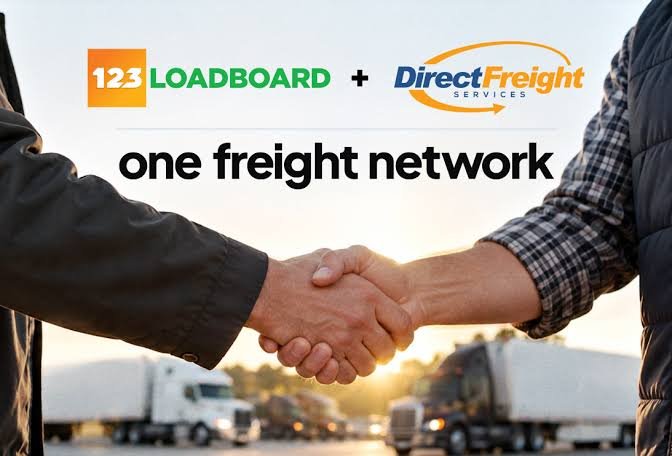
A larger network to cope with ongoing capacity shortages
123Loadboard and Direct Freight are joining forces to build a stronger independent freight ecosystem. Both platforms will continue to work as customers do now but the systems underneath will become increasingly linked together. With this combination, brokers will be able to post freight on both networks in one workflow and carriers will have access to a larger pool of available loads.
“The reason for this combination is a known difficulty in the freight industry,” explains Carmelo Messina, VP of Sales at 123Loadboard. “Even with established relationships and multiple online resources, it is not always guarantyd to find a truck.”
“Freight needs a network. “That’s really the jumping-off point for us,” Messina said. Brokers already use carrier relationships, transportation management systems (TMS) and one or more load boards. The problem is that even with these resources, you still cannot get the capacity you need to move a load.
123Loadboard is not trying to replace what is out there but to be another place to find capacity when a broker’s normal channels are not enough.
Why the last uncovered loads matter the most
Messina calls this challenge the “capacity gap,” a challenge that he says is larger than overall coverage percentages would suggest.
The gap is made up of shipments that brokers can’t cover once they’ve exhausted the most obvious options. These exceptions can disproportionately impact customer relationships. The customer may forget all the shipments delivered successfully, but will remember the one that never moved.
To demonstrate this problem, 123Loadboard uses what Messina calls the “90% idea.” 90% of their freight covered doesn’t do much for a customer’s peace of mind concerning the other shipments. Brokers must have confidence that alternative capacity exists if their primary resources cannot provide a solution.
At 123Loadboard, we subscribe to a simple philosophy – brokers should not rely on a single load board.
Messina emphasises that increasing coverage across multiple networks is not the same as replacing a tried-and-true platform. The company doesn’t want to be the only provider of load board services for brokers already using solutions that work.
“Brokers don’t need us to tell them to throw away tools that are already working for them,” he said. “We think the additive model is smarter.”
The strategy is to leverage the capabilities of 123Loadboard and Direct Freight with existing carrier relationships, TMS platforms and load boards. The network can be layered on top of the broker’s current workflow to help find capacity for loads that would otherwise be uncovered.
“Brokers are doing a great job managing the freight that they can cover, what we want to do is help them find solutions for the freight that they can’t cover,” says Messina.
Strengthen capacity before pressure increases
The merging of the two marketplaces will boost the volume of freight listings available throughout the combined network. But Messina sees the bigger opportunity in making capacity easier to find before brokers reach a critical point.
Brokers should be able to see capacity earlier, engage with the right carriers and make more informed commitments to their customers, instead of waiting until a load is hard to cover and then having to search across multiple platforms.
The idea is to give brokers more visibility and confidence in picking up freight.
For Messina, this speaks to a larger difference between a load board and a freight network. Load board is a platform for posting shipments and finding trucks. A network is the people, the relationships, the information and the activity that makes those transactions happen.
“Posting a load, finding a truck and making contact are still important steps. But 123Loadboard wants to be more than just a basic function.
Brokers are concerned with coverage and confidence. “For carriers, it’s having enough information to know if a load is good for their business. Both sides also need to build trust, determine whether the other is reliable and decide if a commercial relationship is worth developing.
Capacity Radar points towards more proactive freight matching
One example of this network-focused strategy is Capacity Radar, a concept that illustrates how 123Loadboard intends to develop freight matching beyond conventional listings.
Traditional load boards primarily rely on explicit information, such as a posted load or an advertised truck. Yet additional signals may indicate that a carrier could be suitable for a particular shipment, even when that carrier has not posted immediate availability.
A carrier may have searched for a specific lane, previously operated along that route, identified preferred lanes or generated other signals suggesting potential relevance to a load.
Capacity Radar is intended to make these signals useful to brokers, helping them identify possible sources of capacity that might otherwise remain outside their immediate view.
Rather than simply showing which trucks are currently posted, the concept aims to answer a more practical question: where could a broker find the capacity needed for a particular shipment?
This approach could make freight matching more proactive by using available information to identify potential carrier connections earlier in the process.
More listings are not enough for carriers
While access to additional freight opportunities is valuable, Messina believes that volume alone does not address the needs of carriers.
Before accepting a shipment, carriers must evaluate whether the move makes commercial sense. Their decisions depend on several factors, including the offered rate, empty miles or deadhead, conditions at the destination, the possibility of securing a backhaul, confidence in the broker and whether the route brings them closer to where they need to be.
A backhaul can be particularly important in determining whether a journey generates sufficient revenue relative to its operating costs.
These considerations directly influence the financial health of a carrier’s business. Consequently, 123Loadboard views the carrier experience as a decision-support challenge rather than simply a question of increasing the number of available loads.
“More freight matters. Better information about that freight matters just as much,” Messina said.
By helping carriers assess available opportunities more effectively, the network aims to support better commercial decisions while improving the likelihood of successful matches between carriers and brokers.
Technology must support the people behind every shipment
Despite its emphasis on data, matching technology and capacity intelligence, 123Loadboard maintains that freight remains a fundamentally human business.
Behind a difficult-to-cover shipment is often a broker trying to meet a customer’s expectations and a carrier working to make the economics of its week viable. These operational realities cannot be reduced to a line in a TMS.
Messina believes technology should remove unnecessary friction from the process without displacing the professional relationships on which freight transportation depends.
The company’s objective is to help industry professionals perform their jobs more effectively, rather than remove the human element from freight operations.
This philosophy also shapes its approach to trust, particularly as fraud has become an increasingly important concern across the sector.
Brokers need assurance that they are dealing with legitimate, dependable carriers. Carriers, meanwhile, want to know that brokers are legitimate businesses that will pay them and treat them fairly.
According to Messina, both sides face uncertainty in every transaction. Building a stronger network therefore requires more than increasing its size: it also requires improving the reliability of the participants and the information available to them.
A larger network is not automatically a better one. Additional capacity has value, but capacity that users can trust is considerably more valuable.
One Freight Network sets the foundation for further development
The combination of 123Loadboard and Direct Freight represents an important step towards strengthening the shared network. The next opportunity lies in making that network more intelligent through improved matching, capacity intelligence, trust signals and decision-support capabilities, while keeping people involved in the process.
Rather than creating another destination where users simply browse more listings, 123Loadboard wants to build a network that brokers can rely on when their existing resources cannot cover a shipment, and that carriers can use to make better-informed freight decisions.
Both platforms operate under a shared network called One Freight Network, while continuing to maintain their familiar customer-facing operations.
Messina’s message to brokers is clear: do not rely entirely on one load board, build a more complete capacity stack and explore every available option to ensure shipments can be covered.