



Jeddah, Saudi Arabia —
Along the docks of Jeddah’s vast container terminals, cranes continue their steady choreography, lifting cargo from ships arriving from Asia, Europe and Africa.
For decades, the Red Sea port city has quietly played a pivotal role in connecting global trade routes. But today, its importance appears to be growing.
The shocks that have reshaped global trade in recent years — from the pandemic to geopolitical tensions and disruptions across key maritime corridors — have forced businesses to rethink how supply chains operate.
Routes once considered stable are now evaluated through a different lens: resilience.
Within this changing landscape, the Middle East is emerging as an increasingly strategic region for global logistics.
Saudi Arabia sits at a geographical crossroads linking Asian manufacturing centres, European markets and rapidly expanding economies across Africa. Over the past decade, the Kingdom has been investing heavily in port infrastructure, logistics zones and transport corridors as part of its long-term economic diversification programme.
Jeddah’s port, located on the Red Sea, is central to that vision.
From this strategic hub, freight forwarding companies operate at the intersection of global cargo flows. Among them is Arrow Freight Links, a logistics and freight forwarding company headquartered in Jeddah that offers services spanning ocean freight, air cargo and land transportation.
Like many modern logistics providers, the company also highlights services such as customs clearance, warehousing, distribution and specialised cargo handling. According to publicly available information, its operations rely on a network of international partners and agents that coordinate shipments across multiple regions.
That integrated model reflects a broader shift in the freight forwarding industry. As supply chains become more complex, customers increasingly expect logistics providers to manage end-to-end transport solutions rather than individual shipping segments.
The Gulf region has become a focal point for this evolution.
Saudi Arabia’s Vision 2030 strategy places logistics at the centre of its economic transformation, with billions of dollars being invested in port development, industrial zones and transport infrastructure designed to position the Kingdom as a global logistics hub.
Yet the competition is intense.
Neighbouring logistics centres — particularly those in the United Arab Emirates and Qatar — have spent decades building sophisticated infrastructure designed to attract international cargo flows.
In that environment, success often depends on the strength of international relationships.
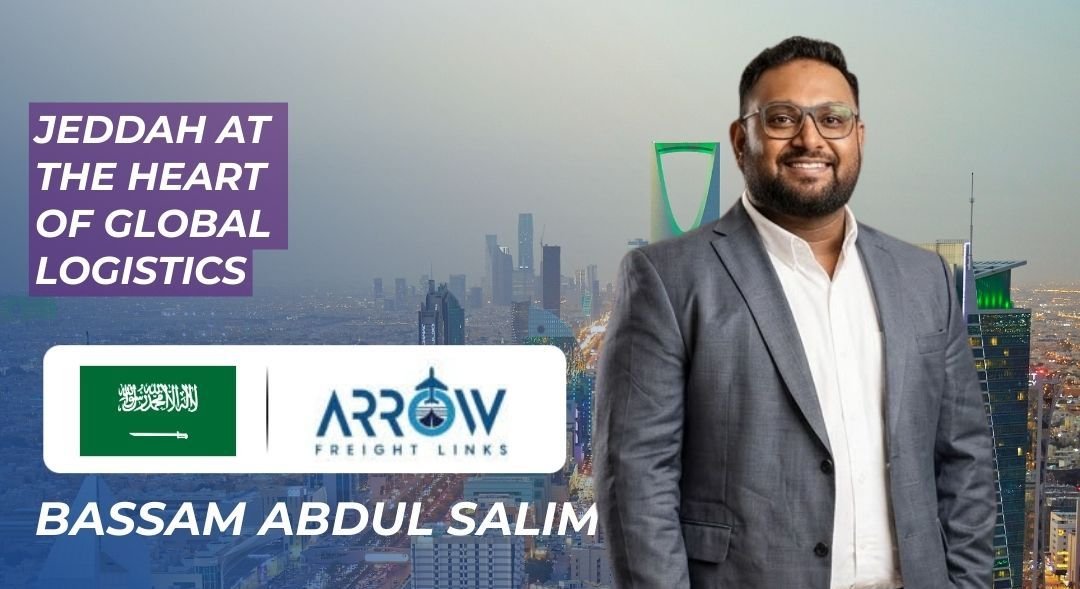
At Arrow Freight Links, those connections are part of the company’s growth strategy. Bassam Abdul Salim, the firm’s Overseas Business Development Manager, is involved in expanding commercial partnerships and strengthening links with freight partners across global markets.
In the freight forwarding industry, such networks often form the invisible backbone of global trade, allowing shipments to move seamlessly between continents and across multiple transport modes.
As trade routes continue to evolve, companies operating at strategic logistics crossroads like Jeddah may find themselves playing an increasingly influential role in shaping the future of international commerce.
For the logistics industry, the Red Sea may no longer be merely a passage between oceans.
It is becoming one of the key arenas where the next chapter of global trade will unfold.