




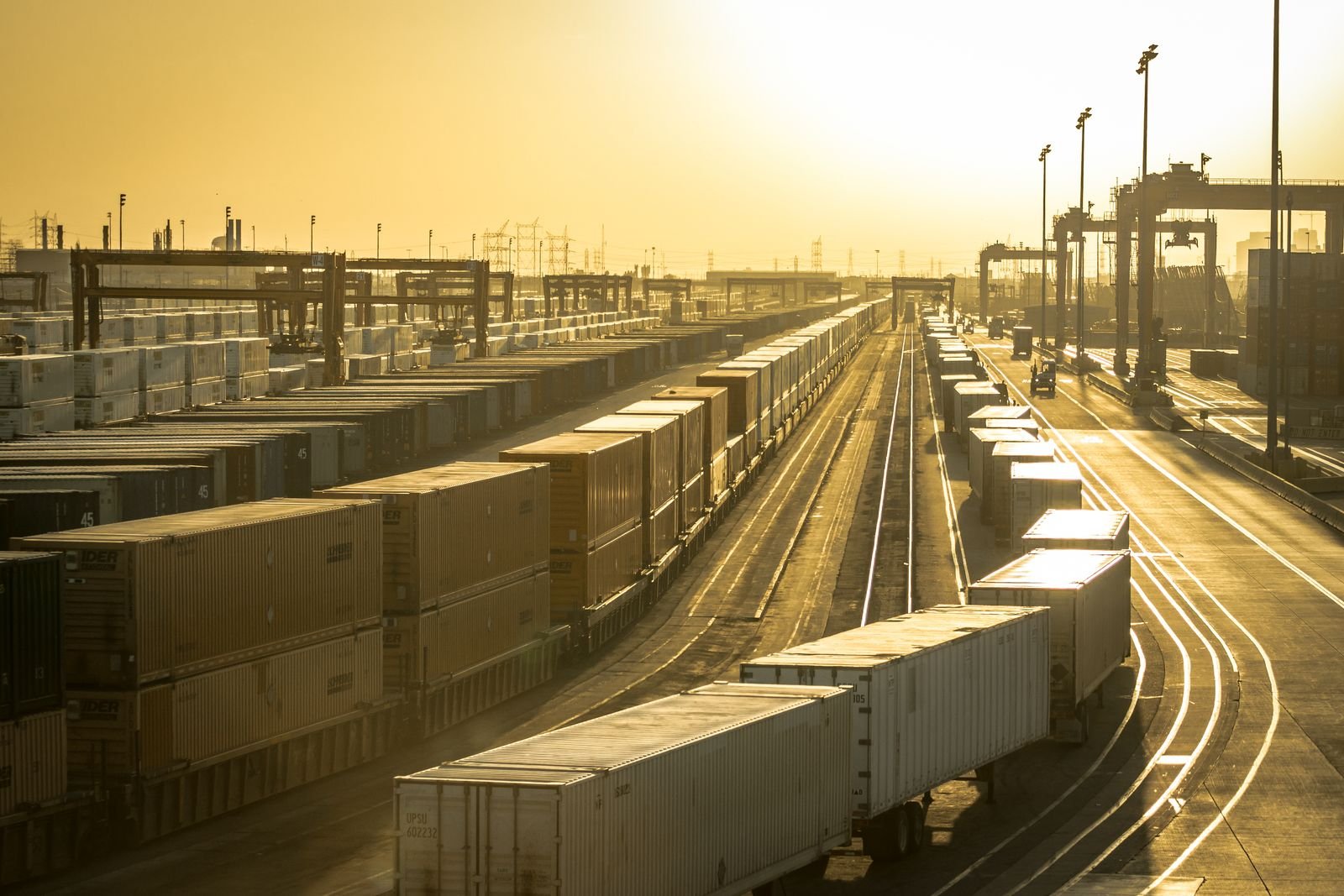
The share of imports arriving in the United States and Western Canada that move inland by rail has been falling for years, and changing ocean shipping patterns are a major reason why.
According to analysis by Larry Gross, one of the clearest long-term trends in North American supply chains has been the gradual move away from West Coast-dominated import strategies, with significant consequences for intermodal freight volumes.
Over the past 16 years, the share of US and Western Canadian import TEUs entering through the West Coast has dropped from 59% in 2010 to below 49% in 2025 on a 12-month moving average basis.
That decline reflects a broader shift by importers away from concentrated West Coast strategies and toward more diversified four-corner and five-corner distribution models, which offer both lower costs and greater flexibility across multiple gateways.
At the same time, the proportion of import containers that travel inland via intermodal rail has also been in long-term decline. This includes both inland point intermodal (IPI) cargo and Southern California transloads.
The two trends have historically moved very closely together. From 2014 through mid-2022, the relationship between West Coast share and intermodal share was strongly correlated, reflecting the simple fact that West Coast cargo generally travels longer inland distances and is therefore more suitable for rail.
That is a structural advantage the West Coast has always held over other port regions. Import containers moving inland from California, Washington or British Columbia tend to cover far longer distances to major consumption centers, making rail a more attractive option than it is for shorter-haul flows from East or Gulf Coast ports.
However, since mid-2022, that close relationship has begun to loosen.
Following the post-pandemic surge and congestion period, intermodal share started to recover roughly a year before West Coast share began moving upward again. Then, in 2023, intermodal share resumed declining even as West Coast volumes continued to improve. In 2025, the pattern shifted again: West Coast share began to fall, while intermodal share moved upward.
That decoupling does not necessarily mean the long-term structural relationship has broken. But it does suggest that other variables — including congestion, volume surges and operational disruption — have temporarily become more important than the historical gateway pattern alone.
Even so, the recent rise in intermodal share despite renewed weakness in West Coast share is notable and could point to a more meaningful change in the market.
At the start of 2026, many observers expected the West Coast’s long-term decline to continue. Tensions around Gaza had eased somewhat, and routing through the Red Sea and Suez Canal had started to look more viable again, improving the attractiveness of East Coast gateway options.
But the latest hostilities involving Iran have altered that equation. Compared with other trades, the trans-Pacific has, for now, remained relatively insulated from the worst direct effects of the Middle East disruption. As a result, West Coast share could stabilise or even improve in the near term.
If that happens, it would provide a temporary tailwind for intermodal rail.
Still, the broader conclusion remains the same: most of what drives this dynamic is outside the railroads’ control. Rail operators remain heavily dependent on routing decisions made by ocean carriers and importers, not by the rail sector itself.
Where the railroads do have more room to influence outcomes is on the domestic side of the intermodal business, where service quality, cost competitiveness and network execution can still shape share.
For now, the data suggests that intermodal performance remains deeply tied to maritime gateway strategies, even if the relationship is being distorted by short-term volatility.