



APM Terminals has strengthened its presence in Vietnam by acquiring a 49% stake in the Hateco Haiphong International Container Terminal (HHIT), a move that further cements its partnership with the country’s Hateco Group and underscores its long-term confidence in Vietnam’s growing container market.
Financial details of the deal were not disclosed. However, the investment marks an important step in a relationship that has already helped deliver one of northern Vietnam’s most significant port developments.
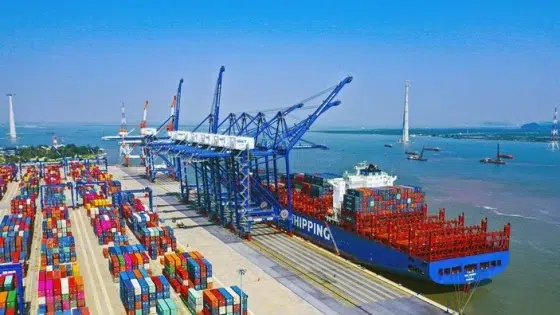
The $450 million HHIT facility, located at Lach Huyen port in Haiphong, became operational 13 months ago and has moved quickly beyond its initial targets. According to terminal figures, the two-berth operation — covering berths 5 and 6 — handled 808,000 TEUs in its first 11 months of operation, outperforming expectations at a site designed for annual capacity of 2.2 million TEUs.
The announcement comes only days after a joint venture between APM Terminals and Hateco was selected as the preferred bidder for a separate $1.8 billion terminal development in Da Nang, roughly 350 miles south of Haiphong. Together, the two projects signal an increasingly strategic push by the Maersk-owned port operator into Vietnam’s container infrastructure.
APM Terminals said its role in HHIT has gone beyond capital. The company has worked with Hateco on safety practices, automation, artificial intelligence, process optimization and decarbonization. Those efforts appear to have translated into measurable operational gains.
According to HHIT, the terminal is now achieving average productivity of 30 container moves per hour, while truck turnaround times have been reduced to 16 minutes — significantly below the local market average of 35 minutes.
Hateco Group Chairman Tran Van Ky said the terminal has already delivered some of the strongest berth productivity figures in Haiphong and has also set new benchmarks for automated gate operations. He said the group looks forward to working more closely with APM Terminals in the years ahead to further improve terminal performance for customers.
The transaction reflects a broader trend in Vietnam’s port sector, where rising trade volumes, growing industrial activity and supply chain diversification continue to attract major global operators looking for long-term footholds in Southeast Asia.