



An Austrian cleantech startup, REPS, is trying to flip a simple idea on its head: instead of seeing traffic as just congestion and emissions, what if it could actually generate electricity?
The company has just secured $23.6 million in fresh funding to accelerate the rollout of its technology, which turns vehicle movement into usable electrical energy. And while the concept sounds almost experimental at first, it’s already moving into real industrial environments, especially ports and logistics hubs.
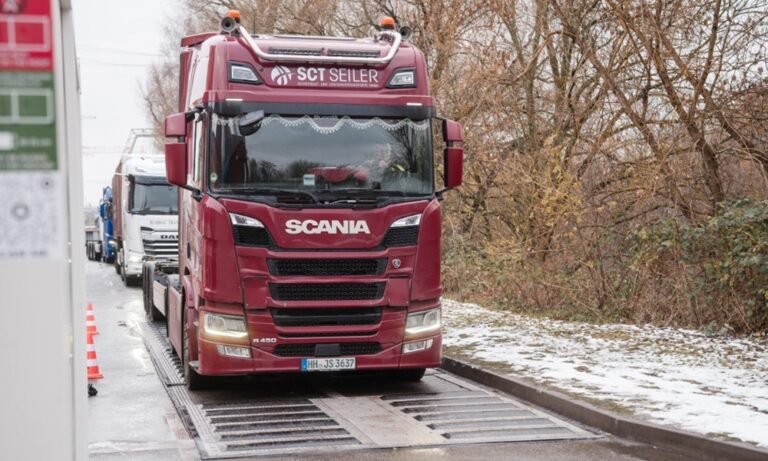
At the centre of the system is what REPS calls the Road Energy Production System. In simple terms, it’s installed directly into existing road surfaces and captures the mechanical energy produced when vehicles pass over it — especially in places where they slow down, brake, or navigate heavy traffic. Think port entrances, industrial zones, logistics yards, or busy urban corridors where trucks are constantly moving anyway.
The idea, as explained by founder Alfons Huber, is not to change traffic, but to take advantage of it. Roads already exist, vehicles are already moving — so instead of letting all that kinetic energy disappear as waste, the system tries to recover part of it and turn it into electricity.
The most important part is that this is no longer just a concept. REPS already has a live installation running at the Port of Hamburg, where it has been operating since November 2025. In just six months, more than 115,000 trucks have crossed the system, generating over 6,700 kWh of electricity under real-world conditions.
That pilot site has quickly become a reference point. The company says it is now in discussions with more than 90 organisations across ports, logistics networks, and infrastructure operators in Europe, North America, Asia, and the Middle East. Interest is also growing from city planners looking at ways to make urban infrastructure more energy productive.
At the Port of Hamburg itself, the system is being watched closely. Hamburger Container Service CEO Justin Karnbach pointed out that the key advantage is simplicity: trucks are already slowing down or braking in those areas, so the system simply captures energy from movements that would happen anyway, without disrupting operations.
If scaled up, REPS estimates that a full deployment across road networks connected to Hamburg’s port could produce around 10 GWh of electricity per year — enough to power roughly 2,800 households — while also offsetting close to 10% of traffic-related emissions linked to port activity.
Beyond ports, the ambition is much bigger. The company sees potential in dense urban road networks and logistics corridors, where traffic is constant and energy demand is close by. In theory, this could turn parts of road infrastructure into decentralised power sources rather than just consumption points.
A key selling point is also independence from weather. Unlike solar or wind, the system works continuously as long as vehicles are moving. REPS also claims its technology is more efficient than similar energy-harvesting solutions and is built to last over 20 years, which is important for infrastructure-heavy environments.
The company’s story also has a bit of a founder-driven angle. Alfons Huber left his physics studies more than six years ago to focus fully on developing the concept, which eventually led to what the company now describes as the world’s first operational road power plant.
Now, with fresh capital in hand, REPS is shifting into a new phase: scaling. The technology has been proven in a real port environment, and the next challenge is convincing more operators to embed it into large transport and logistics networks.
And for ports under pressure to decarbonise while still handling rising traffic volumes, the pitch is fairly straightforward: the roads are already there, the traffic is already happening — the question is whether that movement can now be turned into usable energy.