




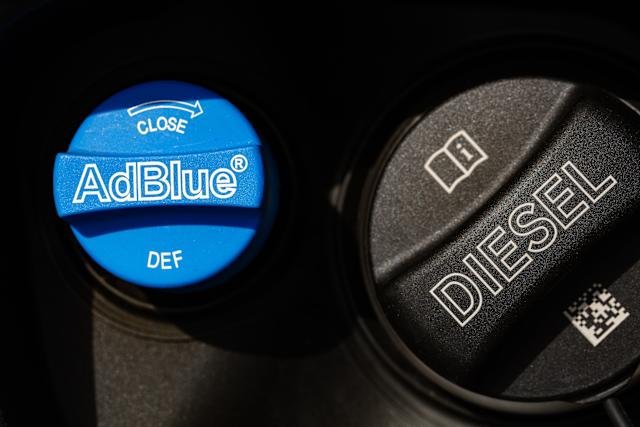
As the Middle East conflict sends shockwaves through energy markets, diesel prices have climbed sharply across the United States. Yet one related cost has, somewhat unexpectedly, remained mostly unchanged: diesel exhaust fluid.
For truckers, that contrast has become increasingly striking. SONAR’s DTS.USA Truckstop average retail diesel price reached $5.18 per gallon on Friday, up from $3.81 on March 2. At the same time, retail DEF prices have shown little sign of reacting, even though the raw material used to produce it has risen dramatically in the global market.
The main ingredient behind DEF is urea, which itself depends heavily on natural gas. The Middle East has long been a major exporter of urea because of its abundant gas resources, so disruptions in the region were widely expected to push DEF prices higher as well.
So far, that has not happened at retail level.
Data from major travel center operators suggests prices have remained broadly stable. Pilot Flying J, which publishes a downloadable price spreadsheet covering more than 800 locations, showed virtually no meaningful rise in DEF prices between March 1 and the present. Where changes did occur, they were limited and generally no more than 10 cents per gallon. Across the network, the most common DEF prices remain between $4.299 and $4.599 per gallon.
A company spokesperson said only that Pilot is working hard to maintain supply for customers.
Love’s Travel Centers has also kept its retail DEF pricing steady since the start of hostilities, according to a company spokeswoman. Although FreightWaves did not have older Love’s pricing data for comparison, its current DEF prices appear broadly aligned with Pilot Flying J levels.
The stability is especially notable given what has happened upstream. According to Argus Media data provided to FreightWaves, the FOB Egypt benchmark price for urea rose from $482.50 per metric ton on Feb. 27 — the last assessment before military action began — to $712.50 by March 13. It has since eased slightly, reaching $705 per metric ton on Monday.
That sharp increase would normally be expected to feed into higher DEF prices. But the pricing chain is more complicated than it first appears.
Suzie Skipper, an editor at Argus, explained that US DEF pricing begins with urea liquor, a derivative of urea. Urea’s primary market is fertilizer, and urea liquor is typically sold at a premium to the Argus benchmark for urea in New Orleans. Importantly, that premium is often negotiated annually and remains fixed for 12 months.
While the underlying New Orleans urea benchmark can change daily, contract DEF prices tied to it usually move only once a month. That time lag may help explain why retail DEF prices have not yet reacted in line with spot market volatility.
Still, that insulation may not last indefinitely. Skipper noted that in periods of extreme volatility — such as the market disruption of late 2021 and 2022 — DEF spot prices can move more than once per month. That already happened in March, with changes recorded on March 5 and again on March 13.
Yet even those moves have not, at least so far, translated into higher prices at the pump.
Harry Minihan, another Argus analyst, described the Middle East urea market as “going bananas,” noting that the reaction is unsurprising given the region’s role in global fertilizer supply. He said Qatar has announced a full reduction in urea production, while other producers are effectively cut off because they cannot move safely through the Strait of Hormuz.
According to Minihan, Gulf producers account for about 20% of world urea supply. He explained that urea is produced by cracking natural gas, combining it with atmospheric nitrogen to create ammonia, and then mixing that ammonia with carbon dioxide to form urea.
The market, however, has been helped by timing. Major importers such as India, Pakistan and Brazil are not currently at a peak buying point in their fertilizer calendars, which has reduced immediate demand pressure. Minihan said that has provided a degree of breathing room.
For now, US truckers are still benefiting from that delay. But if urea markets remain elevated, retail DEF prices may not be able to hold steady much longer.