



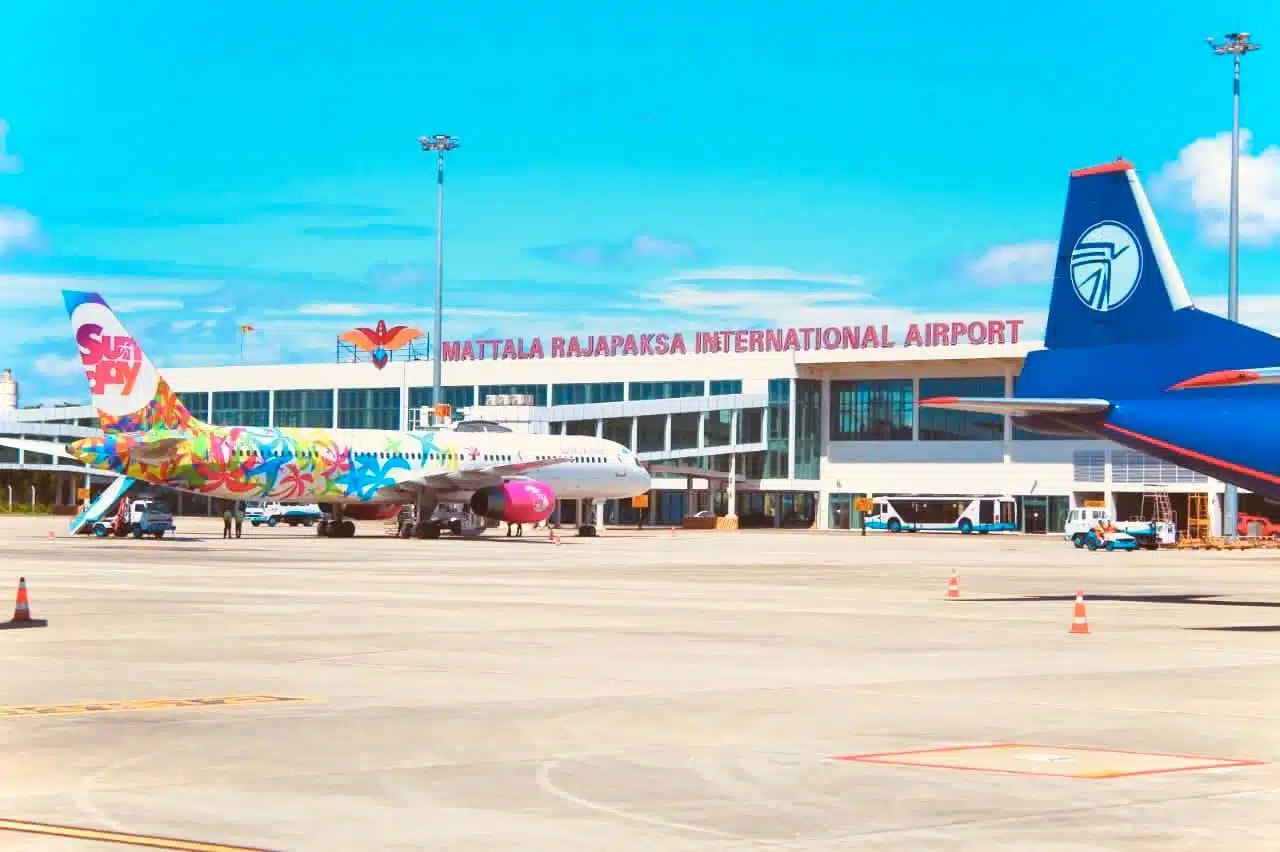
Sri Lanka has put forward Mattala Rajapaksa International Airport as a fallback hub for long-haul carriers affected by the ongoing disruption of Middle Eastern airspace, as the regional conflict continues to unsettle key international flight corridors.
The current crisis has led to full or partial closures of civilian airspace across Iran, Iraq, Israel, Qatar and parts of the United Arab Emirates. The consequences have been significant for Gulf aviation. Major hubs such as Dubai International Airport, Hamad International Airport and Zayed International Airport have all been forced to suspend or scale back portions of their operations, putting pressure on Europe–Asia and Europe–Australia traffic flows.
With traditional Gulf transfer points constrained, airlines have had to rethink their operating patterns. In many cases, that has meant rerouting services, inserting technical stops or cancelling flights altogether. Against that backdrop, industry analysts say there is now an urgent need for dependable secondary airports located outside the affected zones. Sri Lanka argues that Mattala, on the country’s southern coast, is well placed to play that role thanks to its location along East–West Indian Ocean flight paths and its distance from the conflict area.
Opened in 2013, Mattala Rajapaksa International Airport was originally conceived as Sri Lanka’s second international airport. It was intended both to reduce congestion at Colombo’s Bandaranaike International Airport and to strengthen Sri Lanka’s position as a regional aviation and logistics platform. The airport was built with a 3,500-metre runway designed to handle large widebody aircraft, alongside modern passenger facilities and cargo infrastructure.
Yet despite that ambition, Mattala struggled almost from the outset to build regular traffic. Its location in Hambantota, more than 200 kilometres from Colombo and the country’s principal population and commercial centre, has long worked against it. Unlike Colombo, Hambantota does not have the same tourism base or economic concentration, and airlines have remained reluctant to establish sustained operations there.
What now works in Mattala’s favour is precisely the infrastructure that once appeared underused. Its 3,500-metre runway can accommodate large aircraft including the Airbus A350, Boeing 777 and Airbus A380, all of which are central to Gulf carrier fleets. That capability, combined with past experience handling diversions, charter services and medical evacuations, has reinforced the airport’s credibility as a contingency location. Sri Lanka’s Civil Aviation Authority has also already included Mattala in official contingency planning frameworks, with particular attention to passenger handling, fuel provision and operational readiness.
The proposal comes at a time when Sri Lanka’s tourism economy is already feeling the effects of the Middle East disruption. Officials estimate that flight cancellations have contributed to a 20% to 25% decline in tourist arrivals during March, resulting in an immediate revenue shortfall of around US$40 million. Authorities believe that if Gulf carriers begin using Mattala in a formal contingency capacity, the airport could help cushion that blow by supporting the tourism season and generating extra foreign exchange through fuel sales, handling charges and temporary crew accommodation.
However, aviation specialists caution that turning Mattala into a reliable emergency hub will require more than a strategic location and a long runway. Sustaining such a role depends on continued investment in runway and taxiway maintenance, reliable fuel availability, strong ground-handling capabilities and close coordination with regional air traffic authorities. Diplomatic and security sensitivities also remain a critical factor, especially as overflight permissions across multiple Middle Eastern states continue to be politically delicate.
Sri Lanka’s proposal is therefore both practical and opportunistic: a bid to place dormant infrastructure at the centre of an aviation crisis, while also trying to recover some of the economic ground already lost.