



The ceasefire announced between the US and Iran may offer limited short-term relief to the airfreight sector, but a full market recovery is likely to take much longer, according to Xeneta.
After the two-week ceasefire was announced on Tuesday, the market intelligence firm said air cargo rates and jet fuel prices would not immediately return to pre-conflict levels. Airlines will need time to re-establish operations, airspace restrictions remain in place, and shippers are expected to stay cautious about routing cargo back through Middle East hubs while the situation remains fragile.
Niall van de Wouw, Xeneta’s chief airfreight officer, said the market shock has fundamentally been a supply issue. He noted that additional flights through Middle East airspace would help ease pressure on existing capacity and could start to bring rates down. However, he also warned that even once airspace is considered safe, rebuilding operational infrastructure and restoring customer confidence will take time. Insurance providers may also continue advising against transit through Middle East hubs despite the ceasefire.
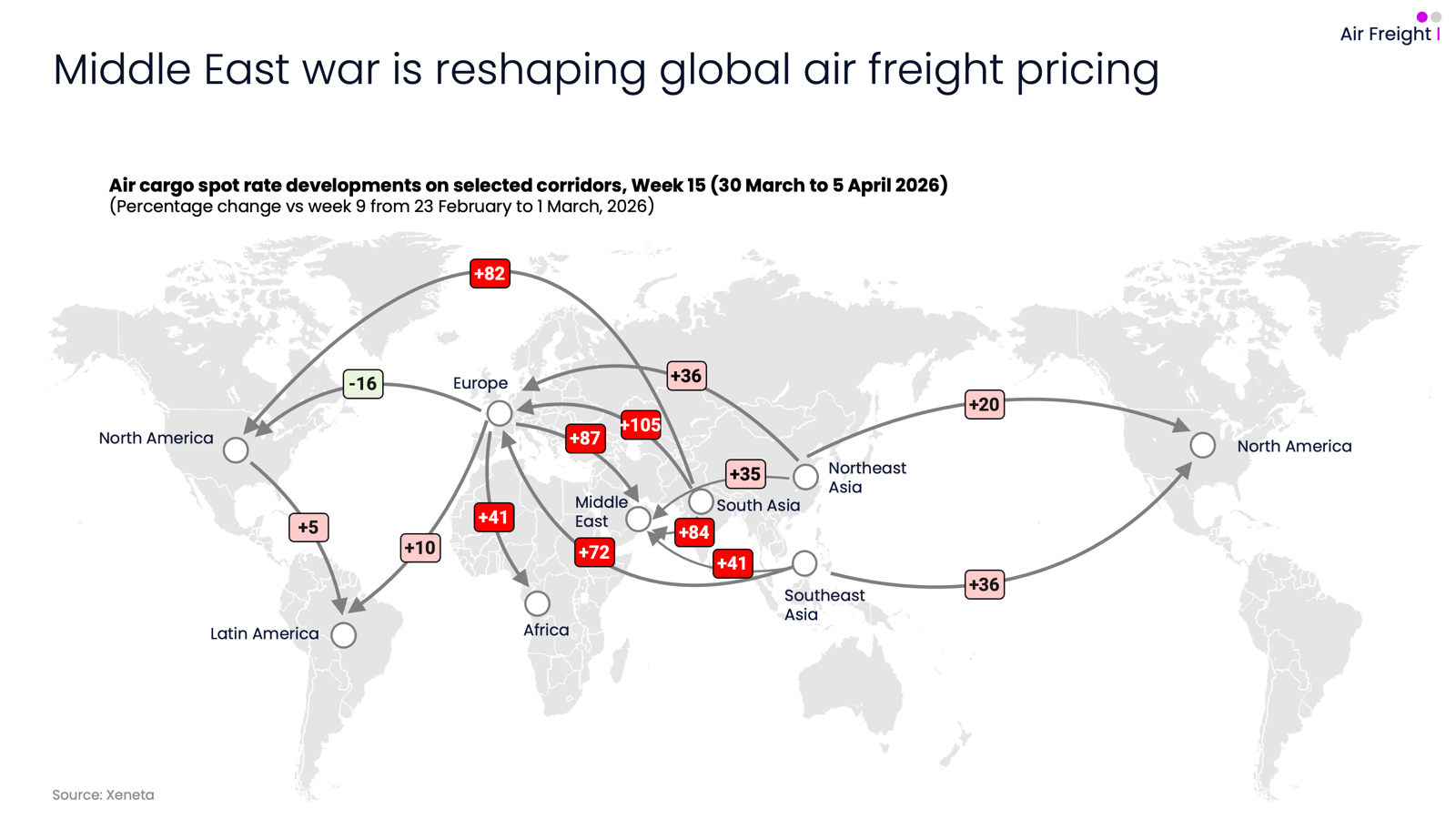
Xeneta’s figures show that rates on the most affected trades have remained sharply elevated. Spot prices from South Asia to Europe are up 105% year on year. From Europe to the Middle East, rates have climbed 87%, while South Asia to the Middle East is up 84%. South Asia to North America has risen 82%, and Southeast Asia to Europe is 72% higher than a year ago.
Van de Wouw said airlines are unlikely to reduce rates quickly, given that the ceasefire is temporary and the geopolitical backdrop remains unstable. He added that shippers are also unlikely to make major routing changes based on what he described as a fragile two-week arrangement, especially after Iran reportedly re-closed the Strait of Hormuz just hours after the agreement was announced.
In his view, a two-week window is too short to justify reworking freight planning, meaning spot rates are unlikely to fall as quickly as they rose.
Jet fuel prices are also expected to take time to settle. Xeneta further warned that bellyhold capacity could remain under pressure if passenger confidence in Middle East travel destinations does not recover rapidly. That matters because major Gulf carriers such as Emirates and Qatar Airways rely heavily on passenger revenues to support some of the world’s most important airfreight networks.
If passenger demand remains weak, airlines may operate routes below sustainable load factors and could eventually trim capacity, creating another constraint for cargo.
The latest data also shows that global air cargo demand was already under pressure. Last week, Xeneta reported that worldwide air cargo demand fell 3% year on year in March, while available capacity was down 6% compared with March 2025. At the same time, the company’s dynamic load factor, its measure of capacity utilisation based on both cargo weight and volume relative to available supply, rose to 65%.