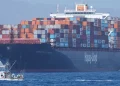
The vessel was struck on 25 June, about 7.5 nautical miles southeast of Dahit, Oman, according to maritime security company Vanguard Tech. The incident came only days after the IMO introduced a coordinated evacuation scheme for merchant vessels that had remained trapped inside the Arabian Gulf.
The United Kingdom Maritime Trade Operations (UKMTO) reported that the projectile hit the ship’s starboard side, damaging the bridge. Despite the impact, the vessel’s master confirmed there were no injuries, no pollution and no loss of the ship’s operational capability.
IMO Secretary-General Arsenio Dominguez clarified that the Ever Lovely was not participating in the organization’s evacuation programme when it was attacked. Nevertheless, he decided to suspend the initiative while the IMO seeks renewed assurances that ships can continue crossing the waterway safely.
Dominguez noted that several vessels had already been evacuated successfully under the programme before it was paused. He added that protecting seafarers remains the organization’s highest priority and that the suspension will stay in place until the security situation becomes clearer.
The attack followed warnings issued by Iran’s Islamic Revolutionary Guard Corps (IRGC), which declared that ships sailing through the Strait of Hormuz without Iranian authorization were doing so illegally.
Following the 60-day agreement reached between the United States and Iran, two navigation corridors had been opened through the strait. One route runs through waters controlled by Iran, while the second follows a southern corridor inside Omani waters near the country’s coastline. The traditional Traffic Separation Scheme (TSS) remains closed because of concerns over possible Iranian naval mines.
Earlier this week, Oman published guidance for vessels using the southern corridor as part of the IMO evacuation programme. Shortly afterwards, Iranian media reported IRGC warnings, while several ships also received radio broadcasts stating that vessels travelling without authorization should not enter the waterway.
If the strike on the Ever Lovely is confirmed to have been carried out by the IRGC, it would represent a direct challenge to the United Nations Convention on the Law of the Sea (UNCLOS), which guarantees the right of unhindered transit passage through the Strait of Hormuz.
Despite the attack, AIS tracking data from Pole Star Global showed that the Ever Lovely continued its voyage into the Gulf of Oman. Two additional Evergreen vessels — Ever Unicorn and Ever Lotus — also completed the passage, along with the Singapore-registered Wan Hai 501.
Traffic through the Strait of Hormuz had been recovering rapidly before the latest incident. Data from AXS Marine recorded 62 verified transits on 24 June, representing about 53% of the number registered on the same date in 2025.
Commenting on the situation, Bimco Chief Safety & Security Officer Jakob Larsen described the attack as a serious setback for efforts to restore normal shipping through the strait. While he expects some commercial traffic to continue, he acknowledged that the incident has complicated plans to resume regular transits.
Even with the IMO programme on hold, vessel tracking data showed at least two ships preparing to use the southern corridor through the Strait of Hormuz at the time of publication. Another vessel, the Togo-flagged tanker Blue Star 1, turned back while leaving the strait on 25 June.