



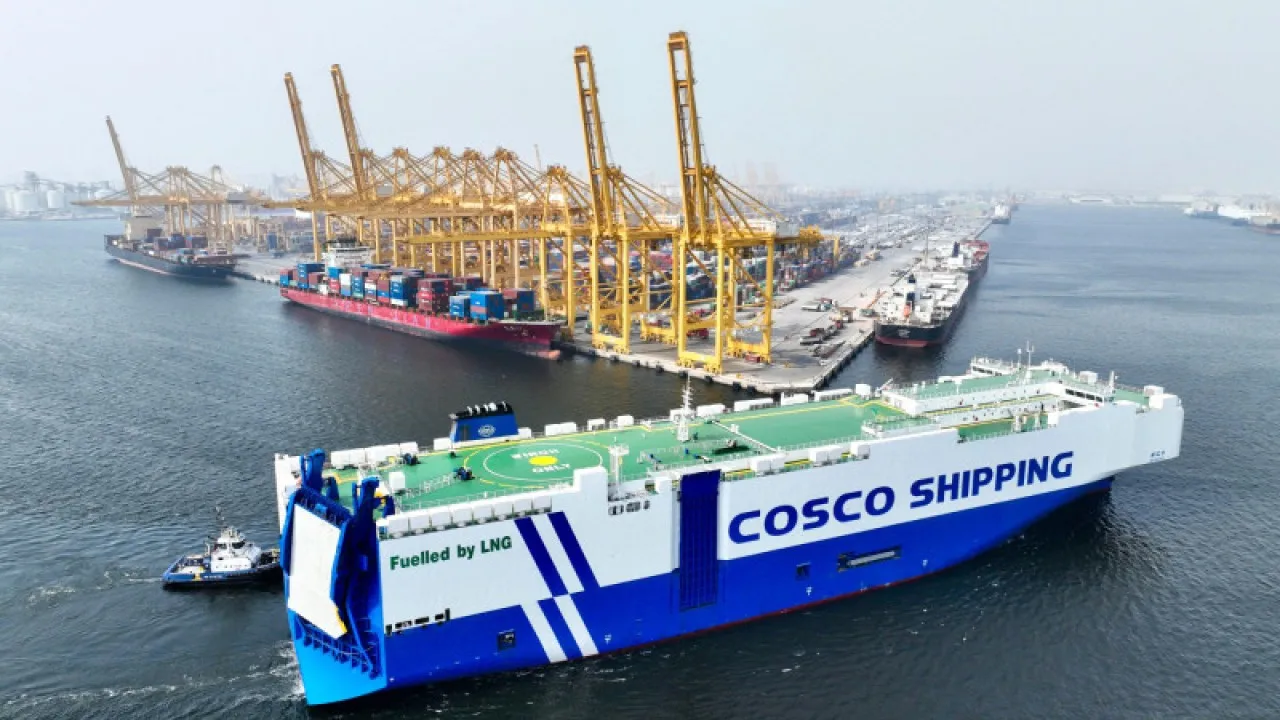
A fire aboard the COSCO-managed car carrier Min Jiang Kou forced all 22 crew members to abandon the vessel on 8 August, prompting an international rescue operation more than 600 miles off the coast of Costa Rica.
The Marshall Islands-registered vessel was sailing towards the Ecuadorian port of Manta when the crew reported an engine room fire. The incident triggered a response coordinated by the US Coast Guard (USCG).
The Coast Guard received an Inmarsat distress call at 01:09 on 8 August, with the Min Jiang Kou located approximately 630 miles south of Costa Rica.
The crew initially activated the ship’s carbon dioxide firefighting system, which managed to contain the fire. The situation later deteriorated as smoke began to spread through the vessel.
“At 11:33 pm, [local time] the ship’s crew reported increased smoke aboard the vessel,” the USCG said. The captain subsequently ordered the crew to abandon ship using the vessel’s lifeboats, while remaining on board himself.
Nearby vessels respond to the distress call
With the crew in lifeboats, the USCG issued a request for assistance to vessels operating in the area.
Two ships responded: the 44,500 dwt bulker Jin Hai Ping and the 50,000 dwt tanker Degu.
The Jin Hai Ping reached the lifeboats and recovered all 22 mariners, while the Degu remained nearby to provide assistance.
By 12:21 pm on Friday, all 22 crew members were safely aboard the Jin Hai Ping, which is now transporting them to Akita, Japan.
The USCG highlighted the response as an example of cooperation between vessels and maritime authorities during an emergency at sea.
“The willingness of fellow mariners to answer a distress call reminds us of the extraordinary commitment the maritime community shares to protecting life at sea,” said Capt. Jessica Davila, Southwest District chief of incident management.
She added that the rescue demonstrated both the importance of international cooperation and the need for effective coordination to ensure that seafarers in distress can receive assistance as quickly as possible.
Questions remain over the cargo
The circumstances surrounding the fire and the vessel’s cargo could attract further attention as the investigation develops.
One industry source believes the Min Jiang Kou may have been carrying Chinese-built electric vehicles. Electric vehicles use lithium-ion batteries, which can present particular risks in the event of mechanical or electrical failures.
If a battery enters thermal runaway, it can generate extremely high temperatures, produce fire and release toxic fumes, creating additional challenges for crews responding to a vehicle fire aboard a ship.
However, the possible presence of electric vehicles has not been confirmed by the US Coast Guard in its account of the incident.
At this stage, the USCG reported no environmental impact from the incident.
Meanwhile, Resolve Marine is assessing the situation and looking to undertake repairs to the affected vessel.