



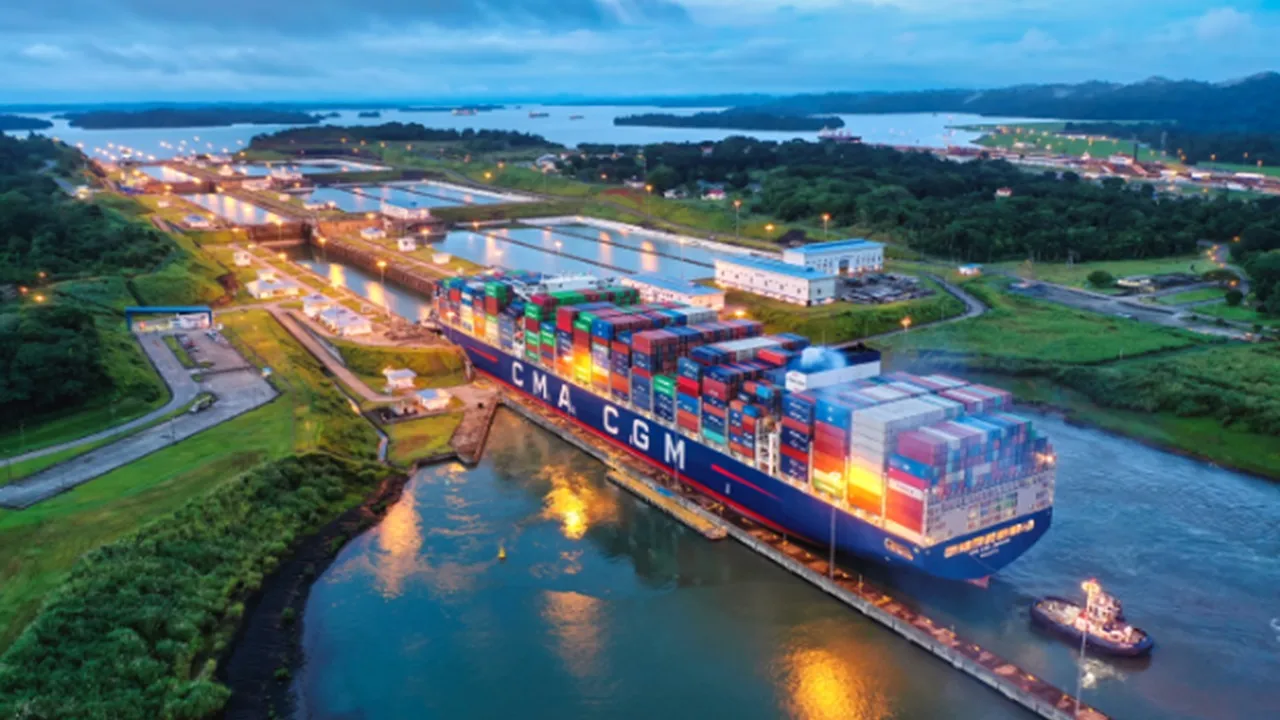
Container shipping lines are facing growing criticism over the transparency of new Panama Canal Adjustment Surcharges (PCAS), introduced as tighter draft restrictions reduce available vessel capacity through the waterway.
Four carriers have announced surcharges ranging from $100 to $500 per TEU as conditions on the Panama Canal become more challenging for Neopanamax vessels.
The restrictions have been introduced by the Panama Canal Authority (ACP) as lower water levels linked to El Niño and other climate-related conditions continue to affect the canal.
Shipping consultancy Drewry, however, says carriers have provided insufficient information to explain exactly what shippers are paying for.
Simon Heaney, senior manager at Drewry, said the surcharges are intended to recover revenue lost as reduced transit capacity affects carrier operations.
“Container lines are starting to announce Panama Canal Adjustment surcharges, but, as usual, there is little context or justification provided to customers,” Heaney said in a report published last week.
Higher transit costs spread across fewer containers
The Global Shippers’ Forum (GSF) has also questioned how the additional charges are being calculated.
James Hookham, director of the GSF, pointed to the daily auctions for available Panama Canal transit slots, where strong demand is pushing up the cost of securing passages.
According to Hookham, carriers are facing higher costs while also having fewer containers over which to distribute those expenses.
“There are auctions of available transit slots every day, due to high demand, more vessels for the same volume, raising the cost per teu,” he said.
“These higher costs need to be spread over fewer boxes, hence the carrier surcharges,” Hookham added.
The central concern for shippers is whether the surcharges accurately reflect the additional costs being incurred by carriers.
Hookham said customers currently lack sufficient information to determine how much transit costs have actually increased and whether the charges imposed by shipping lines correspond directly to those additional expenses.
“Whether the surcharge truly reflects the additional charge having to be paid is the great unknown. Shippers have no visibility on how much transit costs have actually risen,” he said.
The debate highlights the wider challenge facing container shipping as climate-related water constraints affect one of the world’s most important maritime trade routes.
With Panama Canal capacity under pressure and transit slots becoming more expensive, carriers are attempting to recover additional operating costs, while shippers are demanding greater visibility into the calculation and justification of the surcharges being passed on to them.