



The security situation for commercial shipping in the Black Sea has deteriorated further, with the area exposed to attacks now extending into the waters of Romania and Bulgaria. According to maritime security company Ambrey, a series of incidents involving unmanned aerial vehicles (UAVs) and uncrewed surface vessels (USVs) has highlighted a significant geographical expansion of the maritime dimension of the Russia-Ukraine conflict.
Ambrey’s assessment follows three attacks against merchant vessels over a 24-hour period on 5 and 6 October.
The company said the geographical area of the conflict has widened, although the apparent targeting pattern remains unchanged. Russian forces appear to be targeting vessels connected to Ukrainian trade, including ships operating within the exclusive economic zones (EEZs) of two NATO member states.
“Deliberate targeting of unrelated shipping remains unlikely,” Ambrey said, while warning that Romanian and Bulgarian waters should no longer automatically be considered safe.
All three vessels involved in the incidents were trading to or from Danube ports. Ambrey assessed that their connection to Ukraine’s grain exports was the most likely reason they were targeted and said it was highly likely that Russian forces were responsible for the attacks.
Deadly attack in Romania’s EEZ
The St Kitts and Nevis-flagged general cargo vessel Royad Mammadov came under drone attack while sailing from Izmail carrying corn. The incident occurred inside Romania’s EEZ.
Romanian authorities reported that two crew members were killed. Ukraine subsequently attributed the attack to Russian forces.
A second vessel, the general cargo ship Able, was attacked while operating inside Bulgaria’s EEZ. Both aerial and maritime drones were involved in the incident, which triggered a fire onboard. All members of the crew were successfully rescued.
The situation was even more serious for the Togo-flagged general cargo vessel Alfa Watan. The ship sank after being struck by aerial and sea drones. Its 10 crew members remain unaccounted for, although search and rescue operations have now been suspended.
For Ambrey, the fact that commercial vessels have been attacked inside the EEZs of NATO countries represents a major development in the geographical expansion of the threat.
The company nevertheless considers it unlikely that vessels without a connection to Ukrainian trade are being deliberately selected. However, the danger to other commercial shipping has increased because of the possibility of misidentification, collateral damage and unexploded ordnance in the western Black Sea.
Tanker attacked near Russia-Georgia border
The escalation has not been limited to the western Black Sea.
On 5 October, a laden crude oil tanker was attacked by Ukrainian forces in the eastern Black Sea, approximately five nautical miles south of Adler, Russia, close to the Georgian border.
The vessel, identified by Vanguard Tech as the Aframax Rio, was attacked by uncrewed surface vessels.
Russia’s Ministry of Transport later confirmed that all 23 crew members had been rescued and were unharmed.
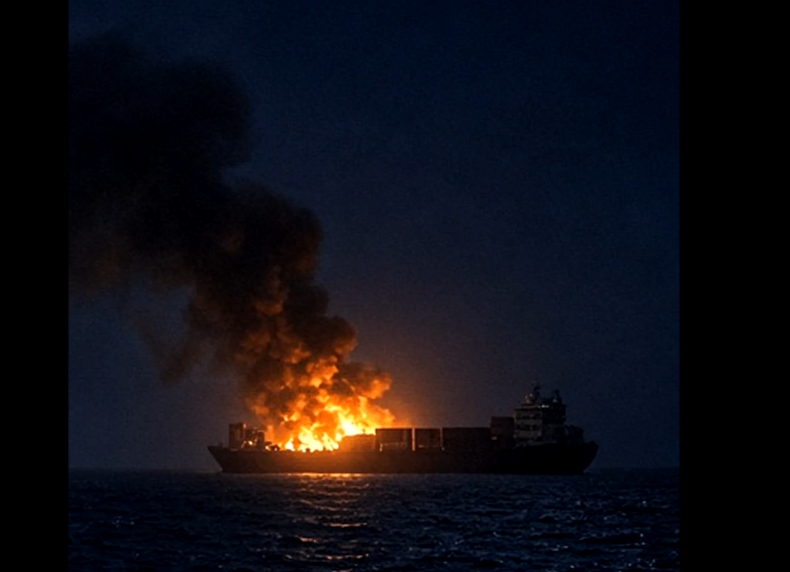
Footage filmed from the shoreline showed a major fire spreading across the surface of the sea. Ambrey subsequently assessed that the vessel may have been subjected to a second attack after the initial incident on 5 October.
Later footage showed that the fire around Aframax Rio had been extinguished, while support vessels were operating around the damaged tanker. Russian authorities said there had been no oil pollution in the water and confirmed that rescue vessels remained on standby.
Russian strike reported at Odessa port
The threat continued to develop on 7 October.
Russia’s Ministry of Defence said it had attacked a dry cargo vessel in the port of Odessa, alleging that the ship was transporting military and dual-use cargo intended for Ukraine.
Separate footage was also released showing a drone apparently targeting a dry cargo vessel at the port of Yuzhny, in the Odessa region.
The latest incidents underline the increasingly complex operating environment facing merchant shipping across the Black Sea. While vessels directly connected to Ukrainian trade appear to remain the primary concern, the expansion of attacks into Romanian and Bulgarian waters means that commercial operators can no longer consider the western part of the Black Sea to be insulated from the conflict.