



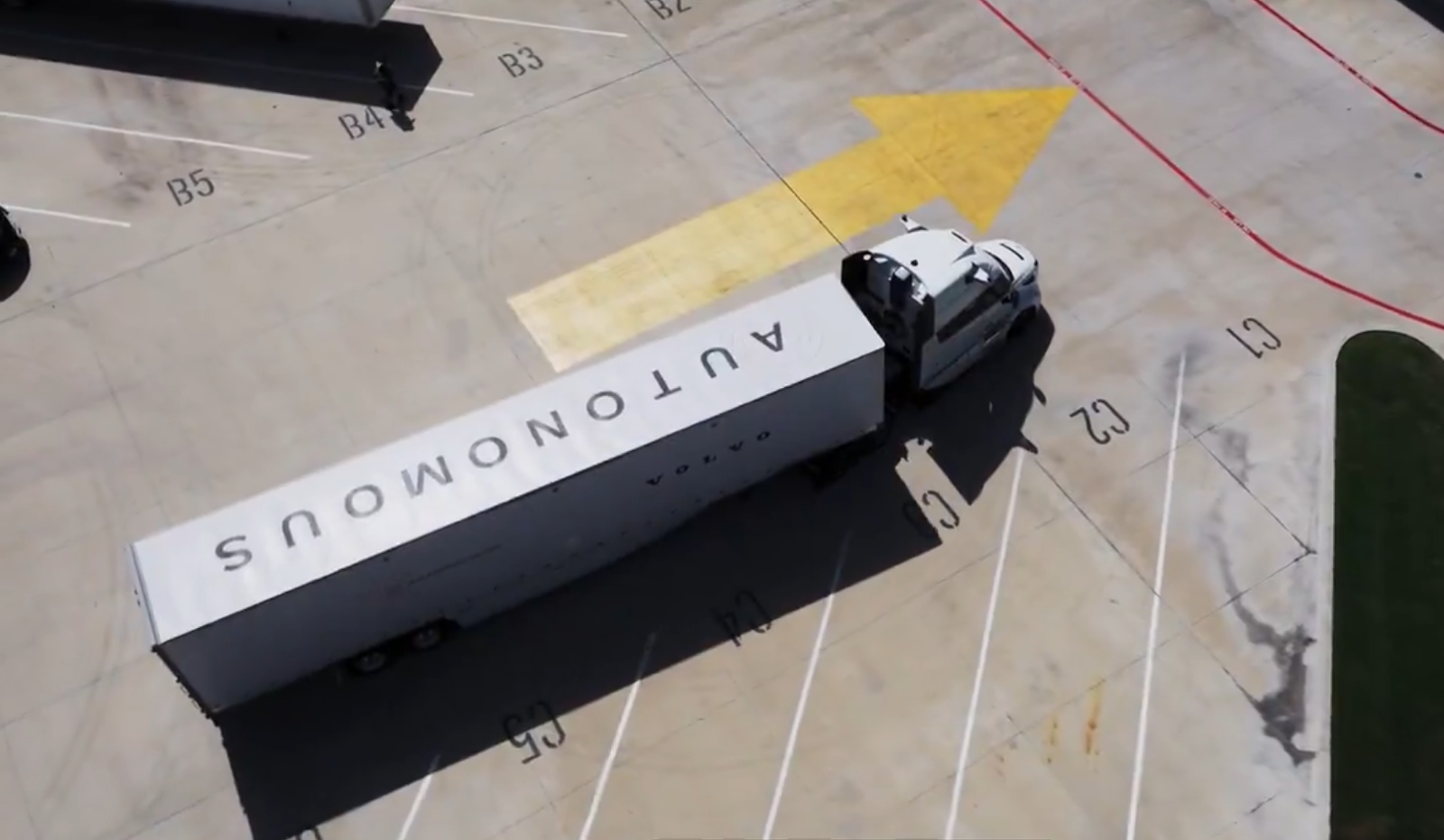
Two cabless electric trucks from Einride have entered daily freight operations in Marysville, Ohio, marking a new phase in the autonomous trucking work being carried out with EASE Logistics.
The two SAE Level 4 vehicles operate scheduled movements between EASE’s warehouses, traveling across company property as well as local public roads without anyone inside the trucks. Remote operators supervise the vehicles from an off-site location and can intervene when human assistance is required.
EASE placed the trucks into service in late August. Since then, the companies said the operation has begun producing data that will help assess safety, reliability and efficiency in an actual freight environment.
The deployment is expected to provide a basis for the next stage of the project. Einride and EASE plan to examine metrics including miles driven, loads transported and vehicle uptime before determining how the operation could expand. Those results will also feed discussions with the Ohio Department of Transportation (ODOT), the Indiana Department of Transportation (INDOT) and potential logistics partners.
The companies did not disclose specific performance figures in Tuesday’s announcement.
“Daily operations in Marysville give us the proof points we need to keep expanding autonomous freight across the corridor and beyond,” said Henrik Green, CTO at Einride.
A new step beyond the pilot phase
The Marysville operation follows an earlier proof-of-concept initiative announced in May by EASE Logistics, Einride, DriveOhio and the Indiana Department of Transportation.
At the time, Peter Coratola Jr., founder, president and CEO of EASE Logistics, said real-world deployments were essential to moving autonomous trucking beyond controlled demonstrations and toward everyday freight operations.
The current project represents EASE’s third autonomous trucking deployment with DriveOhio.
It is part of the Truck Automation Corridor Project, a multi-year initiative launched in 2021 by the Ohio Department of Transportation, DriveOhio and INDOT. The $8.8 million program is examining truck automation along major freight routes connecting Ohio and Indiana.
Marysville serves as a controlled freight environment
For now, the trucks operate on a simple closed loop linking EASE’s two Marysville facilities.
The limited route allows the companies to study the technology in a repeatable environment while also identifying the operational requirements that would accompany broader deployment.
The trucks still require people to load and unload freight, while the autonomous system is being evaluated for how it handles the rest of the movement.
The companies are examining questions ranging from how the vehicles navigate around other trucks to how they approach loading and unloading areas, as well as which operating schedules are most effective.
“Really closed loop right now between our two warehouses, just running things back and forth so we can understand what does it take from a manpower standpoint on either side. You still have to have a human load and unload those things,” Failla said. “But what kind of obstacles does it see navigating around trucks, loading in, loading out, what time frames are best?”
EASE first met Einride at a mobility conference in Ohio last year, according to Failla. The logistics company has been involved in autonomous trucking work with DriveOhio for roughly four years.
For EASE, the objective is not simply to test technology but also to have direct experience as policymakers develop rules for autonomous freight.
“There’s some level of autonomy coming into the freight industry. And what we don’t want is our lawmakers and legislators to decide what that looks like for us without someone who understands the operation at the table,” she said.
An automotive logistics background shapes the strategy
EASE’s interest in autonomous freight is closely linked to its origins in automotive logistics.
Coratola founded the Dublin, Ohio-based company in 2014 after his first logistics position introduced him to automotive shippers. EASE has since expanded into food and beverage, consumer packaged goods, retail and healthcare freight.
Even so, Coratola said the company’s operating model remains heavily influenced by the automotive sector, where freight reliability is critical. Automotive customers require what he described as no-fail transportation, extensive communication and consistent service regardless of the hour or day.
An assembly plant can have between 1,400 and 2,000 suppliers feeding into a single sequence trailer, Coratola said in an August interview with FreightWaves. If a shipment stops arriving, production can stop with it.
That supplier network is now changing again.
According to Coratola, original equipment manufacturers spent roughly two years consolidating their supply bases around electric vehicle production. In some cases, the number of suppliers fell from about 2,700 to approximately 1,200, while manufacturers also added plants capable of handling lithium.
Coratola said he now sees production moving back toward hybrid and internal combustion engine vehicles. Suppliers that had remained inactive for two years are beginning to restart operations.
“It looks like their supply chains are reflected more of what people are buying rather than what they think they’re buying,” Coratola said.
Empty racks could become an early autonomous freight application
For EASE, one of the most immediate opportunities for autonomous technology in automotive logistics may not involve delivering parts to an assembly line at all.
Instead, Coratola sees empty racks as a potential first application.
Parts arrive at plants in racks, but those racks must eventually be removed. When suppliers run late or production falls behind schedule, empty racks can accumulate, creating additional movements that require a driver.
Autonomous trucks could eventually handle these repetitive repositioning tasks without requiring drivers to remain available for them.
“Rather than holding drivers or continuously having to spot drivers to come get racks, this type of technology would be able to deploy essentially an autonomous supply chain that helps that carousel — racks go back,” Coratola said.
The concept is not intended to replace conventional long-haul trucking.
“We’re not talking about sending racks from the Midwest all the way to Texas. We’re talking about getting them out of the plant to a pickup location closer where they can then go on an over-the-road truck,” he said.
In that sense, the Marysville operation represents a warehouse-scale version of the same carousel concept: moving equipment repeatedly between two fixed points.
Coratola said unexpected rack movements are particularly costly because drivers may not be available when they are needed. The resulting freight may then have to be spotted or expedited.
Failla added that an autonomous carousel could potentially operate around the clock and be scheduled according to traffic conditions, allowing vehicles to avoid the busiest roads.
Remote supervision remains part of the operation
The autonomous trucks are not operating without human oversight.
Remote operators continuously monitor the vehicles and can take control if a situation requires human intervention, according to Failla.
EASE also does not view autonomous trucking as a strategy for eliminating driver positions. Instead, the company believes the technology could eventually change the type of work drivers perform.
Failla pointed to the aging driver population as one reason autonomous systems could help preserve experienced workers within the freight industry.
“So with the aging population that just is a fact with our drivers, this is also giving them an opportunity to stay in the industry a little bit longer but get them out of that cab,” she said.
Coratola expects human drivers and autonomous trucks could eventually divide work according to whether freight movements are planned or arise unexpectedly.
Under that model, drivers could focus on scheduled movements entering plants, while autonomous vehicles would handle more of the unplanned, repetitive routes operating as part of the logistics carousel.
“We can reserve the routes that are coming into the plant that are planned for the drivers, and the unplanned routes can be serviced by technologies like this that are running on carousel that might be, in a future state, hopefully less to operate,” Coratola said.
For now, the Marysville deployment is providing EASE and Einride with the operational evidence needed to determine whether that model can move from a controlled warehouse loop to a much broader autonomous freight network.