



TORONTO Artificial intelligence is becoming an increasingly important part of construction education, and the University of Toronto is incorporating the technology into its master’s program in engineering, with a stream focused on construction management.
The two-year graduate program gives students hands-on experience with technologies including digital twinning, building information modelling (BIM) and robotics, while allowing them to explore how AI can be applied to construction, according to Daeho Kim, an instructor in the University of Toronto’s engineering program.
The program may currently be the only graduate degree in Canada offering education specifically focused on AI applications in construction management, although Kim expects that to change as the technology becomes more established across the industry.
For Kim, AI education is becoming essential for the next generation of construction managers. Automation and digitization are increasingly unavoidable forces, changing how construction projects are planned, managed and carried out.
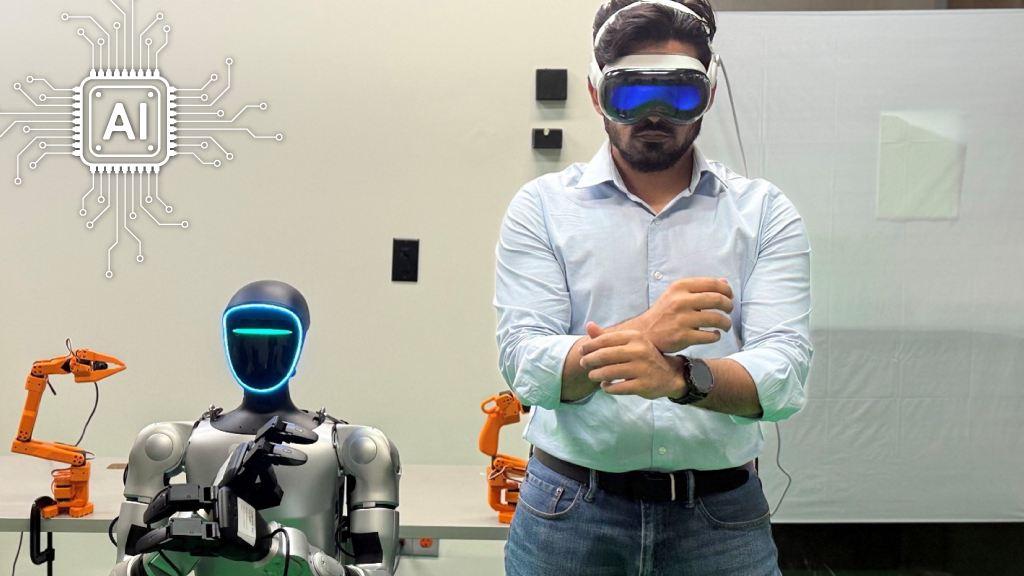
His courses incorporate humanoid and animal robots as part of the learning process. Students have also begun using a motion-capture suit to perform construction-related tasks, allowing their movements to be recorded and converted into data.
That data can then be used to train humanoid robots through a process known as “imitation learning,” in which robots learn by reproducing movements demonstrated by humans.
Kim says the motion-capture suit has significant potential for research involving artificial intelligence and robotics.
The program is also examining how AI and robotics can contribute to construction-site safety. Kim’s team has developed a course focused on identifying weaknesses in safety culture and assessing potential solutions through robotics and other AI-based tools.
One project illustrates how these technologies could support more natural interaction between humans and machines. Students are exploring how human movements captured through immersive AR/VR technology can be transferred to the G1 humanoid robot, with Apple Vision Pro being used for an AR/VR movement demonstration.
The work reflects a broader shift in construction education as universities and colleges adapt their programs to prepare students for an industry increasingly shaped by AI, automation, robotics and digital technologies.