



BRUSSELS — Brussels Airport has launched a pilot project to test an autonomous electric tow tractor for cargo operations, exploring how automated vehicles could make freight movements more efficient, safer and more sustainable.
The trial is being carried out as part of the European Stargate programme, in partnership with WFS Cargo and Charlatte Autonom, a joint venture between Charlatte Manutention and Navya Mobility.
The project will examine how autonomous technology performs in the demanding environment of an international airport and what would be required for wider adoption. Safety is at the centre of the trial, with operations conducted under controlled conditions and a trained operator remaining on board throughout the tests.
Autonomous transport for cargo movements
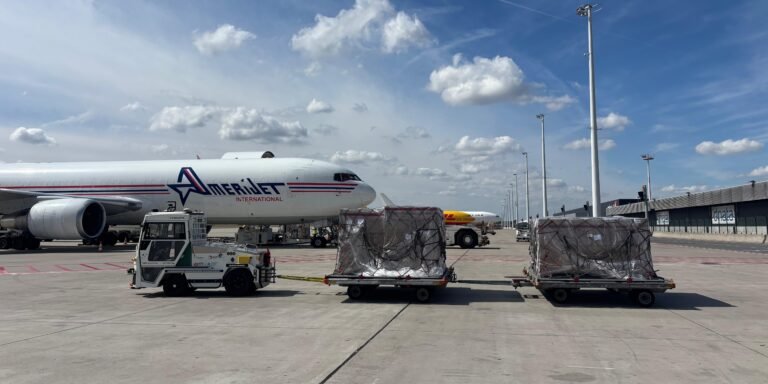
The electric tow tractor operates along four predefined routes within Brussels Airport’s cargo zone, connecting warehouses with apron areas. One of the test scenarios involves moving cargo between the aircraft apron and a cargo warehouse.
The vehicle can tow up to four cargo trailers at a time and is limited to 12 km/h when operating autonomously.
The pilot is intended to provide practical data on how autonomous vehicles could improve the movement of cargo trailers between operational areas while reducing the workload associated with routine transport activities.
Brussels Airport has tried out autonomous transport technology before. In 2024, the airport ran a pilot with a self-driving shuttle that was supposed to ferry airport workers around. The latest initiative shifts the focus specifically to freight operations.
Sensors and autonomous navigation
The tow tractor combines satellite navigation and laser sensors to monitor its surroundings and detect potential obstacles.
Navya Mobility has developed the autonomous driving software, enabling the vehicle to follow its programmed routes while navigating an airport environment where aircraft, vehicles, equipment and personnel operate simultaneously.
The vehicle carries the CE marking and complies with the applicable Machinery Directive requirements.
For the duration of the trial, the tractor operates only on approved routes and during off-peak periods. A trained operator supervises every journey and can intervene immediately if necessary.
Technology adapted to airport logistics
The autonomous vehicle combines a logistics platform developed by Charlatte Manutention with Navya Mobility’s autonomous driving technology. Their joint venture, Charlatte Autonom, focuses on autonomous solutions for industrial and airport applications.
Jean-Claude Bailly, CEO of Navya Mobility, said the project demonstrates the partners’ experience in deploying autonomous technology in complex airport environments, while maintaining a strong focus on safety and reliability.
WFS Cargo is also contributing to the project, with several of its operators receiving training to work safely alongside the autonomous vehicle.
Part of Europe’s sustainability programme
The pilot is part of Stargate, a programme selected by the European Commission to develop and test technologies aimed at making aviation more sustainable.
Brussels Airport leads the initiative alongside a consortium of 22 partners, including three European airports and several airlines.
Arnaud Feist, CEO of Brussels Airport, said the airport is continuing to investigate technologies that can deliver practical improvements to cargo operations while supporting sustainability.
The results of the autonomous tow tractor trial will provide additional data for the wider Stargate consortium, helping partners evaluate how automation and smart mobility solutions could contribute to more efficient and sustainable airport operations across Europe.