



TEXAS — Two major universities in Texas are embarking on ambitious expansion programmes designed to strengthen academic infrastructure, research capabilities and connections with the wider economy.
In Houston, Texas Southern University (TSU) is preparing for its centennial in 2027 with a $1.7 billion Campus Master Plan covering more than 20 projects over the next decade. The programme is intended to modernise facilities while preserving the university’s historic character and supporting its long-term strategic priorities.
The plan aligns physical development with TSU’s Ascend 2030 strategy, with investments focused on student success, workforce development, research, community engagement and improved campus facilities.
TSU prepares for its centennial
The first phase of TSU’s expansion began in 2025 and includes three academic and research facilities: the Catalyst for Urban Transformation, the Nabrit Science Center and the Health and Wellness Center.
Supported by more than $95 million in state funding, the three facilities are scheduled to open during the university’s centennial year in 2027.
The second phase is expected to unfold over the following three to five years. Among the proposals is a new Thurgood Marshall School of Law building, supported by a $10 million allocation from the Texas Legislature and developed in collaboration with the Texas Facilities Commission.
Plans also include an Aviation and Engineering building, a facility for the Ocean of Soul marching band and additional student housing.
A proposed 10,000-seat football stadium and track complex would require private-sector partnerships and additional fundraising before moving forward.
Longer-term projects include new multi-level parking facilities, additional student housing and expanded museum spaces. Funding is expected to combine university capital, private investment and donations.
The scale of the programme is also expected to create opportunities for construction companies, developers and other project partners. Public-private partnerships, private financing and alternative project delivery models are likely to play an important role in delivering the wider plan.
Texas A&M expands its Fort Worth presence
Further north, Texas A&M–Fort Worth is also expanding its downtown campus.
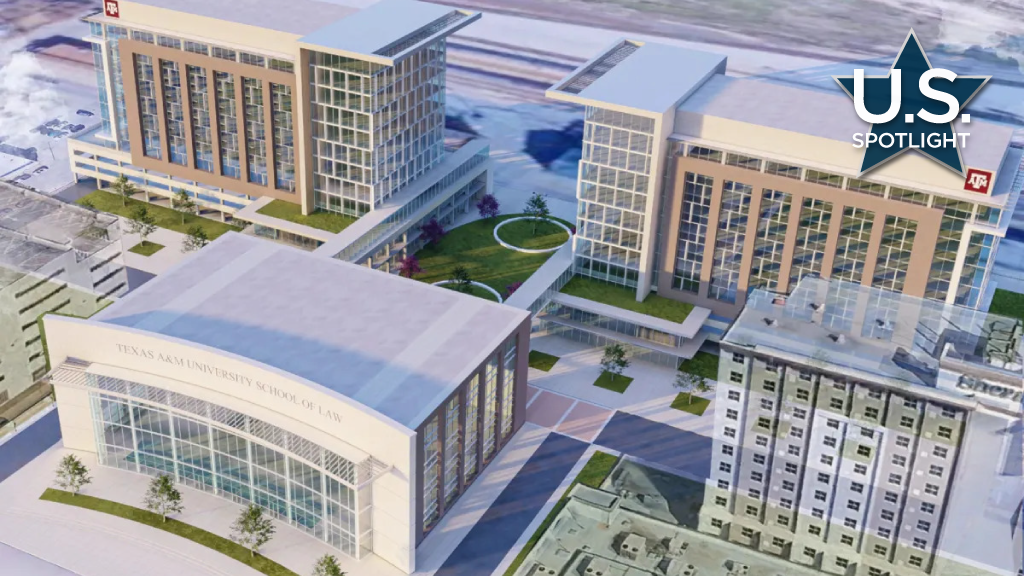
The Texas A&M University System recently opened an eight-storey, 228,000-square-foot Law and Education Building, marking a major step in the development of its Fort Worth presence.
The university also broke ground on Research and Innovation Building-A, an 11-storey facility scheduled for completion in 2029.
The building will form part of the emerging Switchyard Innovation District, a multi-phase urban technology and research hub with an estimated overall investment of $1.5 billion.
A new research and innovation ecosystem
The Switchyard district is designed to bring together university researchers, government agencies and private-sector companies.
Its areas of focus are expected to include aerospace, engineering, agriculture, health sciences, medicine, biotechnology, transportation, food and nutrition science and virtual production.
Unlike a conventional undergraduate campus, the Fort Worth development is being designed primarily as a research and workforce ecosystem focused on graduate-level innovation, skills development and the commercialisation of new technologies.
Additional buildings are also being considered, including a Performance, Visualization and Fine Arts Building featuring a virtual production studio and a Gateway Building that would eventually replace the existing law school facility.
Potential impact beyond the campuses
The long-term vision for the Switchyard Innovation District extends beyond university facilities. Developers hope to connect the district with the Fort Worth Convention Center, Water Gardens, public transportation and surrounding residential and commercial areas.
The development could eventually support as many as 25,000 jobs and generate an estimated $3 billion in annual economic activity.
The projects at both universities reflect a broader shift toward campuses that function not only as educational institutions but also as centres for research, workforce development, technology and economic activity.
For Texas Southern University, the focus is on modernising a historic campus while expanding academic and community facilities. In Fort Worth, Texas A&M is taking a more research-driven approach, creating an ecosystem intended to connect higher education directly with industry and emerging technologies.
Together, the developments highlight the growing role of university investment in shaping regional construction, innovation and economic development across Texas.