

• Latest
  • Trending
‘Rail relocation is not going to happen’: Should Winnipeg move its train tracks outside the city?

‘Rail relocation is not going to happen’: Should Winnipeg move its train tracks outside the city?

September 4, 2026
DHL to establish dedicated healthcare logistics facility at Changi Airport

DHL to establish dedicated healthcare logistics facility at Changi Airport

September 4, 2026
Doncaster Sheffield Airport sets new sustainability benchmark with independent EcoVadis assessments

Doncaster Sheffield Airport sets new sustainability benchmark with independent EcoVadis assessments

September 4, 2026
ADVERTISEMENT
Archer launches ‘No Roads’ flight tour ahead of LA28

Archer launches ‘No Roads’ flight tour ahead of LA28

September 4, 2026
Off-Price Retailers Reveal How They Are Using Tariff Refunds

Off-Price Retailers Reveal How They Are Using Tariff Refunds

September 4, 2026
Amazon Shipping prepares higher holiday delivery surcharges for the 2026 peak season

Amazon Shipping prepares higher holiday delivery surcharges for the 2026 peak season

September 4, 2026
Temu owner invests in local fulfillment as de minimis rules reshape global trade

Temu owner invests in local fulfillment as de minimis rules reshape global trade

September 4, 2026
New Union Coalition Demands BC Ferries Build Its Next Fleet in British Columbia

New Union Coalition Demands BC Ferries Build Its Next Fleet in British Columbia

September 4, 2026
VRCA challenges municipal candidates to confront the rising cost of construction

VRCA challenges municipal candidates to confront the rising cost of construction

September 4, 2026
Samsara’s Revenue Surges 30% in Q2 as Transportation and Mexico Drive Growth

Samsara’s Revenue Surges 30% in Q2 as Transportation and Mexico Drive Growth

September 4, 2026
XPO’s August Performance Keeps the Carrier on Track for Q3 Targets

XPO’s August Performance Keeps the Carrier on Track for Q3 Targets

September 4, 2026
Mexican truckers block California border crossing amid B-1 visa crackdown

Mexican truckers block California border crossing amid B-1 visa crackdown

September 4, 2026
New Data Shows Container Shipping’s On-Time Performance Suffers Its Biggest Drop in Five Years

New Data Shows Container Shipping’s On-Time Performance Suffers Its Biggest Drop in Five Years

September 4, 2026
  • Home
  • About Us
  • Press Room
  • Podcasts
  • Media Kit
  • Contact Us
  • Careers
Friday, September 4, 2026
  • Login
  • Register
The Logistic News
  • Logistic
  • Air
  • Maritime
  • Land
  • World
  • Business
  • Tech
  • Events
  • Advertise
No Result
View All Result
  • Logistic
  • Air
  • Maritime
  • Land
  • World
  • Business
  • Tech
  • Events
  • Advertise
No Result
View All Result
The Logistic News
No Result
View All Result
Home Land

‘Rail relocation is not going to happen’: Should Winnipeg move its train tracks outside the city?

As Manitoba examines the feasibility of building a rail bypass around Winnipeg, the proposal is generating both optimism and skepticism. Supporters see an opportunity to transform the city, while critics warn that the enormous costs and complexity could make the project impossible to deliver.

The Logistic News by The Logistic News
September 4, 2026
in Land, Logistic
Reading Time: 5 mins read
0
‘Rail relocation is not going to happen’: Should Winnipeg move its train tracks outside the city?
ADVERTISEMENT

Winnipeg’s growth has long been closely tied to its railway infrastructure. From the point where the Red and Assiniboine rivers meet, the city expanded alongside rail lines and vast marshalling yards where freight trains are assembled and dismantled.

Today, Winnipeg remains one of Canada’s most rail-intensive urban centres. More than 240 kilometres of active railway lines cross the city, while approximately 50 trains travel through residential and commercial neighbourhoods every day.

For some residents, however, this railway presence has become increasingly difficult to live with.

ADVERTISEMENT

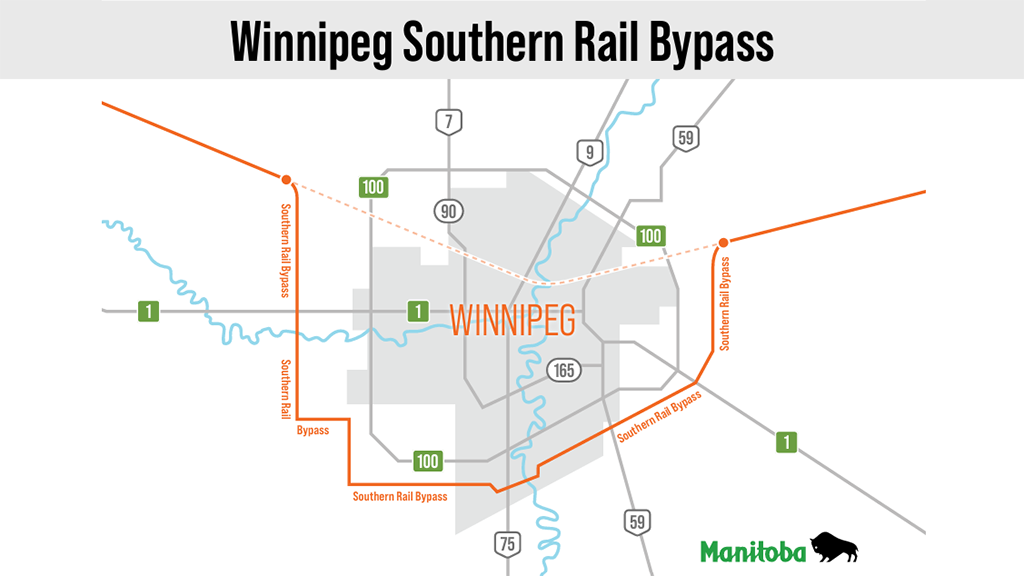
The Government of Manitoba is now examining a proposal, championed by retired politician Lloyd Axworthy, to construct a rail bypass around the city. The broader objective of relocating railway infrastructure would be to reduce urban traffic congestion and move major rail yards away from Winnipeg’s core.

The provincial government has recently launched a 90-day feasibility study and proof-of-concept consultation to assess whether the idea could realistically move forward.

Supporters argue that removing a significant share of freight rail traffic from Winnipeg’s urban centre could improve the movement of goods, reduce dirt, noise and delays affecting residential communities, and create new opportunities for housing and economic development.

At this stage, however, the study will not include detailed engineering work or financial cost estimates.

The initiative builds on the Winnipeg Rail Relocation and Renewal Study, launched in 2024.

A southern bypass under consideration

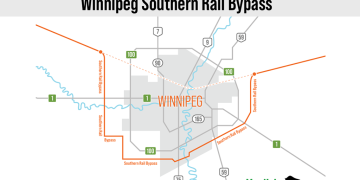
The 90-day study will examine the potential of using Manitoba Hydro’s southern transmission corridor as part of a new route around Winnipeg. The corridor sits on Crown land that has already been cleared and serviced, making it potentially available for future development.

For Lloyd Axworthy, the project represents an opportunity to rethink Winnipeg’s long-term development.

“This is an opportunity to think ahead about the kind of city we want Winnipeg to become,” Axworthy said in an announcement.

“We have a chance to plan for growth in a way that brings communities together, protects the land around us and leaves future generations a stronger, more connected city.”

Manitoba Premier Wab Kinew said the study team will work with the railway companies whose tracks and rail yards could be affected by any relocation plan. These include Canadian Pacific Kansas City, Canadian National and Burlington Northern Santa Fe.

The goal, according to Kinew, is to determine whether a viable business case exists for the proposed relocation.

The premier also believes a bypass could reinforce Manitoba’s north-south and east-west trade corridors while benefiting CentrePort Canada Inc. (CPC), the industrial park located near Winnipeg airport.

A stronger rail network?

Carly Edmundson, president and CEO of CentrePort Canada Inc., believes rail relocation would “definitely” deliver benefits for Winnipeg, Manitoba and Canada.

“It will help build a stronger rail network and move more freight more efficiently,” Edmundson said.

She also believes the project could create a clearer distinction between residential life in central Winnipeg and economic activity outside the city centre.

“It will also help create a more deliberate division between a more residential central Winnipeg and more economic activity outside the centre,” she added.

From an urban development perspective, Ahmed Shalaby, a professor of civil engineering at the University of Manitoba, said relocating freight rail lines and rail yards could help reconnect neighbourhoods currently separated by railway infrastructure.

Such a transformation could also allow industrial areas to be redeveloped into urban and suburban spaces, creating new development opportunities while eliminating the need for grade crossings.

But Shalaby stressed that the scale of the undertaking should not be underestimated.

“Rail relocation is a massive undertaking requiring land acquisition, new crossings and new grade separations,” he said. “The construction cost together with any potential disruption to rail operations can be cost-prohibitive.”

Optimism, but significant financial challenges

Christopher Adams, an adjunct professor of political science at the University of Manitoba, said he remains cautiously optimistic about the potential benefits of rail relocation.

He believes the project could have an impact comparable to the Red River Floodway, which has protected Winnipeg from flooding on numerous occasions.

“It could have a comparable impact on Winnipeg and the surrounding region as the Red River Floodway, which has saved the city many times from flooding,” Adams said.

However, he acknowledged that such an ambitious project would require extensive coordination with railway companies and substantial government funding.

“It will require a lot of co-ordination with the railroads and a lot of government money, and there is already a lot of pressure on provincial and federal government finances,” he added.

According to Adams, one factor working in favour of the proposal is the political approach of Premier Wab Kinew, whom he described as a “bold” leader compared with previous Progressive Conservative premiers.

“They were more cautious about spending money,” Adams said.

‘The train has left the station’

Not everyone is convinced that Winnipeg will ever see its railway infrastructure relocated.

Chris Lorenc, president and CEO of the Manitoba Heavy Construction Association and a lifelong Winnipeg resident, offered a far more skeptical assessment.

“The train has left the station. Rail relocation is not going to happen,” he said.

Lorenc believes that rail rationalization, including the abandonment of certain rail infrastructure, could nevertheless be a more realistic option.

He also argues that Winnipeg faces numerous other transportation priorities that should be addressed before embarking on a project that could take decades to complete.

“Anyway, there are many other transportation needs in Winnipeg that need to be addressed first, and they can be done faster than rail relocation, which would take decades to bring off,” Lorenc said.

He also questioned whether the railway companies themselves would support the idea.

“And are the railways interested? Whenever the subject of rail relocation has come up in the past they’ve been very reluctant.”

That reluctance is reflected in the position of Canadian Pacific Kansas City.

Terry Cunha, a spokesperson for CPKC, said assessing the feasibility of relocating railway infrastructure is an extraordinarily complicated process.

“Evaluating the feasibility of relocating railway infrastructure is an enormously complex matter,” Cunha said. “The challenges inherent with any proposal to relocate railway infrastructure are vast, complex and should not be underestimated.”

According to Cunha, the difficulties and costs associated with rail relocation are too often underestimated.

“Given the magnitude of the challenges and costs with any such proposal, we have generally cautioned governments against rail relocation,” he said.

“Such proposals would invariably require significant public dollars to rebuild infrastructure that already exists.”

As Manitoba’s 90-day feasibility study moves forward, the debate over Winnipeg’s railway future is therefore likely to intensify. The proposed bypass could potentially reshape freight transportation, urban development and trade connectivity across the region.

But between the promise of a more efficient rail network and the enormous financial, technical and political challenges involved, one question remains unresolved: whether Winnipeg is truly ready—and able—to move its railways beyond the city limits.


Previous Post

Samsara’s Revenue Surges 30% in Q2 as Transportation and Mexico Drive Growth

Next Post

VRCA challenges municipal candidates to confront the rising cost of construction

Next Post
VRCA challenges municipal candidates to confront the rising cost of construction

VRCA challenges municipal candidates to confront the rising cost of construction

Leave a Reply Cancel reply

Your email address will not be published. Required fields are marked *

A D V E R T I S E M E N T

Popular News

  • Drone Delivery Takes Flight: Amazon Partners with UPS for Trial Program

    Drone Delivery Takes Flight: Amazon Partners with UPS for Trial Program

    0 shares
    Share 0 Tweet 0
  • Rail Cargo Group Strengthens European Network with Captrain Netherlands Acquisition

    0 shares
    Share 0 Tweet 0
  • Automotive Inbound Logistics Market: Navigating Future Challenges

    0 shares
    Share 0 Tweet 0
  • Global Inflation Cools to Target After Three Years, Central Banks Face Policy Dilemma

    0 shares
    Share 0 Tweet 0
  • Dubai Mercantile Exchange Rebrands as Gulf Mercantile Exchange Following Saudi Tadawul Group Acquisition

    0 shares
    Share 0 Tweet 0

Recent News

DHL to establish dedicated healthcare logistics facility at Changi Airport

DHL to establish dedicated healthcare logistics facility at Changi Airport

September 4, 2026
Doncaster Sheffield Airport sets new sustainability benchmark with independent EcoVadis assessments

Doncaster Sheffield Airport sets new sustainability benchmark with independent EcoVadis assessments

September 4, 2026
Archer launches ‘No Roads’ flight tour ahead of LA28

Archer launches ‘No Roads’ flight tour ahead of LA28

September 4, 2026

Discover a new era of logistics reporting with The Logistic News, your go-to platform for breaking news, insightful features, and exclusive interviews shaping the global logistics and freight landscape. Trust us to deliver accurate, timely, and relevant information that empowers professionals and enthusiasts alike in navigating the intricacies of this vital sector.

Navigation

  • Home
  • About Us
  • Press Room
  • Podcasts
  • Media Kit
  • Contact Us
  • Careers
  • Privacy Policy
  • Terms of Use

© 2024 - thelogisticnews.com

Welcome Back!

Login to your account below

Forgotten Password? Sign Up

Create New Account!

Fill the forms below to register

All fields are required. Log In

Retrieve your password

Please enter your username or email address to reset your password.

Log In

SIgn Up Newsletter

This will close in 20 seconds

Manage Cookie Consent
We use technologies like cookies to store and/or access device information. We do this to improve browsing experience and to show (non-) personalized ads. Consenting to these technologies will allow us to process data such as browsing behavior or unique IDs on this site. Not consenting or withdrawing consent, may adversely affect certain features and functions.
Functional Always active
The technical storage or access is strictly necessary for the legitimate purpose of enabling the use of a specific service explicitly requested by the subscriber or user, or for the sole purpose of carrying out the transmission of a communication over an electronic communications network.
Preferences
The technical storage or access is necessary for the legitimate purpose of storing preferences that are not requested by the subscriber or user.
Statistics
The technical storage or access that is used exclusively for statistical purposes. The technical storage or access that is used exclusively for anonymous statistical purposes. Without a subpoena, voluntary compliance on the part of your Internet Service Provider, or additional records from a third party, information stored or retrieved for this purpose alone cannot usually be used to identify you.
Marketing
The technical storage or access is required to create user profiles to send advertising, or to track the user on a website or across several websites for similar marketing purposes.
Manage options Manage services Manage {vendor_count} vendors Read more about these purposes
View preferences
{title} {title} {title}
No Result
View All Result
  • Logistic
  • Air
  • Maritime
  • Land
  • World
  • Business
  • Tech
  • Events
  • Advertise

© 2024 - thelogisticnews.com