



Container shipping activity through the Red Sea and Suez Canal is gaining momentum again, but the latest figures show that the recovery is being driven primarily by larger vessels rather than a significant increase in the number of ships.
New data from consultant MDS Transmodal shows that 1,230 container vessels transited the route between January and August 2025. During the same period in 2026, that figure slipped slightly to 1,186 vessels.
Despite the lower number of ships, however, the amount of container capacity deployed on the route rose sharply. Average capacity per vessel increased by 60%, with total capacity reaching 7.2 million teu during the first eight months of 2026.
Average vessel size consequently climbed from around 3,800 teu to 6,000 teu.
The figures provide a markedly different picture of the container industry’s gradual return to the shorter Suez route, after carriers diverted large parts of their networks around the Cape of Good Hope more than two years ago.
The acceleration has been particularly pronounced in recent months.
“The acceleration is particularly clear in August,” said Antonella Teodoro, senior analyst at MDS Transmodal.
According to Teodoro, 196 ships transited the route in August, representing a 36% year-on-year increase. Aggregate capacity reached 1.68 million teu, up 184% compared with August 2025.
August also saw the largest vessel to use the route since the Red Sea crisis began, with a capacity of 24,232 teu.
Suez Canal containership transits
Max ship size (TEU)
Source: MDST Containership Databank
MDS Transmodal’s detailed figures underline just how significant the increase in vessel size has become. In August alone, nine vessels of more than 20,000 teu, along with another vessel just below that threshold, transited the Suez Canal route.
Among the carriers increasing their use of the route is MSC, which has recently trialled vessels through the Bab el Mandeb in both northbound and southbound directions.
MSC deployed two 24,232 teu vessels — MSC Irina and MSC Michel Cappellini — as well as the 19,224 teu MSC Tina on services linking the Indian Subcontinent with the Mediterranean and the Mediterranean with the Far East.
Maersk has likewise returned a number of vessels to shorter routes connecting the Far East with the Mediterranean and North Europe, the Indian Subcontinent with the US East Coast, and the Middle East with West Africa.
Its recent deployments include the 20,568 teu Manchester Maersk.
French carrier CMA CGM has remained the most consistent major operator using the Red Sea route. Its services connect the Far East with Europe, including the Mediterranean, as well as India with the US East Coast and India with the Mediterranean.
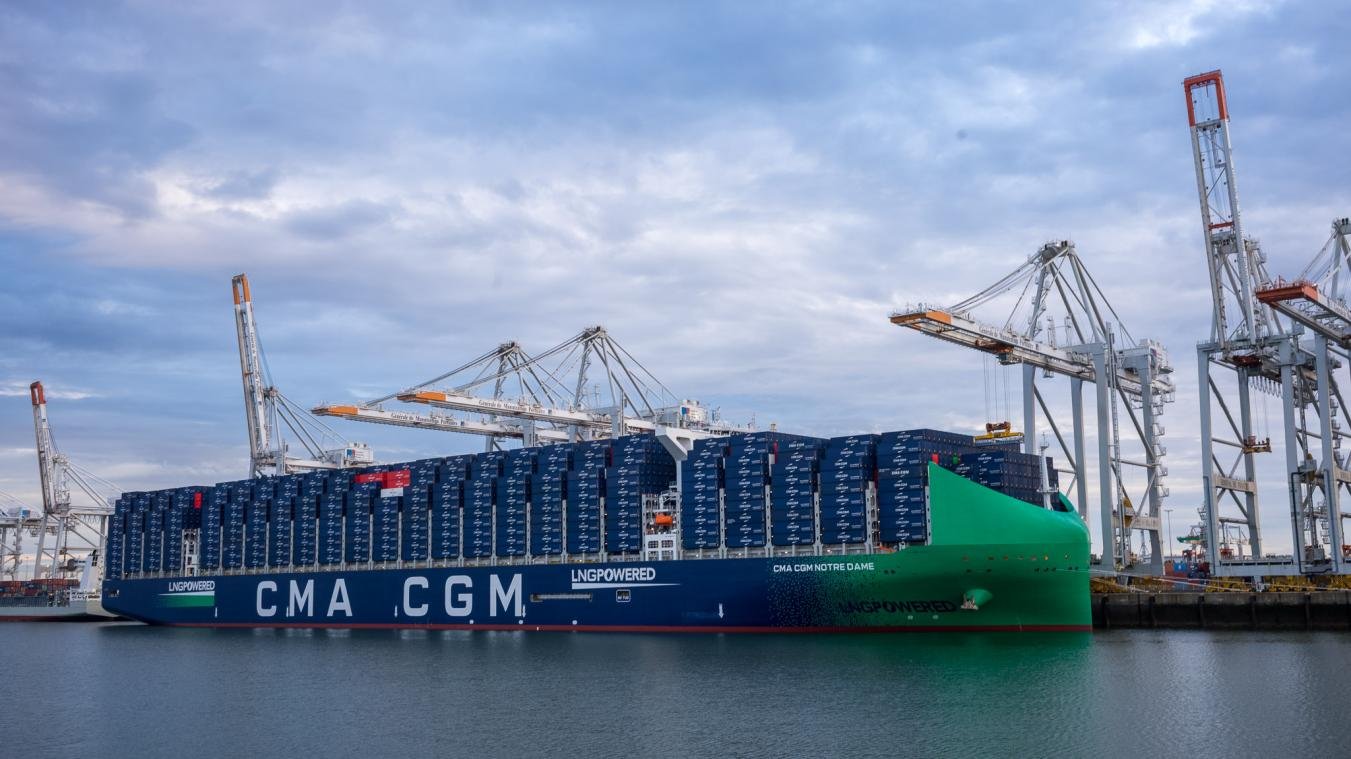
The carrier currently has six ULCVs operating on these routes. They include the 24,212 teu CMA CGM Notre Dame, alongside five vessels of 23,104 teu each: CMA CGM Sorbonne, CMA CGM Saint Germain, CMA CGM Champs Elysees, CMA CGM Seine and CMA CGM Rivoli.
“This is a very different picture from the first half of the year and indicates that the return of liner capacity to the Suez route is becoming increasingly substantial,” Teodoro said.
Recovery remains far from pre-crisis levels
Despite the rapid increase recorded over the summer, activity through the Suez Canal remains well below the levels seen before the Red Sea crisis.
Compared with August 2023, the number of vessels using the route is still approximately 65% lower, while deployed container capacity remains around 74% below its pre-crisis level.
The recovery is also far from evenly distributed across the container shipping industry.
Teodoro highlighted a high degree of concentration among the carriers that are currently returning capacity to the Suez route, suggesting that the recent increase cannot yet be interpreted as a broad-based industry-wide return.
The data increasingly points instead to a selective and cautious return to Suez. While the pace of this movement accelerated during July and August 2026, the current level of activity remains insufficient to conclude that the market has returned to its pre-crisis operating pattern.
The key issue now is whether the latest acceleration represents the start of a sustained shift in carrier strategies or simply another stage in the gradual repositioning of capacity.
“The key question now,” Teodoro said, “is whether the trend seen in July and August [this year] represents the beginning of a sustained return or a further stage in a cautious, carrier-specific repositioning of capacity?”