



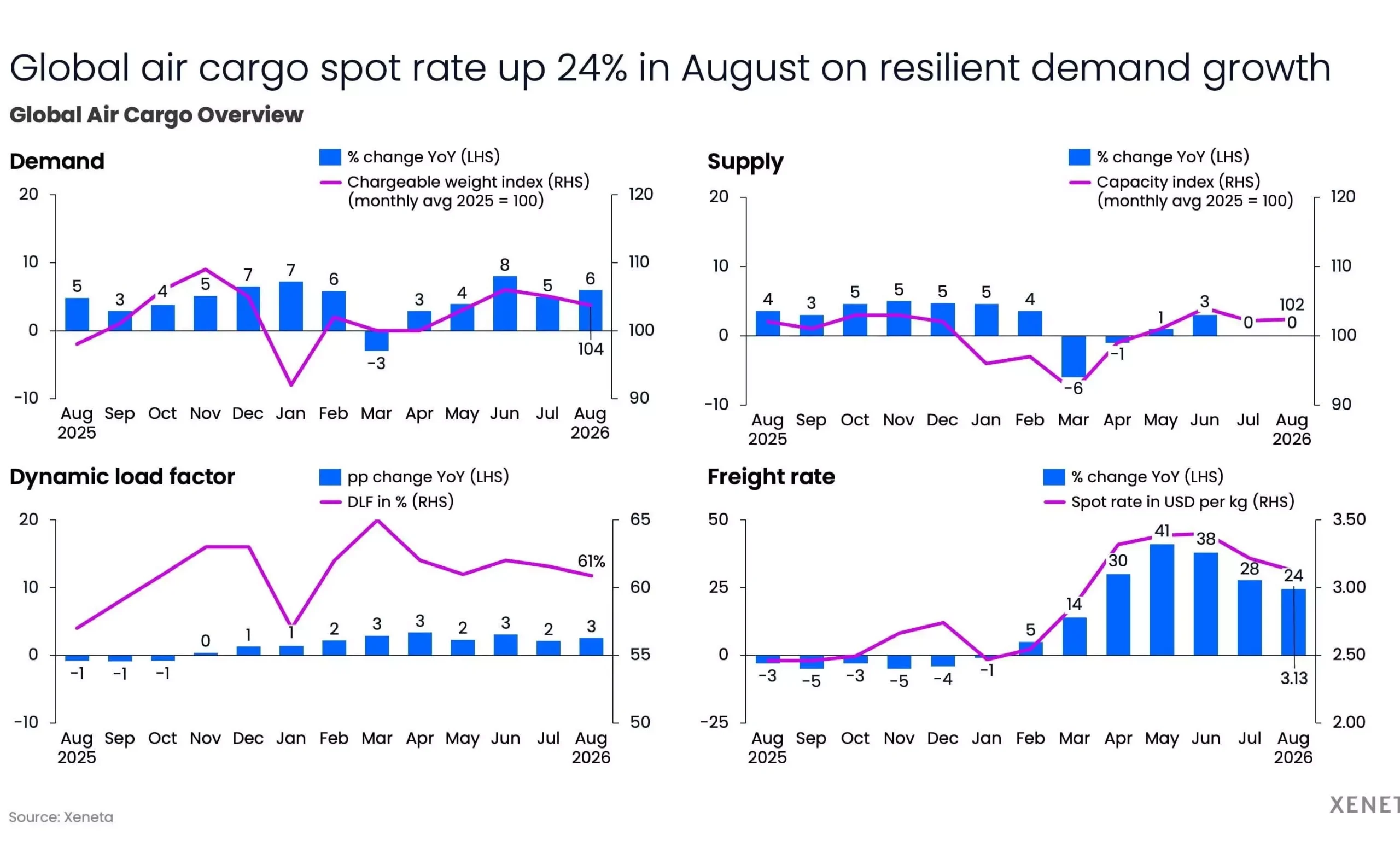
Global air cargo demand remained resilient in August, with volumes rising 6% year-on-year, according to industry analysts Xeneta.
The increase follows a 5% year-on-year rise recorded in July, extending the air cargo market’s strong performance through what is traditionally a quieter period for the industry.
At the same time, the growth in spot rates continued to lose momentum, although prices remained substantially higher than a year earlier. Global air cargo spot rates averaged $3.13 per kg in August, representing a 24% increase year-on-year.
This marked the third consecutive month in which annual spot-rate growth slowed. The increase eased from 41% in May to 38% in June and then 28% in July. On a monthly basis, spot rates fell 3% in August, compared with a 6% decline in July.
The continued strength of cargo volumes indicates that shippers may have to wait longer before seeing a more substantial reduction in elevated air freight rates.
Niall van de Wouw, Xeneta’s Chief Airfreight Officer, said: “Rates are easing their way down month-on-month, and the gap to last year’s levels is narrowing, perfectly in line with what we expected, and airlines will be hoping to hold on at the current level until the busier season starts.”
Despite the recent decline, shippers are continuing to push for lower air freight costs, with prices still 24% above year-ago levels. Xeneta, however, said it is not seeing indications of a significant increase in demand in the coming months and expects rates to continue falling, although likely at a slower pace than shippers would prefer.
The market therefore remains favourable to carriers, as demand continues to expand faster than available capacity.
Shippers are also turning increasingly to the short-term market, hoping that the month-on-month decline in rates will accelerate and ease pressure on transportation budgets. Yet the imbalance between demand and supply, combined with rising jet fuel prices in recent weeks, is restricting how quickly rates can fall.
Air cargo capacity was flat year-on-year in August. Meanwhile, Xeneta’s dynamic load factor, which measures capacity utilisation based on cargo volume and weight against available capacity, increased by three percentage points from August 2025 to reach 61%.
China’s E-commerce Exports to Europe Fall 25% as EU Duty Takes Effect
The latest figures also point to a structural shift in the air cargo market, largely linked to weaker e-commerce volumes.
According to an analysis by Xeneta and Trade and Transport Group based on China Customs data, China’s low-value and e-commerce exports declined 11% year-on-year in July 2026.
Europe experienced the sharpest contraction, with exports falling 25% compared with the same period a year earlier. The decline appears to have followed the EU’s decision to remove the €150 duty-free threshold for low-value goods on July 1, alongside the introduction of a flat €3 customs duty per item.
Xeneta nevertheless expects the impact on China-Europe e-commerce volumes to be temporary. A comparable development occurred after the United States removed its de minimis threshold in 2025. China’s e-commerce exports initially declined before recovering.
By July 2026, China-US e-commerce shipments were 23% higher year-on-year, although the comparison was made from a lower base.
Xeneta expects China-Europe e-commerce volumes to follow a similar recovery trajectory. However, the longer-term consequences of the EU’s policy changes remain uncertain.
Trade Corridors Continue to Diverge
Across other major trade corridors, air freight rates continued to be shaped primarily by supply-and-demand conditions rather than fuel prices.
During week 35, covering August 24–30, spot rates to the Middle East remained significantly above the levels recorded before the conflict in late February. Rates were 100% higher from South Asia, 66% higher from Europe, 21% higher from Northeast Asia and 20% higher from Southeast Asia.
On the transpacific market, strong demand for AI-related shipments continued to support freight rates. Spot rates from Northeast Asia and Southeast Asia to North America were respectively 36% and 34% above late-February levels.
Northeast Asia–North America rates averaged USD 5.76 per kg in August, an increase of 2% compared with July.
The transatlantic market followed a different pattern. Ample summer belly capacity kept Europe–North America spot rates 25% below their late-February levels.
Even so, the route showed early signs of strengthening, with spot rates rising 2% month-on-month in August.